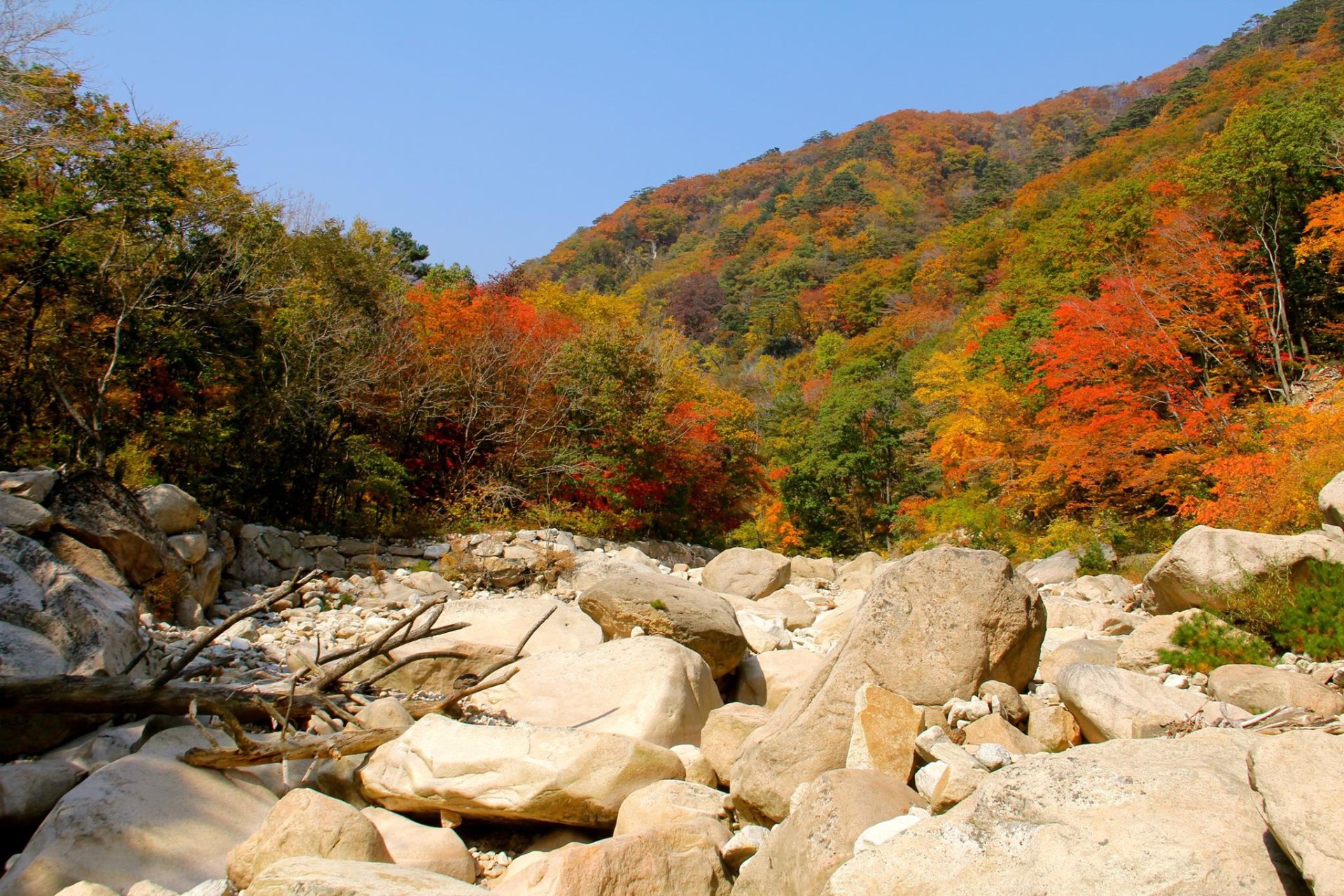
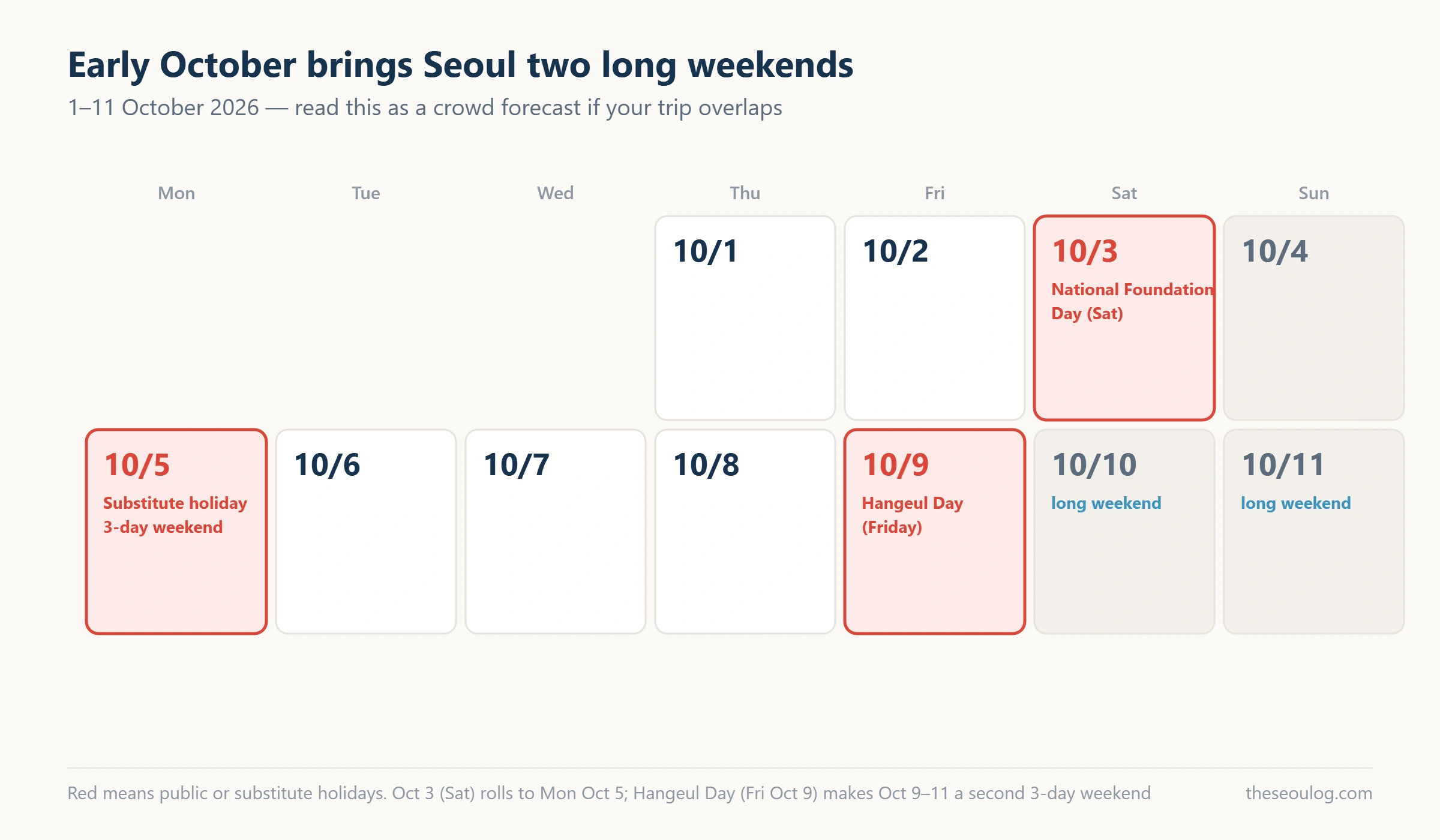
- The structure: wave one, 3–5 October — Foundation Day hits a Saturday, so Monday becomes a substitute holiday.
- Holidays crowd wherever Korean families go: the palaces (especially hanbok events), Namsan, the amus…
- Hotel rates tend to peak on the nights of 2–4 October and 8–10 October.
Who this is for
- Anyone planning early-October Seoul whose dates can still move
- People worried that Korean public holidays mean closed shops
- Anyone who wants to know exactly which nights hotels get expensive
Chuseok isn’t the end of Korea’s autumn holidays. Early October delivers two long weekends: National Foundation Day on Saturday 3 October generates a substitute holiday on Monday the 5th, and Hangeul Day lands on Friday 9 October to make the 9th–11th a second three-day weekend.
For travellers this cuts both ways. Holiday Seoul grows festive—and domestic-travel demand lifts hotel prices while Korean families join every queue you were planning to stand in. Here’s the thing: whether you know these two waves decides how comfortable your October trip feels.
“So when do I do what?” Here’s how to read the early-October calendar for 2026, and how to move on the red days versus the quiet ones. Let’s get into it.
Contents
1. Read the calendar first
2. Moving on the red days — what jams and what empties
3. Beds and wheels — the price wave is predictable
4. What only early October has
5. Frequently asked questions
1. The Red Days Are Two Waves! Read the Calendar First
✔ The structure
Wave one, 3–5 October—Foundation Day hits a Saturday, so Monday becomes a substitute holiday. Wave two, 9–11 October—Hangeul Day falls on a Friday. And the overlooked prize: the weekdays in the trough, Tuesday 6 to Thursday 8. Domestic crowds recede, the weather sits at its autumn best, and the city exhales. Those three days are October’s flat water.
✔ Got this far? Then this is your next move. “Hangeul Day 2026 Falls on a Friday” is the step after.
2. One Headline Sight at Opening? Moving on the Red Days: What Jams and What Empties
| Holiday | Dates | Why |
|---|---|---|
| National Foundation Day | Oct 3 (Sat) – Oct 5 (Mon) | Oct 3 falls on Saturday so Monday is a substitute holiday |
| Hangeul Day | Oct 9 (Fri) – Oct 11 (Sun) | Friday holiday = automatic 3-day weekend |
| Weekdays in between | Oct 6 (Tue) – Oct 8 (Thu) | The quietest window for sightseeing |
✔ Holidays crowd wherever Korean families go
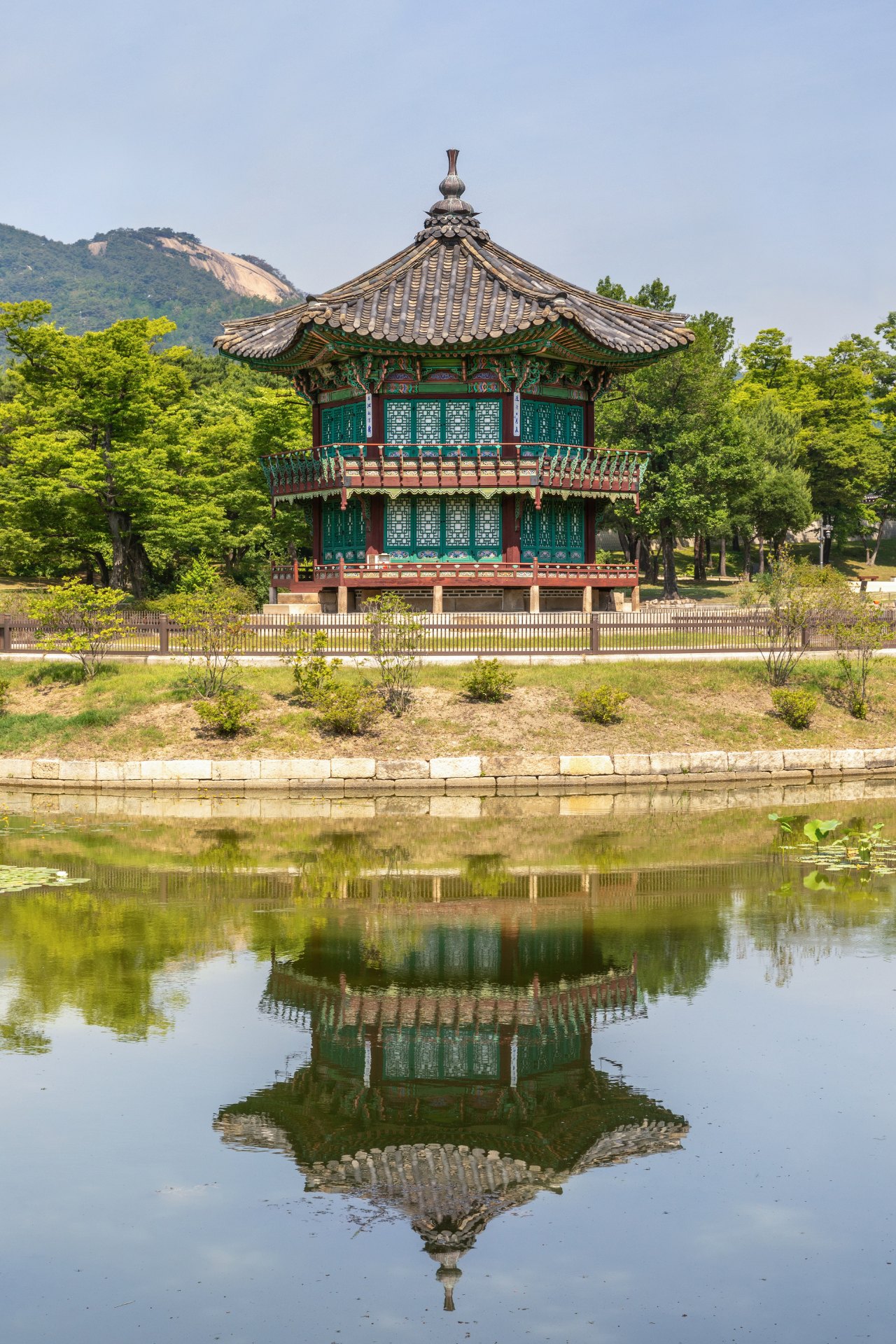
The palaces (especially hanbok events), Namsan, the amusement parks, foliage spots near the city, and every expressway. Meanwhile the business districts around Gwanghwamun and City Hall, and Dongdaemun’s wholesale blocks, actually calm down.
The red-day formula is simple: hit one headline sight at opening time, then spend the afternoon in distributed places—markets, alleys, cafés—and give the evening to the river or the fortress wall, straight from our night timetable. A holiday Han River is lively, but it’s far too big to saturate.
3. Visibly Cheaper Midweek! Beds and Wheels: The Price Wave Is Predictable
✔ Rates peak on the holiday eves
Hotel rates tend to peak on the nights of 2–4 October and 8–10 October. The same room in the trough weekdays is visibly cheaper. If your dates are flexible, assign weekends to distributed city sightseeing and the trough weekdays to palaces and day trips—dodging crowds and prices in one move.
Trains and express buses peak on each holiday’s first morning and last evening. Day trips belong in the trough — the wave-dodging logic from our Chuseok movement playbook applies unchanged.

4. Highs Near 20°C, Lows Near 10°C! What Only Early October Has
✔ Some scenes exist only on the red days
It isn’t all logistics. These holidays bring commemorations and performances around Gwanghwamun Square and the palaces, and on Hangeul Day the King Sejong statue area turns into a small festival of the alphabet he invented. It’s also the season of autumn fireworks and riverside music events—dates drop close to the day, so check official calendars before flying.
And the climate seals it: October Seoul averages a high near 20°C and a low near 10°C, with falling humidity and high skies. Read the two waves, and early October is the most walkable Seoul of the year. That’s the whole thesis—pencil in those three trough days.
In short
• Two long weekends: 3–5 Oct (Foundation Day + substitute) and 9–11 Oct (Hangeul Day)
• The trough weekdays 6–8 Oct are the month’s best sightseeing days — quiet, cheaper, perfect weather
• Red days: one headline sight at opening, distributed spots after, the river at night
• Hotel prices peak on holiday nights; flexible dates belong in the trough
• Holiday-only events are announced late — check official calendars before departure
Frequently asked questions
Do shops close on these holidays?
Unlike Chuseok, commerce runs essentially as normal on Foundation Day and Hangeul Day. Count on government offices and banks closing, and little else.
Will I see autumn foliage in early October?
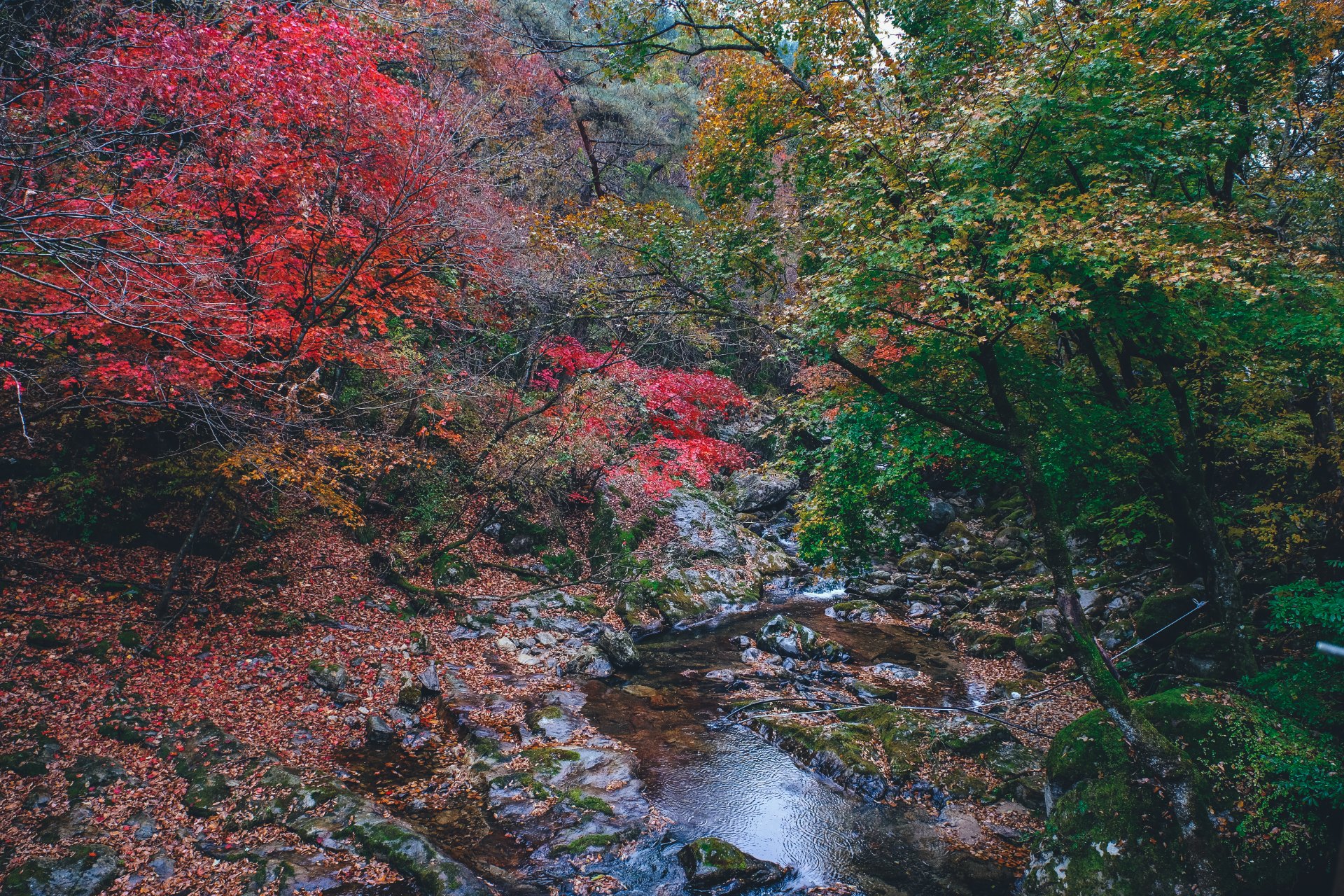
Seoul’s peak runs late October into early November. For early color, head to the northern mountains like Seoraksan — covered in a separate guide.
Should I avoid palaces on the holidays?
They are busy, but the first hour after opening stays comfortable — and holiday ceremonies add more to see, not less.
When should I book hotels?
As early as possible for holiday weekends; the trough weekdays (6–8 Oct) usually keep options open even late.
How warm is it?
Averages near 20°C by day and 10°C at night. One long-sleeve layer by day, a light jacket for evenings.
Information current as of 17 August 2026. Event schedules are announced close to the dates — check official calendars. Sources: Korea’s public/substitute holiday rules, KMA climate normals. Photos: Wikimedia Commons.
This article is based on the official information below. Rules can change, so please check the original before you travel.
· Korea Meteorological Administration
Information as of 2026-09-04 (official listings and Google Maps as shown at publication). Updated when things change.