- Tap your T-money card (or WOWPASS with transit function) on the turnstile going in and again going out.
- Base fare: about ₩1,550 by card, plus small distance increments Line-to-line transfers inside the ga…
- Big Seoul stations have 10–15 exits, and they can surface a quarter mile apart.
Who this is for
- First-timers wondering whether they need a ticket at all
- Anyone who’s surfaced from the wrong Gangnam exit into August heat
- People who’d rather not watch their stop fly past on a Line 9 express
The time you lose on the Seoul subway is not spent on the train. It’s spent after the gates.
Fares are low, trains come every few minutes, and every station carries a number. Riding it may be among the easiest systems anywhere. But stations like Gangnam and Express Bus Terminal have well over ten exits, and choosing wrong costs you ten minutes of backtracking in the open.
“So what do I actually need to memorize?” Not the map—the exit number in your route result. That single detail changes the quality of every trip. Let’s get into it.
Table of Contents
No Ticket Machines! The Basics—Tap In, Tap Out
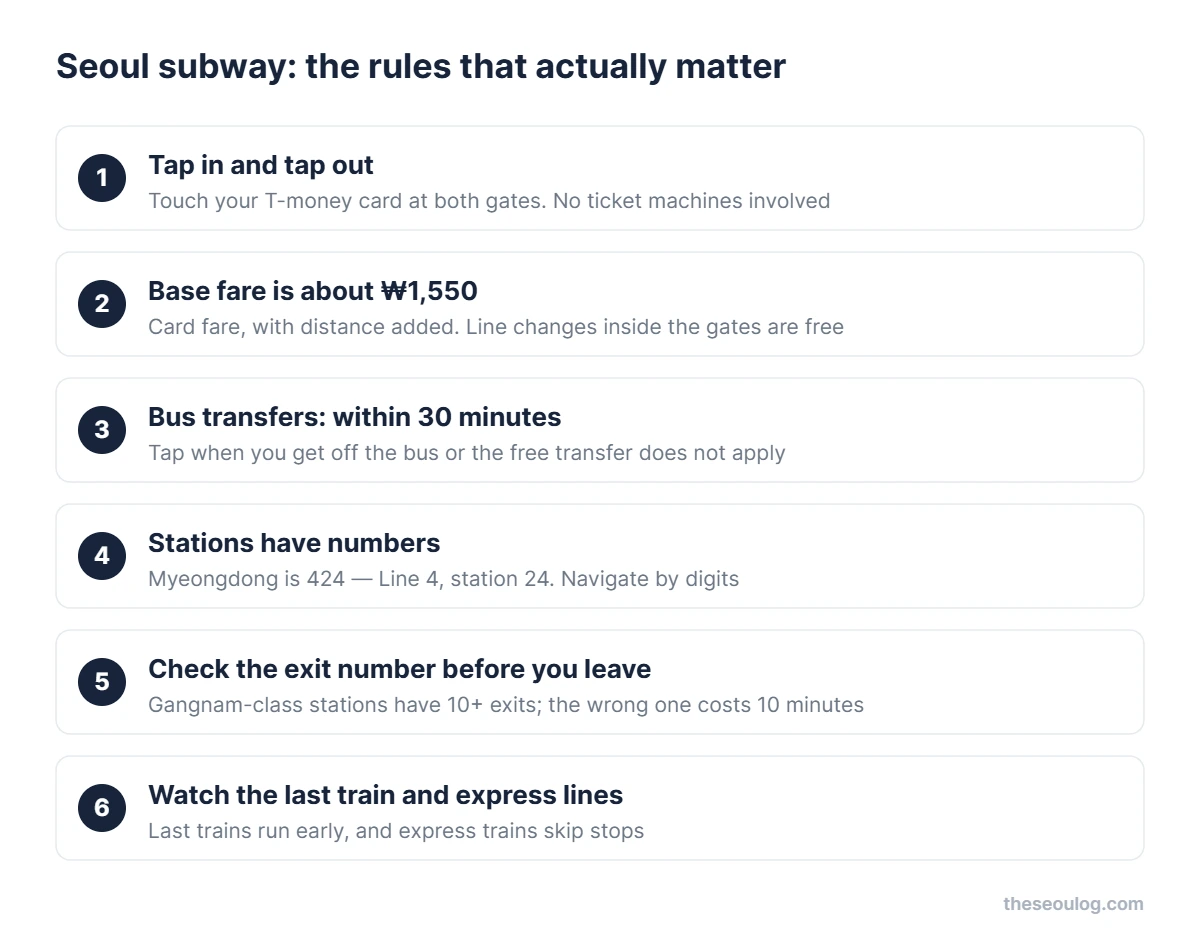
Tap your T-money card (or WOWPASS with transit function) on the turnstile going in and again going out. No ticket machines, no route planning at the fare gate. Which card to get is covered in the transport card comparison.
Every station has a number—Myeongdong is 424, meaning Line 4, station 24—so you can navigate by digits even where the romanization gets creative. Major stations announce stops in English, and all signage is bilingual.
✔ Worth reading first. Go through “Pick T-money, WOWPASS or the Climate Card by How You Top Up and Refund” and the calls ahead get a lot easier.
Five Rides a Day for Under $6! Fares and Free Transfers
| Item | How it works |
|---|---|
| Base fare | About 1,550 won by card, plus distance surcharge |
| Bus transfers | Discounted within 30 min of alighting (tap out when leaving the bus) |
| Line changes inside the gates | No extra charge |
| Station numbers | Myeongdong = 424 → Line 4, 24th stop. Navigate by numbers, not Hangul |
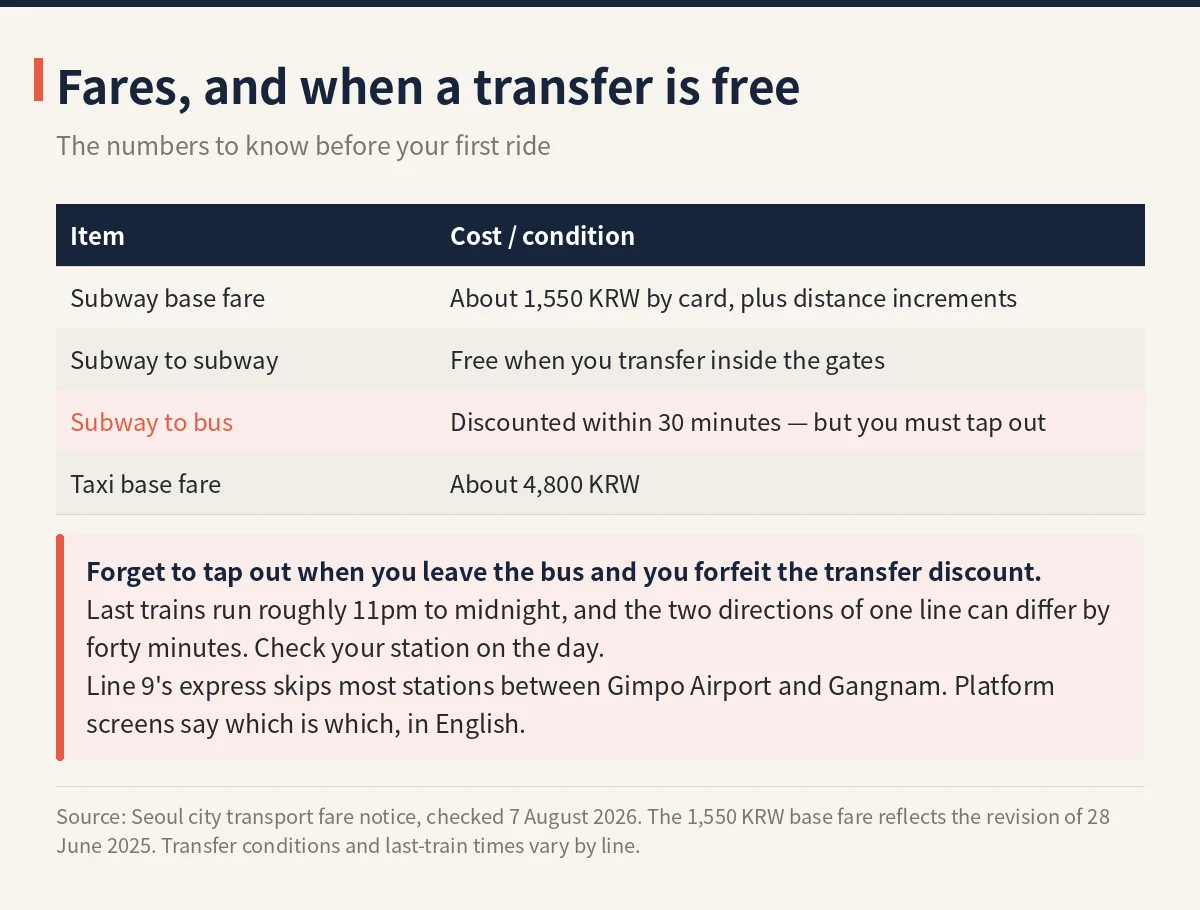
- Base fare: about ₩1,550 by card, plus small distance increments
- Line-to-line transfers inside the gates: free
- Subway-to-bus transfers within 30 minutes: discounted — but you must tap out when leaving the bus or you forfeit it
✔ Transit is the one line item that feels like a gift
Ride five times a day and you’ll spend under $6. In a city where lattes cost $4, that’s a bargain.
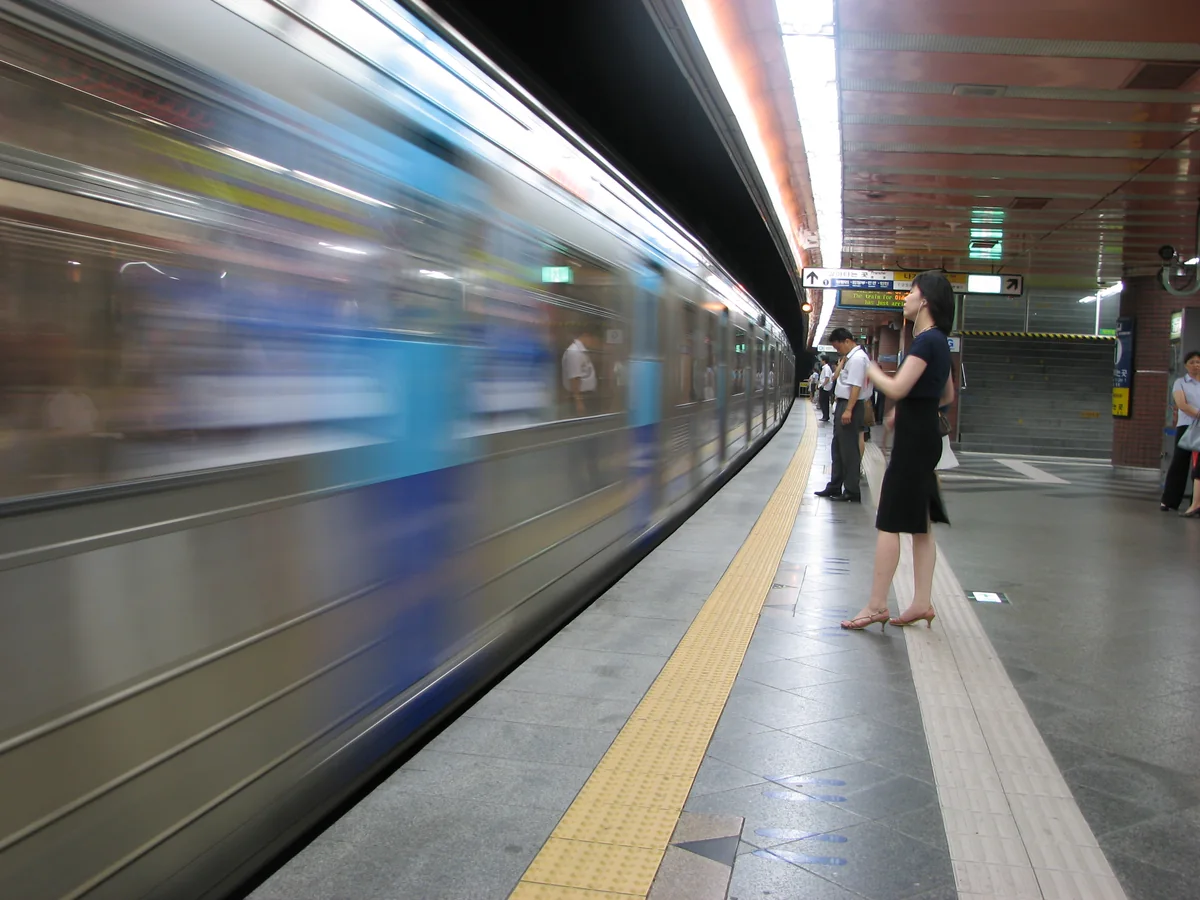
The Wrong One Costs Ten Minutes in the Heat! Exit Numbers Run Your Day
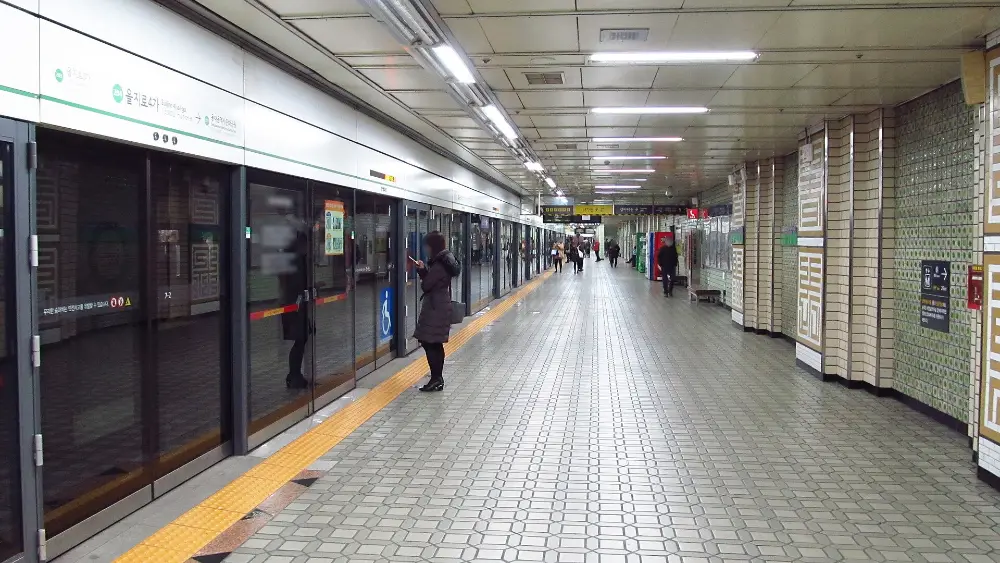
✔ Big Seoul stations have 10–15 exits
They can surface a quarter mile apart. Surfacing from the wrong one means recrossing an eight-lane boulevard in August heat. The fix is one habit: Naver Map’s route result names an exit number—check it before you pass the turnstiles, then follow the yellow overhead signs. This single habit eliminates most “lost in Seoul” moments.
Priority Seats Stay Empty! Etiquette—Three Things to Know
- Priority seats stay empty. The designated seats at each car’s end are left vacant even in crowds unless you’re elderly, pregnant, or disabled. This is observed far more strictly than in American transit — just don’t sit there
- Eating and phone calls are fine. Coffee in hand, full conversations — normal. The silent-car culture of some countries doesn’t apply
- Boarding is lightly contact-friendly. People line up at the door markings but a bit of shoulder traffic is standard, not aggression
Last Trains Are Earlier Than You Think! The Two Things That Strand People
✔ Last trains are earlier than you think
Service winds down around midnight, but the exact time swings by line, by station and by direction—the last train toward one end of a line can leave forty minutes before the last train the other way. Don’t plan a night out around “the subway runs till midnight”; check the actual last departure for your station in Naver Map before you settle in somewhere. If you miss it, Seoul runs late-night N buses from around midnight until dawn, and they’re a fraction of a taxi fare.
Express trains skip your station. Several lines run express services alongside the all-stop trains, and Line 9 is the one that catches visitors—the express blows through most of the stations between Gimpo Airport and Gangnam. The platform screens and announcements do say which is which, in English, but if you board on autopilot you’ll surface somewhere you didn’t intend. When it works in your favour it’s a real time saver; the trick is knowing which one you’re standing in front of.
One more practical note: not every exit has an elevator, and the ones that do aren’t always signposted from the platform. With a suitcase, look for the exit number the app gives you and check for the lift icon before you commit to a staircase. Paying with the right card also matters more than people expect — the transit card comparison covers which one actually saves money on a short trip.
Transfer Corridors of 5–10 Minutes? The Honest Downsides
- Transfer corridors can be brutal. Some connections (Line 9 and the express-train stations especially) involve 5–10 minutes of walking. With a suitcase, choose routes with fewer transfers over fewer stations — it’s faster in practice
- Elevators exist but require hunting; escalators sometimes only go up
- Rush hour (8–9am, 6–7pm) on Lines 2 and 9 is genuinely crushing. Start your sightseeing at 10am and you’ll never see it
- Last trains run earlier than you’d expect — roughly 11pm to midnight depending on the line. After that it’s Kakao T taxis, which start around ₩4,800
✔ My split after years here
Subway for everything in daylight, taxi for the airport-luggage run and post-midnight returns. Do the same and four days of Seoul transport costs less than one airport Uber back home.
The better a transit system is, the more its difficulty migrates from transfers to the last few hundred meters. Deciding where to surface is the highest-leverage move. One glance at the exit number before the gates—that’s the whole trick!
Frequently asked questions
Do I need to buy a ticket?
No. Tap a T-money card (or a WOWPASS with the transit function) on the gate going in, and tap again going out. There is nothing to plan at the fare gate. Every station also has a number — Myeongdong is 424, meaning Line 4, station 24 — so you can navigate by digits even if you read no Korean.
How much is a ride, and do transfers cost extra?
A card ride starts around ₩1,550 with distance added on longer trips. Changing lines inside the gates is free. Subway-to-bus transfers within 30 minutes are discounted, but only if you tap out when leaving the bus — miss that and you lose the discount. Four or five rides a day still comes in under $7.
What is the single habit that stops me getting lost?
Check the exit number before you leave the gates. Gangnam and Express Bus Terminal have well over ten exits, and the wrong one means ten minutes of backtracking outdoors. Naver Map always names the exit in the route result; follow the yellow signs inside the station from there.
What etiquette differs from the US?
Priority seats at the ends of each car stay empty even when the train is full — the convention is much stricter here, so do not take one. Talking on the phone in the car is completely normal. And boarding is a little more compressed than Americans expect; nobody is being rude.
When does the subway stop running?
Around midnight, but the exact time varies sharply by line, station and direction — the last train one way can leave forty minutes earlier than the opposite direction from the same platform. Check the specific station in Naver Map rather than assuming midnight. If you do miss it, Seoul runs N-numbered night buses from midnight until dawn for a fraction of a taxi fare.
Is the subway workable with a suitcase?
Sometimes. A few transfers involve five to ten minutes of walking, not every exit has an elevator, and the ones that do are not always signposted from the platform. On luggage days, check whether your exit shows an elevator icon in the app, or take a taxi — the base fare is ₩4,800.
This article is based on the official information below. Rules can change, so please check the original before you travel.
· KORAIL (Korea Railroad) official site
Information as of 2026-08-22 (official listings and Google Maps as shown at publication). Updated when things change.