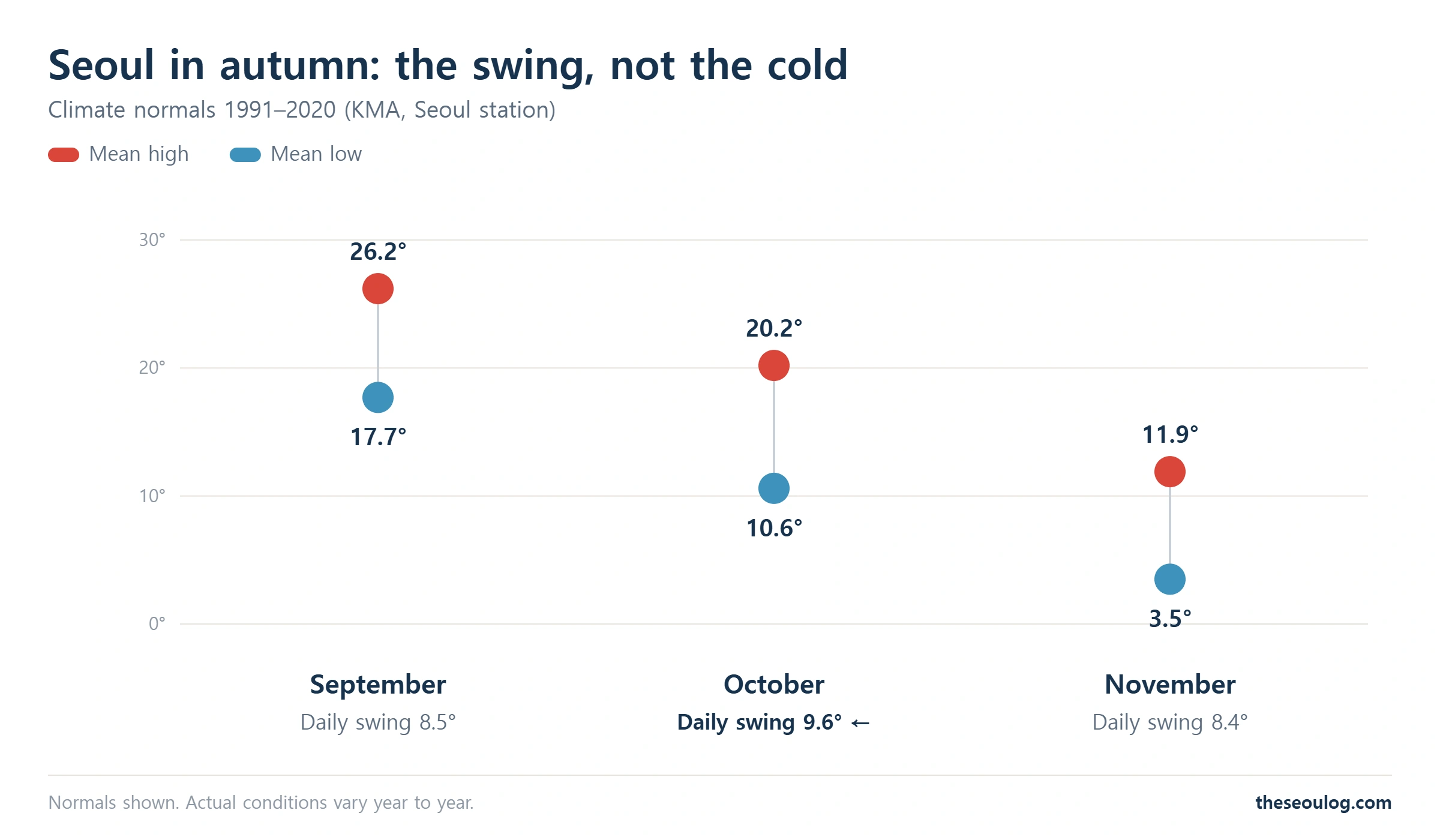
- These are the Korea Meteorological Administration normals for 1991–2020.
- September afternoons in Seoul are still short-sleeve weather.
- October is the hard one.
Who this is for
- Anyone flying to Seoul between late September and November and unsure what to pack
- People assuming “it’s autumn, one light coat will do”
- Anyone planning to bring new boots (regret arrives on the second evening)
People who dress wrong for a Seoul autumn haven’t misread the temperature. They’ve packed for one temperature.
October in Seoul averages 20.2°C by day and 10.6°C at dawn. Here’s the thing: that’s a swing of nearly ten degrees inside a single date—an afternoon you can walk in short sleeves, and an evening you can’t stand still in without a jacket.
“So what do I actually pack?” What you need isn’t warm clothing but removable clothing. Here’s how to dress for late September through November, built from the actual numbers. Let’s get into it.
Contents
1. Seoul’s autumn in numbers
2. Late September — still the end of summer
3. October — two seasons in one day
4. What to actually pack
5. Shoes — assume 15,000 steps a day
6. You can top up locally
7. Frequently asked questions
1. October Has the Widest Swing! Seoul’s Autumn in Numbers
| Month | Mean | Mean high | Mean low | Daily swing |
| September | 21.6°C | 26.2°C | 17.7°C | 8.5°C |
| October | 15.0°C | 20.2°C | 10.6°C | 9.6°C |
| November | 7.5°C | 11.9°C | 3.5°C | 8.4°C |
✔ The column that matters is the last one
These are the Korea Meteorological Administration normals for 1991–2020. The widest daily swing belongs to October, not September. The reason is simple—October mornings drop to around 10°C in absolute terms, so the same gap costs you more.
By November the mean low is 3.5°C. That’s sharply colder than Tokyo and another planet entirely if you’re arriving from Taipei or Hong Kong. Late October is the dividing line: what you need shifts from a layer to actual insulation.
✔ Got this far? Then this is your next move. “Korea Autumn Foliage 2026: Seoraksan Mid-October, Seoul Late October” is the step after.
2. Late September — Short Sleeves Plus One Layer? Still the End of Summer
✔ Afternoons are still short-sleeve weather
A mean high of 26.2°C means you’ll sweat if you walk, and the metro and shops run their air conditioning hard.
The answer here is short sleeves plus one thin long-sleeved layer. A cardigan or a light shirt, carried over your arm through the afternoon and put on when the sun goes. That covers all of September.
If you’re visiting for Chuseok (24–27 September in 2026), this kit is fine. Note that with the palaces open free, you’ll spend longer outdoors than usual—sun protection still applies.
3. October — Ten at Breakfast, Twenty at Lunch, Twelve at Dinner! Two Seasons in One Day
✔ October is the hard one
Ten degrees at breakfast, twenty at lunch, twelve at dinner. Any single outfit will fail at one end of that day.
The practical answer is three layers: a thin long-sleeved base, a shirt or sweatshirt over it, and a light windproof jacket on top. Adding and removing those three carries you from morning to night. Three thin layers beat one heavy coat in a Seoul October.
After mid-month, add a scarf. Cold in Seoul arrives as wind. Along the Han River and up on Namsan it feels two or three degrees below the street readings.
4. What to Actually Pack? The Period-by-Period Table
| Period | Base | Outer | Feet |
| Mid–late September | Short sleeves | One thin long-sleeved layer | Trainers |
| Early–mid October | Thin long sleeves | Shirt plus light jacket | Trainers |
| Late October–November | Long sleeves plus mid-layer | Windproof jacket | Thicker socks |
✔ Choose layers that work together in colour
If you’re travelling light, that’s the trick. Seoul gives you a lot of reasons to be photographed, and three layers pulling in three different directions shows in every frame.
Rain is lighter in October than September. One folding umbrella is enough.
5. Shoes — More Important Than Clothes! Assume 15,000 Steps a Day
✔ Footwear matters more than clothing
Even on a one-district-a-day itinerary, you’ll average around 15,000 steps.
Seoul is hilly. Bukchon, Namsan and Itaewon all look flat on a map and aren’t. Palace grounds are gravel, which breaks your stride. Broken-in trainers are the only correct answer; new boots or loafers produce regret by the second evening.
Bring one more pair of socks than nights. From late October, thin socks let the cold in at the toes first.
6. Misjudged It? You Can Top Up Locally
✔ Misjudging the cold is easy to fix here
Uniqlo has branches at the major stations, and Daiso sells scarves, gloves and disposable hand warmers for a few thousand won.
Hand warmers—haetpaek—are sold in convenience stores too. For an outdoor event in November, two of them in your pockets change the experience more than another jumper would. Still unsure? Look at what people are wearing on the metro—the local reading is usually right.
The simple version. September: short sleeves plus one layer. October: three layers. November: swap the outer layer for a winter one. If you are still unsure, look at what people are wearing on the metro. Seoul is pragmatic about cold, and the local reading is usually right.
In short
• The problem is the swing, not the cold. October averages a 9.6°C daily range
• Late September needs short sleeves plus one thin layer
• October needs three layers: thin base, shirt, windproof outer
• Add a scarf after mid-October. The river and Namsan feel 2–3°C colder
• Broken-in trainers only. Plan for 15,000 steps a day
• Uniqlo and Daiso will cover anything you underpacked
Frequently asked questions
Is Seoul still hot at the end of September?
In the afternoon, yes. The September mean high is 26.2°C and you will sweat walking. Mornings and evenings fall to around 17°C, so bring one light layer.
Do I need a coat in October?
Not in the first half. From late October some mornings drop below 10°C, so a windproof jacket is worth having. A heavy coat is a November item.
Should I bring an umbrella?
A folding one. Autumn in Seoul is dry, and October is drier than September.
What does the “daily swing” feel like in practice?
You walk with your sleeves rolled up at lunch and start looking for a jacket the moment the sun drops. In a Seoul October this happens every day.
Can I buy clothes there instead?
Easily. Uniqlo is at the main stations, and Daiso sells cheap scarves, gloves and hand warmers. Convenience stores stock hand warmers too.
Temperatures are Korea Meteorological Administration normals for the Seoul station, 1991–2020. Information current as of 11 August 2026; actual conditions vary year to year.
Source: KMA Open MET Data Portal, climate normals (1991–2020). Photographs: Wikimedia Commons
This article is based on the official information below. Rules can change, so please check the original before you travel.
· Korea Meteorological Administration
Information as of 2026-08-27 (official listings and Google Maps as shown at publication). Updated when things change.