- So the rule is: “K-ETA waived, e-Arrival Card still due.
- K-ETA (Korea Electronic Travel Authorization) is normally the online pre-approval that visa-free tra…
- At the end of December 2025, Korea abolished the paper arrival card — the little form flight attenda…
Who this is for
- Anyone who read “K-ETA exempt” and assumed the paperwork was gone
- People still expecting a paper card from the flight attendant
- Frequent flyers to Korea who want the least-hassle route
“Exempt” sounds like the paperwork went away. What actually happened is that one requirement was swapped for another.
Americans don’t need a K-ETA through the end of 2026. That much is true, and it’s exactly where most travellers stop reading. Here’s the thing: in its place came the e-Arrival Card, an electronic declaration that replaced the paper form you used to fill out on the plane.
“So what do I actually have to do?” The reason people end up typing on their phones in the immigration queue is that this substitution hides inside a single reassuring word. It’s one task, not zero. Seoulog laid it out in order—let’s get into it.
Table of Contents
1. The Short Answer: One Task, Not Zero!
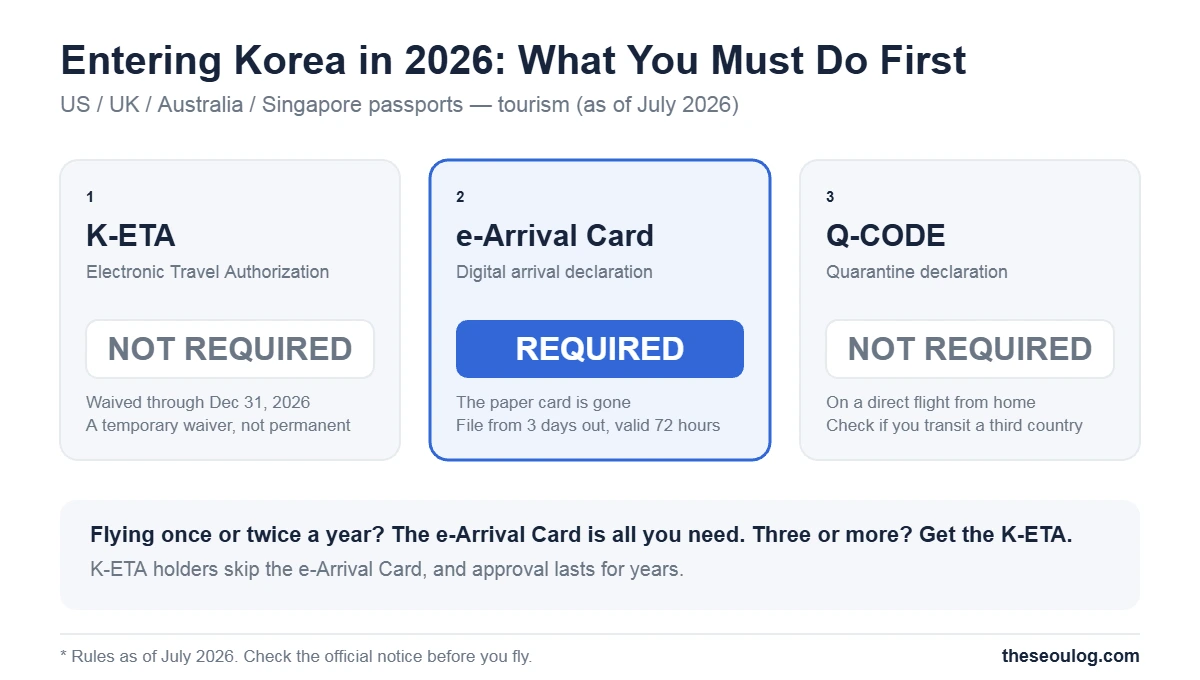
AS OF JULY 2026 — TOURISTS FROM K-ETA-EXEMPT COUNTRIES (US, UK, AUSTRALIA, SINGAPORE, ETC.)
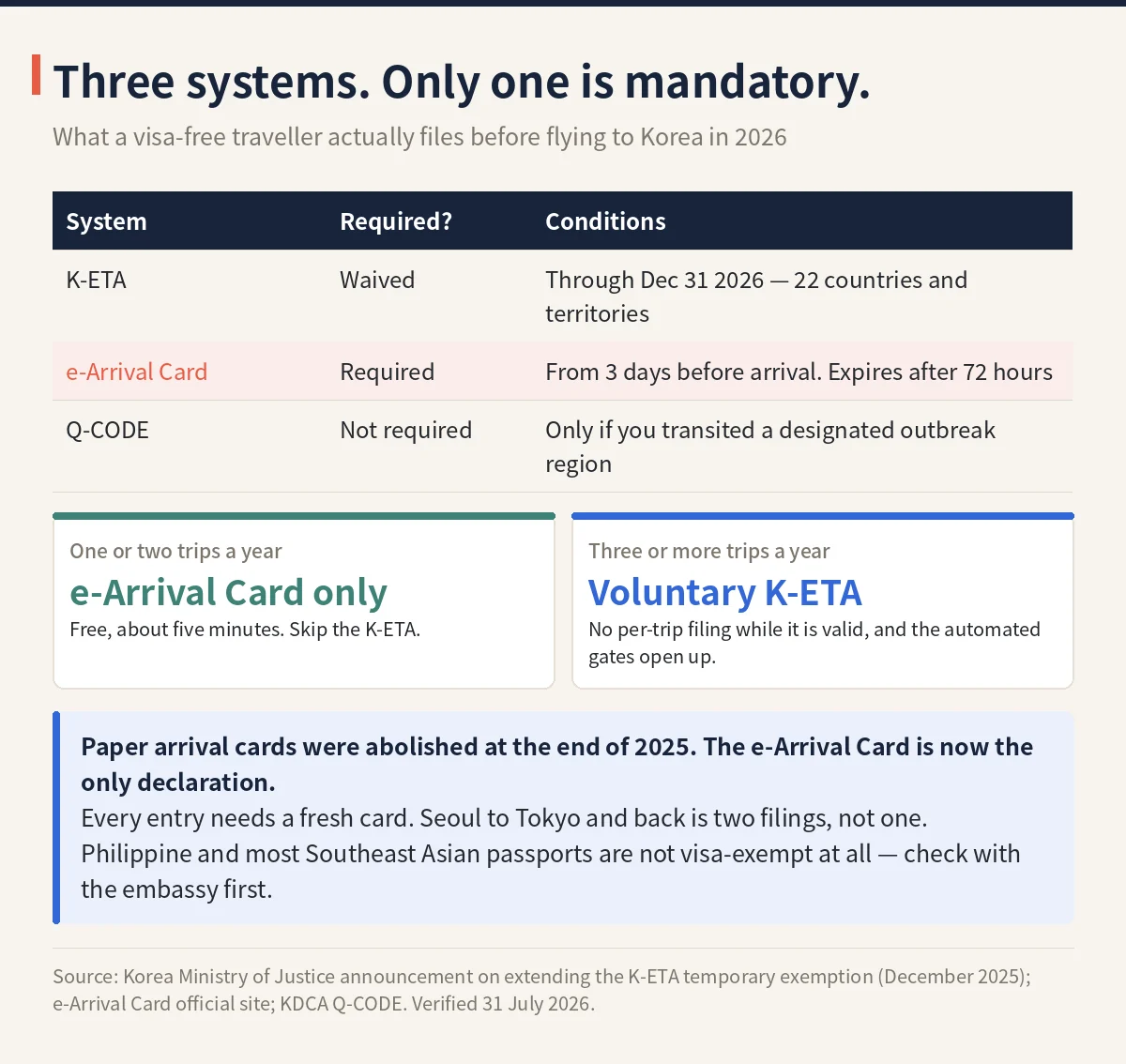
1. K-ETA = NOT required (waived through December 31, 2026)
2. e-Arrival Card = REQUIRED (the paper arrival card no longer exists)
3. Q-CODE = NOT required (unless arriving from a designated outbreak region)
So the rule is: “K-ETA waived, e-Arrival Card still due.” That single sentence is the whole trap.
The word “exemption” makes it sound like all pre-arrival paperwork is gone. In reality, K-ETA and the e-Arrival Card are two completely separate systems, and only one of them is paused.
One more thing before we go on. Philippine passport holders—and travellers from most Southeast Asian countries other than Singapore, Malaysia, Brunei and Thailand—are not visa-exempt for Korea at all. If that’s you, the K-ETA discussion doesn’t apply; check the Korean embassy in your country for current visa requirements before booking anything.
✔ Here’s the question that comes next. “Incheon Airport to Seoul by Train, Bus or Taxi” picks up right where this leaves off.
2. Not Permanent? K-ETA Is Waived Through December 31, 2026
| Procedure | Status in 2026 |
|---|---|
| K-ETA | Waived through Dec 31, 2026 (22 countries/regions) |
| e-Arrival Card | Required — the paper arrival card is gone |
| Q-CODE | Not required on direct flights |
✔ Think of it as Korea’s ESTA
K-ETA (Korea Electronic Travel Authorization) is normally the online pre-approval that visa-free travellers must get before boarding a flight to Korea. Think of it as Korea’s version of the US ESTA.
Right now, 22 countries and territories are temporarily exempt, and that waiver has been extended through December 31, 2026. The list includes the United States, United Kingdom, Australia, Singapore, Hong Kong, Macao, Taiwan and Japan, among others.
Note the word “temporarily.” The exemption has been extended year by year several times, but it isn’t a permanent policy. Planning a 2027 trip? Re-check the rules when you book.
3. No More Paper Card! The e-Arrival Card Is the Part Everyone Misses
✔ The paper arrival card is gone
At the end of December 2025, Korea abolished the paper arrival card—the little form flight attendants used to hand out. It has been fully replaced by the electronic e-Arrival Card.
In principle, every foreign national entering Korea has to file one. It’s free, takes about five minutes online, and can be submitted starting three days before your arrival date (arrival day included).
Two rules that catch people off guard.
First: your submission expires if you don’t enter Korea within 72 hours. You cannot knock this out a week early — the system won’t let you, and an early filing would be void anyway.
Second: you need a new card for every entry. Doing Seoul → Tokyo → Seoul on one trip? That’s two separate e-Arrival Cards.
4. A Shortcut Almost Nobody Mentions? The Voluntary K-ETA
✔ Here’s the part most visitors miss
Even though you’re exempt, you can still voluntarily apply for a K-ETA—and an approved K-ETA exempts you from the e-Arrival Card entirely.
Approved travellers can also often use the automated immigration gates or priority lanes, which shortens the wait after a long-haul flight.
A K-ETA stays valid for multiple years. So if you fly to Korea several times a year, paying for one approval up front means never touching the 72-hour e-Arrival Card cycle again.
Which one should you pick?
- One or two Korea trips a year: the e-Arrival Card alone is fine. File it three days before departure; it takes about five minutes. Skip the K-ETA.
- Three or more trips a year, or frequent business travel: get the K-ETA. While it’s valid, you’re done with per-trip paperwork completely.
To be blunt: for a one-off vacation, the voluntary K-ETA is paying a fee to solve a problem you don’t have. Five minutes of free form-filling covers you.
5. Q-CODE: Can Most Travellers Skip It?
✔ It used to apply to everyone; it no longer does
Q-CODE is Korea’s pre-arrival health declaration system. It used to apply to everyone; it no longer does.
Today it’s required only if you’ve stayed in or transited through a designated quarantine-watch region—areas with active outbreaks of things like avian influenza or MERS.
Flying direct from the US, UK, Australia or Singapore, you almost certainly don’t qualify. But if your itinerary connects through a third country, check the current list. Arriving from a designated region without declaring can mean a steep fine.
6. Four Steps and You’re Done! Your Pre-Departure Timeline
- 1 month out: check your passport validity. It must be valid on entry; six months of remaining validity is the safe standard.
- 1 week out: (optional) apply for K-ETA — frequent travelers only. Processing can take time, so don’t leave it to the last minute.
- 3 days out to departure day: file your e-Arrival Card. Mandatory if you didn’t get a K-ETA. Remember the 72-hour rule.
- Right after filing: screenshot the confirmation screen. You’re not supposed to need to show it, but save it in case of connectivity trouble at the airport.
Once you’re through immigration, the next problem is getting around—and Google Maps won’t route you. Here’s which map app to use in Korea.
7. Remember One Thing and Fly! Key Takeaways
- K-ETA is waived through December 31, 2026 for 22 countries including the US, UK, Australia, and Singapore — but it’s not permanent
- The e-Arrival Card is still mandatory. Paper arrival cards were abolished at the end of 2025
- File it no earlier than 3 days before arrival; it dies after 72 hours — and every re-entry needs a fresh one
- Flying to Korea 3+ times a year? Get a voluntary K-ETA and skip the e-Arrival Card entirely
- Q-CODE only applies if you’re arriving from a designated outbreak region
- Philippine and most SEA passports are not visa-exempt — check visa requirements with the Korean embassy first
The confusing part is that Korea runs the exemption system and the declaration requirement as two separate tracks. One being switched off doesn’t switch off the other. Treat them as one system and you’ll miss a step.
My advice, same as I give every friend who visits: set a phone reminder for three days before your flight, file the e-Arrival Card, and forget the rest.
About the author
I live in Seoul and have given this exact rundown to visiting friends more times than I can count. The “exempt but not exempt” split trips up almost everyone, so I finally wrote it down.
When a government announces that a requirement has been waived, it usually means the requirement moved rather than vanished. What was added is the part worth checking before you fly.
Frequently asked questions
If K-ETA is waived, is there nothing left to do?
No. The K-ETA waiver runs through December 31, 2026, but the e-Arrival Card is a separate requirement and it has not been waived. The paper arrival card no longer exists, so this is effectively the one task you cannot skip.
When should I file the e-Arrival Card?
The window opens 72 hours before arrival. Filing about three days before departure is the safe habit, and it takes roughly five minutes.
Is there any reason to apply for a K-ETA even though I am exempt?
Yes. An approved K-ETA exempts you from the e-Arrival Card entirely, and it stays valid for multiple years. If you fly to Korea three or more times a year, one approval means never repeating the 72-hour filing. Approved travelers can also often use the automated gates or priority lanes.
What if I only visit once or twice a year?
The e-Arrival Card alone is fine. File it three days before you fly and skip the K-ETA — the paperwork is not worth it at that frequency.
Do I need a Q-CODE?
Most travelers do not. Q-CODE is the pre-arrival health declaration, and it is required only if you stayed in or transited through a designated quarantine country.
Will the K-ETA waiver continue into 2027?
What is confirmed runs to December 31, 2026. Nothing has been announced for after that date, so check the current guidance before a 2027 trip.
Entry rules change often. Facts verified as of July 31, 2026 against official announcements. Re-check the official sites right before you travel.
- K-ETA temporary exemption extension — Korea Ministry of Justice announcement (December 2025)
- K-ETA official site — Korea Ministry of Justice
- e-Arrival Card official site — Korea Immigration Service, Ministry of Justice
- Q-CODE (quarantine pre-entry system) — Korea Disease Control and Prevention Agency
- Incheon Airport to Seoul 2026: Train, Bus, Taxi Costs
Once you are through immigration, this is how you actually get into the city.
This article is based on the official information below. Rules can change, so please check the original before you travel.
· HiKorea (Korea Immigration Service)
Information as of 2026-08-01 (official listings and Google Maps as shown at publication). Updated when things change.