- Plan around it: outdoor sights (palaces, markets, walking neighborhoods) in the morning and evening,…
- August: shorts, breathable everything, more shirts than days — you will sweat through them.
- Korean indoor air conditioning runs cold — cafes, subways, buses sit around 72°F while outside is 95°F.
Who this is for
- Anyone flying to Seoul in August wondering if their Tokyo packing list transfers
- September travelers asking “do I need fall clothes?”
- Anyone who’d rather not lose the second half of the trip to an AC-induced cold
What wears you down in Seoul in August is not the temperature.
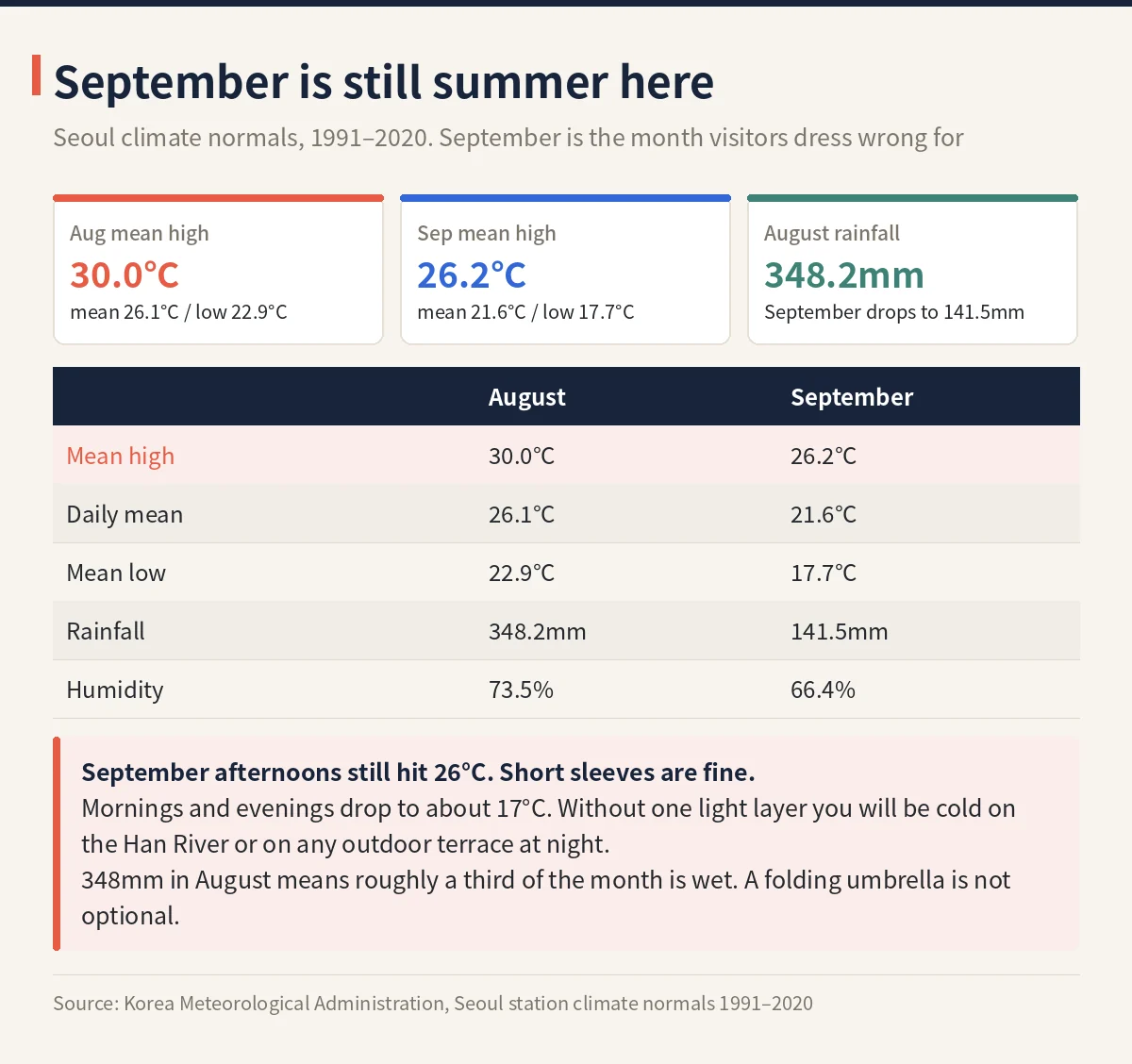
On paper, Tokyo runs slightly hotter and Taipei considerably hotter. What makes walking here punishing is rain: 348.2mm in August, more than double Tokyo. That number means sudden downpours will interrupt your itinerary more than once.
The other factor is indoors. Ninety-five degrees outside, seventy-two in a cafe, several times a day. “So what do I actually pack?” That swing costs more energy than the heat itself. Let’s get into it.
Table of Contents
Still Summer Through Mid-September! The Numbers
| Period | High / Low | Feels like |
|---|---|---|
| Early–mid August | 90–95°F / 77–81°F | Peak heat, tropical nights |
| Late August | 86–91°F / 73–77°F | Still hot, mornings ease slightly |
| Early–mid September | 81–88°F / 68–73°F | Extended summer, shorts weather |
| Late September | 75–81°F / 59–64°F | Finally early fall |
✔ Plan around it
Outdoor sights (palaces, markets, walking neighborhoods) in the morning and evening, indoor stops (cafes, museums, underground shopping arcades) midday. Touring Gyeongbokgung at 1pm in August is a self-inflicted wound.
✔ Here’s the question that comes next. “What to Wear in Seoul from Late September to November” picks up right where this leaves off.
No Long Sleeves Before September 20! What to Pack
✔ August: shorts, breathable everything, more shirts than days
You’ll sweat through them. Quick-dry fabrics earn their keep. Sun umbrellas are completely normal here for all genders, so use one without feeling odd.
Through September 20 or so, pack exactly like August plus one light layer. My blunt rule: no long-sleeve-heavy luggage for any trip starting before September 20. It’s dead weight.
95°F Outside, 72°F Inside! The AC Whiplash Problem
✔ Korean indoor air conditioning runs cold
Cafes, subways, buses sit around 72°F while outside is 95°F. You’ll cross that 20-degree gap a dozen times a day, and it’s how visitors actually get sick in summer. One thin cardigan or overshirt in your bag solves it. This matters most on heavy subway days and long cafe stops.
Convenience-Store Umbrellas Are Disposable! Rain and Typhoons
✔ August brings a handful of sudden, violent downpours
Late August through September is typhoon season, and some years a storm clips the peninsula. Flight cancellation calls usually come the day before or the day of. If you travel in that window, turn on your airline’s app notifications and don’t schedule anything unmissable on your final day.
A compact umbrella from home beats the ₩5,000–10,000 convenience store ones, which are strictly disposable.
Step Out of the Heat Every Ninety Minutes! Where to Cool Down, for Free
✔ The trick isn’t enduring the heat
It’s planning where you’ll step out of it every ninety minutes. The city is unusually good at this if you know where to look.
- Underground shopping arcades. Gangnam, Myeongdong, Euljiro and Express Bus Terminal all have long air-conditioned tunnels connected to the subway. You can cover serious distance without surfacing — worth rerouting for on a 95°F afternoon.
- Designated cooling centers. Local governments open muddeowi-swimteo (무더위쉼터) in community centers, banks and libraries through the summer. They’re for anyone, tourists included, and they’re marked with a blue sticker at the entrance.
- Weak-AC cars on the subway. Several lines run one designated car at a milder temperature, marked on the platform screen doors and above the train doors. Useful in the other direction too — if you’re freezing, avoid that car.
- The ice cup trick. Convenience stores sell a cup of ice for about ₩1,000 and any bottled drink to pour into it. It’s the cheapest cold drink in the city by a wide margin.
Two things worth knowing before you need them: what to ask for at a pharmacy if the heat gets to you, and how the hospital and insurance process works if it goes further than that. Heat exhaustion sends real numbers of people to Korean ERs every August, and it’s the one summer risk visitors underestimate.
Water for ₩1,000, Chuseok 24–27 Sept! Season-Specific Notes
- Hydration is trivially easy: a 500ml water is about ₩1,000 at any of the convenience stores you’re never more than a block from
- Forgot sweat wipes or sunscreen? Olive Young (the drugstore chain everywhere) stocks better versions than you brought
- Late September travelers: check the Chuseok dates. In 2026 it runs September 24 (Thu) to 26 (Sat), with Sunday the 27th attached — four days in practice. Family-run restaurants and markets close for several days, Thanksgiving-style. Big chains and palaces stay open, but food options thin out noticeably
✔ My honest take
August Seoul trades brutal heat for cheaper hotels and the world’s best cafe-hopping infrastructure. If you hate heat, don’t force it—October is Seoul’s finest month, dry and crisp with fall color, and it’s worth the wait.
Coping with heat on a trip is less about enduring the outdoors than about how quickly you can get inside. Seoul is unusually well equipped for that. Put one thin layer in the bag and go!
Frequently asked questions
Is Seoul cooler than Tokyo or Taipei in August?
Marginally cooler on paper. Seoul averages 26.1°C (79°F) with a mean high of 30.0°C (86°F), against Tokyo at 26.9°C and Taipei at 29.5°C. That gap does not save you: 35°C days and tropical nights are routine. The real difference is rain — Seoul gets 348.2mm in August, more than double Tokyo.
Can I pack for autumn if I visit in September?
Not before roughly the 20th. Seoul stays summer through mid-September, and shorts weather runs to about 88°F. Pack exactly as you would for August and add one light layer; a suitcase full of long sleeves is dead weight until late in the month.
Do I need a jacket in the middle of a heatwave?
Yes, for the air conditioning. Interiors here run cold — 95°F outside, 72°F inside a cafe or subway car, several times a day. A light shirt or cardigan in your bag is the difference between enjoying a long cafe stop and leaving with a sore throat.
Should I bring an umbrella or buy one there?
Bring a compact one. Convenience stores sell umbrellas for ₩5,000–10,000, but they are strictly disposable. August brings sudden downpours, and late August into September is typhoon season in some years — turn on your airline app notifications if you travel in that window.
Where can I escape the heat for free?
The underground arcades. Gangnam, Myeongdong, Euljiro and Express Bus Terminal all have long air-conditioned tunnels linked to the subway, so you can cover real distance without surfacing. Local governments also open cooling centers (무더위쉼터) in community centers, banks and libraries — marked with a blue sticker, open to tourists too.
Does the Chuseok holiday affect a late-September trip?
Yes. In 2026 the public holidays run Thursday 24 to Saturday 26 September, effectively a four-day weekend through Sunday the 27th. Independent restaurants close in larger numbers and parts of traditional markets shut down. Palaces and major shopping complexes mostly operate as usual, but check opening hours for any specific place you have your heart set on.
This article is based on the official information below. Rules can change, so please check the original before you travel.
· Korea Meteorological Administration
Information as of 2026-08-17 (official listings and Google Maps as shown at publication). Updated when things change.