- The number to remember above all: 1330.
- Korea’s public 119 ambulance is free of charge as a rule.
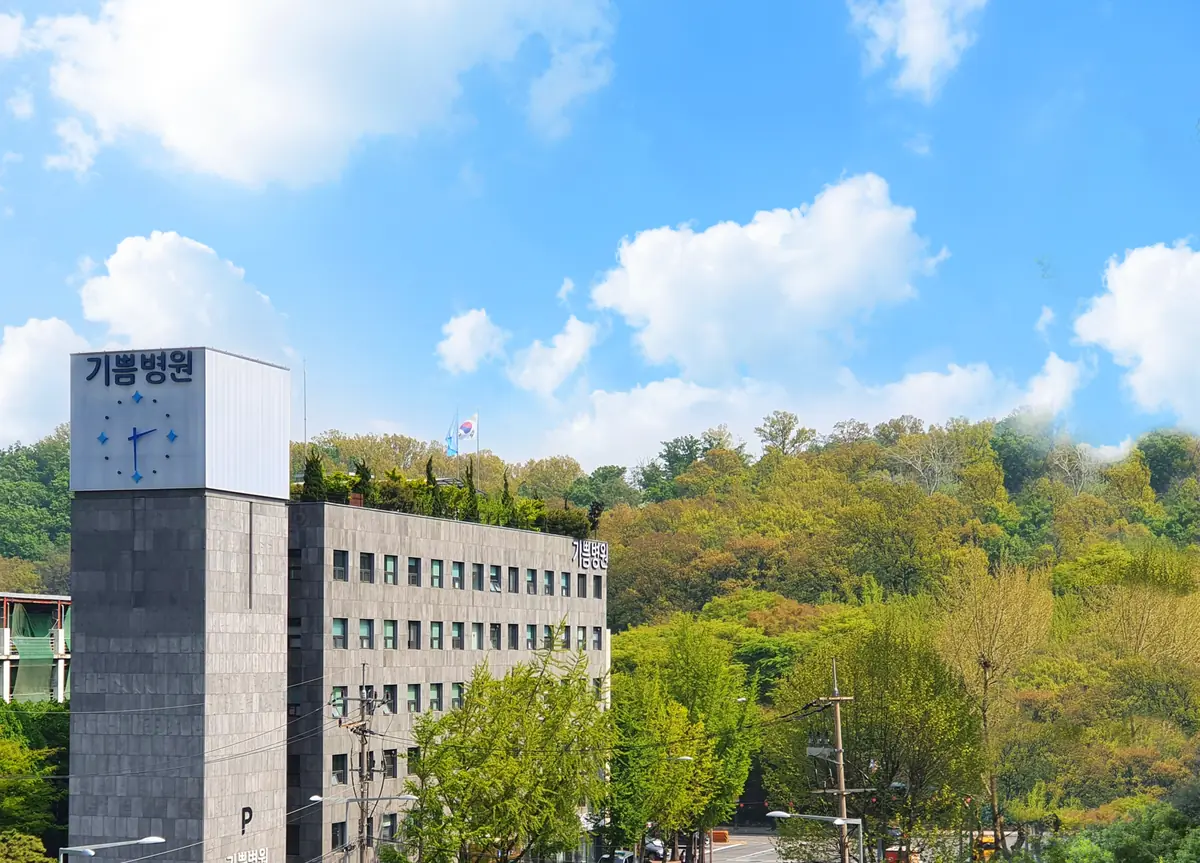
- Most major university and general hospitals in Seoul run an International Healthcare Center (국제진료센터)…
Who this is for
- Anyone who’s woken up feverish in a hotel with no idea which number to call
- People who bought travel insurance and never checked what a claim requires
- Anyone who’s hesitated to call an ambulance because they weren’t sure it’s free
What a medical emergency abroad ends up costing depends less on the treatment than on the paperwork.
Foreign visitors cannot use Korean national health insurance, so you pay in full at the counter. Travel insurance gives it back—but whether it does turns on what you collected while standing at that counter, not on how serious the problem was.
A medical certificate, an itemized receipt, a treatment breakdown. “Can’t I just request them later?” Requesting these later is far harder than it sounds, and once you’ve flown home it’s close to impossible. Let’s get into it.
- 1. When in Doubt, 1330! Three Numbers to Memorize—119, 1339, 1330
- 2. The 119 Ambulance Is Free! How Ambulances and the ER Work
- 3. International Healthcare Centers Run in English! Finding English-Speaking Hospitals and Clinics
- 4. ER From ₩110,000–220,000 Plus Tests! What It Costs Without Insurance
- 5. Four Documents, Before You Leave the Desk! What to Collect for Your Insurance Claim
- 6. The Clinic Won’t Hand You the Medicine! After the Visit—Take Your Prescription to a Pharmacy
1. When in Doubt, 1330! Three Numbers to Memorize—119, 1339, 1330
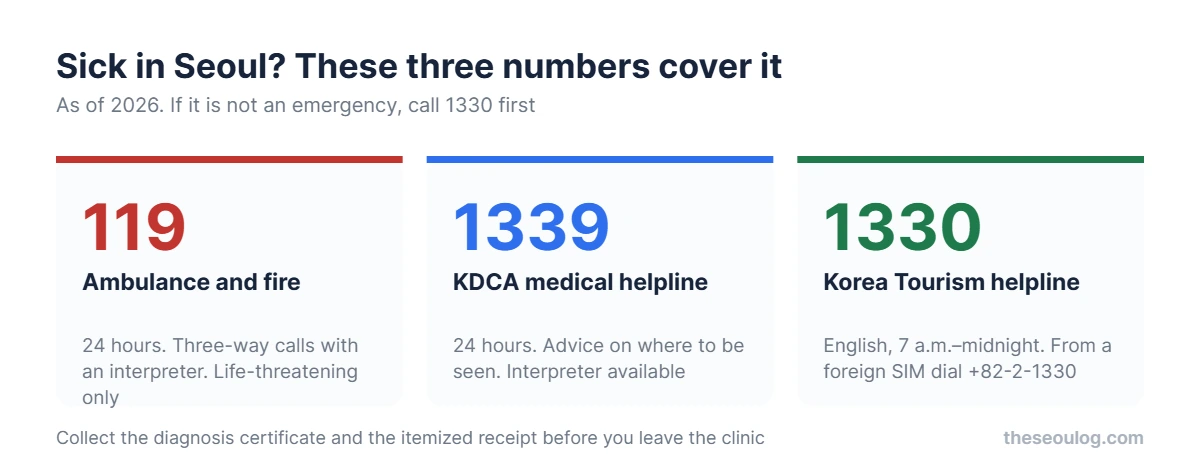
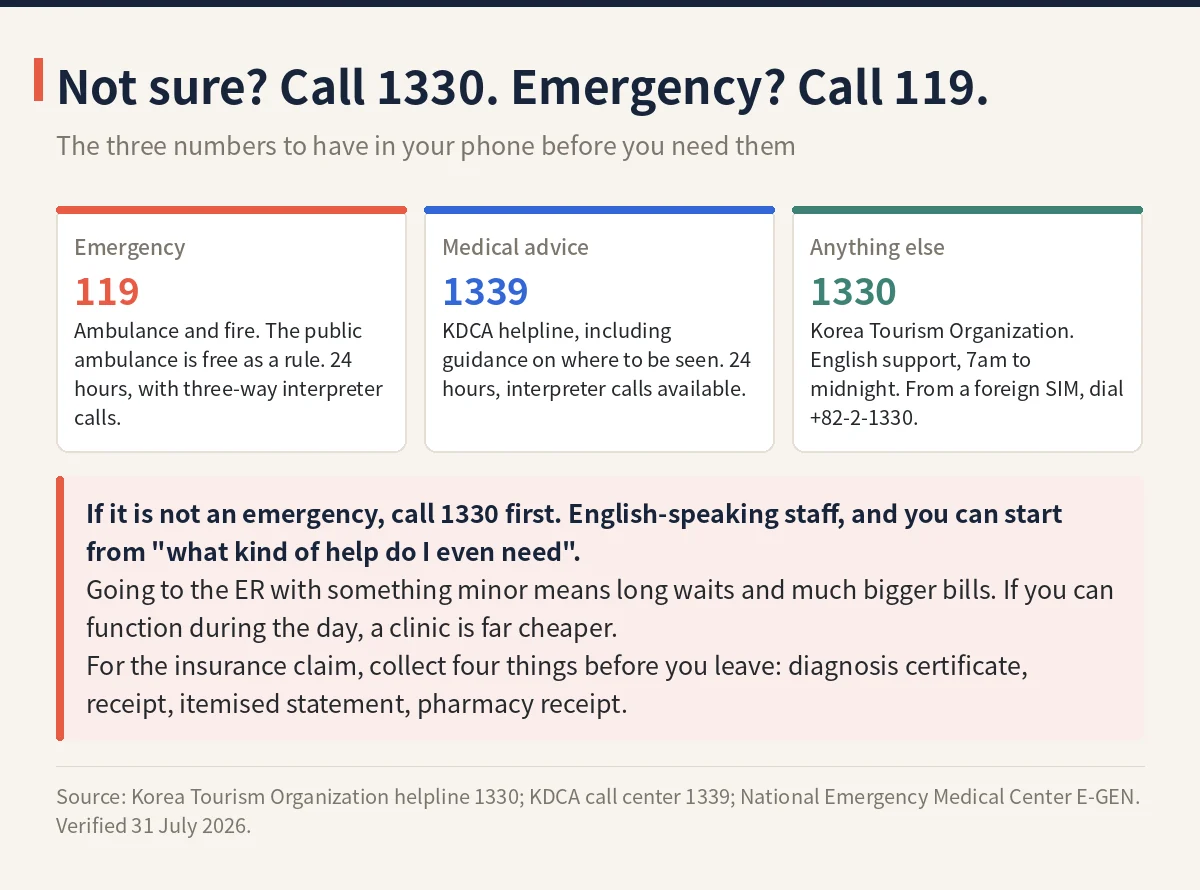
| Number | What it does | Language / hours |
| 119 | Ambulance and fire. Emergencies go here | 24 hours. Three-way calls with an interpreter available |
| 1339 | KDCA medical helpline — advice and guidance on where to be seen | 24 hours. Interpreter three-way calls available |
| 1330 | Korea Tourism Organization travel helpline — any traveler problem | English support. 7 a.m.–midnight (as of 2026) |
✔ The number to remember above all: 1330
It’s a helpline with English-speaking staff, built for exactly the situation you’re in—sick, confused, and not sure what kind of help you need. If it’s not an emergency, call 1330 first. From a foreign SIM or eSIM, dial +82-2-1330.
For specifically medical questions, 1339 is the specialist line. It’s also the right call when you cannot tell whether your symptoms count as an emergency.
✔ Want to go a level deeper? “Saw a Doctor in Korea The Three-Document Habit” digs into what comes after this.
2. The 119 Ambulance Is Free! How Ambulances and the ER Work
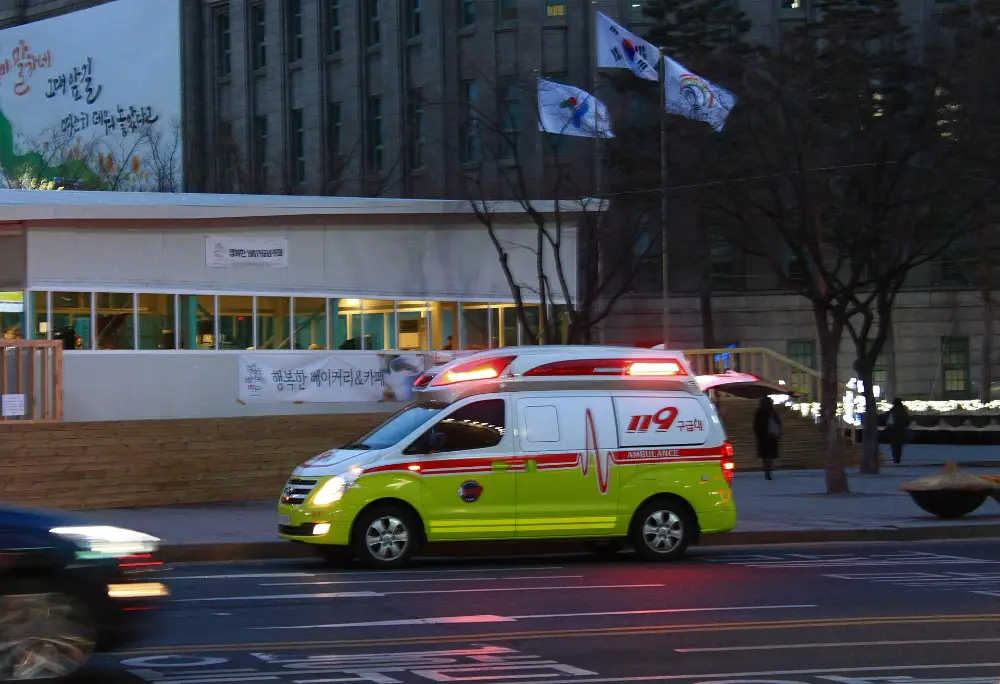
✔ Korea’s public 119 ambulance is free of charge as a rule
If it’s a real emergency, don’t hesitate over cost—call.
You’ll be taken to an emergency room (응급실) matched to your condition. The front desk will ask for your passport, so keep it on you throughout your trip.
One caution: going to the ER for something minor means long waits and much bigger bills. If you can function during the day, a regular clinic visit is far cheaper and usually faster. For a bad cold, I’d call 1330 in the morning and ask for a nearby clinic rather than sit in an ER all night.
3. International Healthcare Centers Run in English! Finding English-Speaking Hospitals and Clinics
✔ Most major hospitals run an International Healthcare Center
These centers (국제진료센터) serve foreign patients, with English as the primary language and staff used to handling overseas insurance paperwork.
Interpretation coverage still varies by hospital and day, so a phone call ahead is worth it. And if you need an interpreter at any point, 1330 and 1339 can join your call three-way.
For finding a specific hospital, stick to official sources. The Korea Tourism Organization’s medical tourism information, plus the 1330 and 1339 helplines, can match you to a suitable facility by symptom and neighborhood. For nights and holidays, the government’s emergency medical portal E-GEN lists which hospitals and pharmacies are open right now.
4. ER From ₩110,000–220,000 Plus Tests! What It Costs Without Insurance
✔ Tourists pay full price out of pocket
Korean national health insurance doesn’t cover you. These are rough estimates only—tests and procedures move the numbers fast.
| Service | Estimated out-of-pocket cost |
| Clinic visit (mild cold, etc.) | Tens of thousands of KRW — roughly $25–70 |
| Emergency room | 110,000–220,000 KRW (≈ $79–158) + tests and procedures |
| Hospitalization (per night) | From about 470,000–630,000 KRW (≈ $340–450) and up |
Once hospitalization or surgery enters the picture, bills can climb into the thousands or tens of thousands of dollars. Even for a short trip, confirming your travel insurance—including any coverage bundled with your credit card—is non-negotiable.
Before departure, save your policy number and the insurer’s 24-hour assistance line somewhere you can reach offline. If you rely on credit card coverage, check the activation conditions (some cards require the trip to be paid with that card).
5. Four Documents, Before You Leave the Desk! What to Collect for Your Insurance Claim
✔ Collect these at the payment desk before you leave
Requesting them later from abroad is a headache you don’t want.
- Diagnosis certificate (진단서, jindanseo) — issued for a fee, typically 10,000–20,000 KRW (≈ $7–14)
- Bill and payment receipt (진료비 계산서·영수증)
- Itemized statement of charges (진료비 세부내역서)
- A copy of your prescription, plus the pharmacy receipt (약국 영수증)
Claims work one of two ways. At hospitals partnered with your insurer, “cashless” treatment may be possible—no payment on the spot. Call your insurer’s assistance line before the visit to check.
At non-partner hospitals, you pay first and claim after you get home, attaching the documents above. Pay by credit card if you can: it creates a clean payment record and skips the currency-exchange hassle.
For something mild, a pharmacy is often the faster call. Registration and the insurance claim both assume you’re online, so sort out data on day one.
6. The Clinic Won’t Hand You the Medicine! After the Visit—Take Your Prescription to a Pharmacy
✔ Korea separates prescribing from dispensing
For outpatient visits, the doctor hands you a prescription (원외처방), and you fill it at a pharmacy near the hospital—the clinic itself doesn’t give you the medicine.
ER visits and inpatient stays are the exception; those medicines may be dispensed in-house. Either way, keep the pharmacy receipt—it goes into your insurance claim too.
Unsure how to take the medicine? Ask the pharmacist right there. With a translation app, the conversation works fine.
- Emergency: 119 (public ambulance is free). Medical advice: 1339. English-language help with anything: 1330
- Big hospitals have International Healthcare Centers with English service — call ahead to confirm
- Find hospitals through official channels: 1330, 1339, E-GEN, Korea Tourism Organization
- Uninsured clinic visits start around $25–70; ER from ≈ $79–158 plus tests — check your travel insurance and save the assistance number before departure
- Get the diagnosis certificate, receipt, itemized statement, and pharmacy receipt before leaving
- Outpatient prescriptions are filled at a pharmacy, not the clinic
If you do exactly one thing after reading this, save +82-2-1330 in your contacts tonight. That single number untangles nearly every situation that isn’t a 119 emergency, and it costs you ten seconds now—the best deal in this whole article. Go save it!
Frequently asked questions
Does calling an ambulance in Korea cost money?
No — the public 119 ambulance service is free. Do not hesitate in a genuine emergency. You will be taken to an emergency room (응급실) appropriate to your condition, and reception will ask for your passport, so keep it on you.
What if nobody speaks English?
Call 1330, the Korea Tourism Organization helpline — English-speaking, and it handles any kind of traveller problem. From a foreign SIM, dial +82-2-1330. For medical questions specifically, 1339 (the Korea Disease Control and Prevention Agency) runs 24 hours and can set up a three-way call with an interpreter.
Should I call 119 or 1339?
Call 119 for anything life-threatening — unconsciousness, heavy bleeding, chest pain. Call 1339 when you are not sure whether it counts as an emergency; they will also point you to an appropriate clinic. Walking into an ER with a minor complaint costs you both time and money.
What does treatment cost without insurance?
Visitors cannot use Korean national health insurance, so you pay in full. A clinic visit for something minor runs from a few tens of thousands of won up to around 100,000 KRW; an ER visit starts around 110,000–220,000 KRW before tests and procedures. Admission or surgery can reach several thousand dollars, which is why travel insurance — including the coverage bundled with your credit card — is worth checking before you fly.
What documents do I need for an insurance claim?
Collect them at the payment desk, not later: the medical certificate (진단서, issued for a fee), the itemized bill and receipt, the detailed treatment breakdown, and a copy of your prescription plus the pharmacy receipt. If your insurer has a partner hospital, cashless treatment may be available — call their assistance line before you go in.
Do I get medicine at the hospital?
Usually not. Korea separates prescribing from dispensing, so outpatient visits end with a prescription you take to a nearby pharmacy. Keep the pharmacy receipt — it is part of your insurance claim.
This article is based on the official information below. Rules can change, so please check the original before you travel.
· Korea Tourism Organization official site
Information as of 2026-08-16 (official listings and Google Maps as shown at publication). Updated when things change.