- Gwangjang Market opened in 1905 and draws about 65,000 people a day. Budget 5,000–6,000 won for bindaetteok (Sunhee-ne charges 6,000), 3,000 for mayak gimbap, 20,000 for yukhoe; many stalls are cash-only.
- Tongin Market’s coin lunchbox: buy 500-won brass coins on the second floor and trade them at member stalls to fill a tray. 10,000 won (20 coins) per person is plenty; closed Tuesdays and the third Sunday.
- Gyeongdong Market, opened in 1960, is one of Seoul’s largest. The Starbucks Gyeongdong 1960 in a converted cinema (opened late 2022, about 200 seats) pulls 1,000-plus visitors on weekdays.
Who this is for
- Anyone who’d rather have griddle oil and stall noise than a tasting menu
- People who’ve heard of Gwangjang and want to know what the other markets are
- Anyone who wants to know how much cash to bring and when the seats are free
Skip fine dining. Stand in the smell of griddle oil and the din of the stalls and taste Korea’s everyday food culture raw—that’s the traditional market street-food tour. From the flagship the world met on Netflix to a market with its own currency and one steeped in retro, you pick by taste.
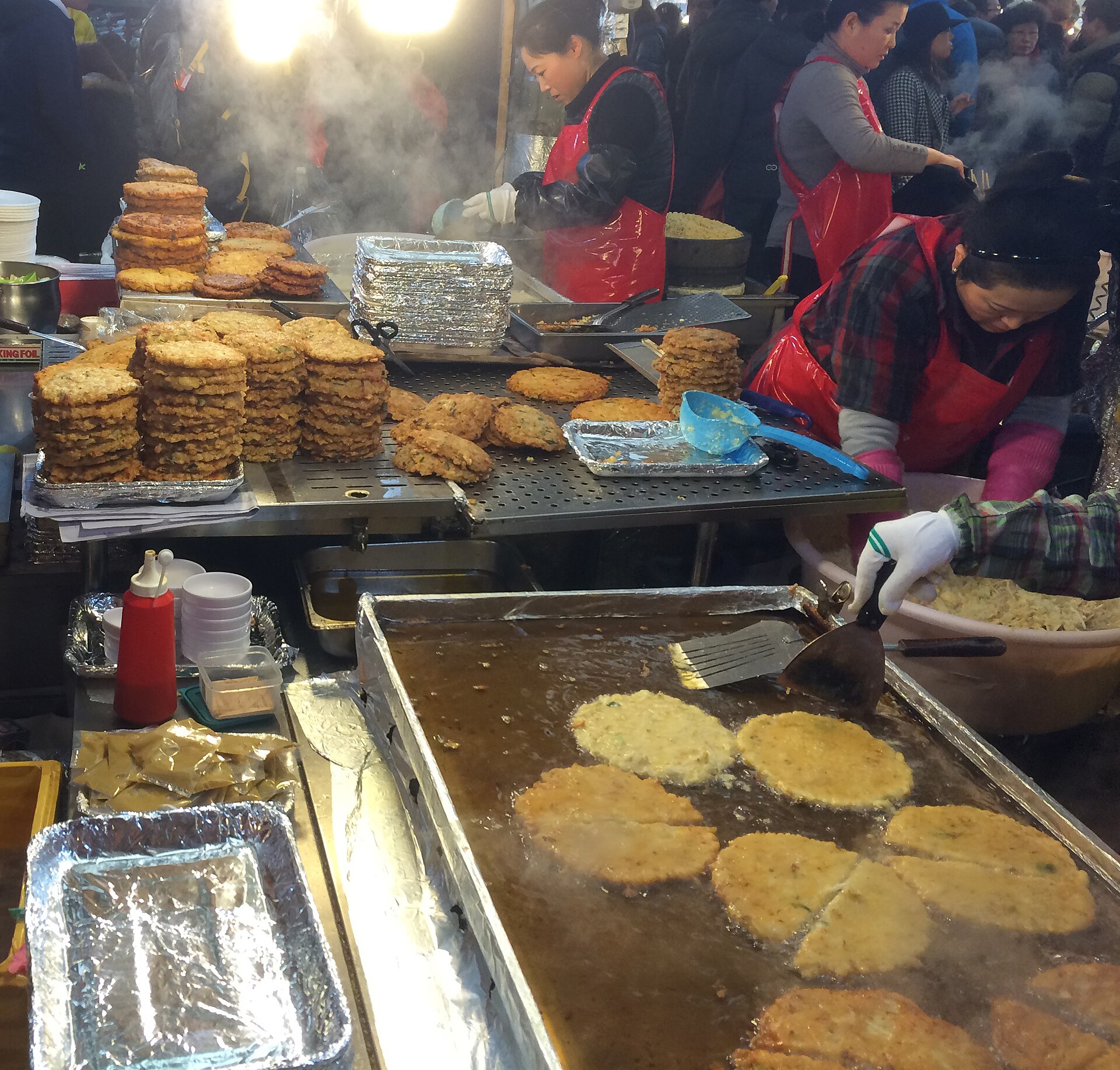
Three things make it work. You watch the dish get made: mung beans ground on a stone mill, bindaetteok fried in oil on a griddle the size of a pot lid. Portions are single-serve, so two or three people share and hop three or four stalls in a row. And you sit on a plastic stool or a narrow bench, shoulder to shoulder with strangers, a cup of makgeolli in hand.
“So which market, how much cash, and what time?” This piece lines up Gwangjang, Tongin and Gyeongdong with prices, hours, how much cash to bring and when to go. Let’s get into it.
Everything Finishes in Front of You! Why a Market—Made to Order, Shared, Shoulder to Shoulder
✔ It starts with watching the dish come together
Mung-bean batter from a stone mill hits a pot-lid-sized griddle slicked with oil and fries into bindaetteok; tteokbokki bubbles in a vat. Everything finishes in front of you after you order.
Portions are small, so two or three people share and move through three or four stalls. Seating is a plastic stool or a narrow bench, and your neighbor is a stranger. Order makgeolli or a soft drink and sit close—that distance is what gives a market its air.
The three markets have different personalities: Gwangjang for scale and fame, Tongin for its game-like setup, Gyeongdong for the contrast of herbal medicine and retro. Rather than all three in a day, one in the afternoon and another in the evening leaves room to breathe.
| Market | Nearest station | Character | Signature dishes | Watch out |
|---|---|---|---|---|
| Gwangjang (Jongno) | Line 1 Jongno 5-ga, exit 8 | Opened 1905; the central aisle is one huge food court | Bindaetteok, mayak gimbap, yukhoe, kkwabaegi | Many cash-only stalls; some close Mondays |
| Tongin (Seochon) | Line 3 Gyeongbokgung, exit 2, 8-min walk | Coin lunchbox built with brass yeopjeon | Oil tteokbokki, tteokgalbi, jeon | Lunchbox café 11:00–16:00; closed Tuesdays and third Sundays |
| Gyeongdong (Jegi-dong) | Line 1 Jegi-dong | Opened 1960; herbal-medicine market plus retro cafés | Sundae, fried dumplings, young vendors’ snacks | Starbucks Gyeongdong 1960 gets crowded |

✔ This one comes first, in order. Skim “The Gwangjang Market Method” and the rest of this page lands better.
Four Things Not to Miss! Gwangjang Market—Opened 1905, the First Stop for Foreign Eaters
✔ Two minutes from exit 8 of Jongno 5-ga Station
Korea’s first permanent market opened in 1905 and now sees about 65,000 visitors a day. The entire central aisle is a stall food court, and since a Netflix series introduced it to the world it has been the first destination on foreign food itineraries. It’s two minutes from exit 8 of Jongno 5-ga Station on Line 1.
Four things not to miss. Soon-hee’s Bindaetteok near Gate 2: stone-milled mung-bean pancakes, crisp outside and moist inside, plus meatballs. Mother-and-Daughter Mayak Gimbap: tiny rolls dipped in mustard sauce, simple and impossible to stop eating. On yukhoe alley, Miok Yukhoe (Google ★4.9, 269 reviews) and Changsin Yukhoe Branch 3 (★4.8, 125 reviews): fresh beef tartare topped with an egg yolk and still-wriggling chopped octopus. To finish, queue for kkwabaegi—chewy twisted doughnuts in cinnamon sugar, straight from the fryer. For bindaetteok, the famous Sunhee-ne (★4.0, 1,726 reviews) is the landmark, but neighboring stalls fry the same thing with shorter queues.
Budget 5,000–6,000 won for bindaetteok (Sunhee-ne charges 6,000), 3,000 per roll of mayak gimbap, 20,000 for yukhoe and 3,000 for makgeolli. Many stalls are cash-only; there are ATMs at the entrance. A fuller walk through the market is in a separate guide.
Brass Coins at 500 Won Each? Tongin and Gyeongdong—a Coin Lunchbox, and a Starbucks in a Dead Cinema
✔ Start on the second floor, where the coins are sold
Tongin Market, in Seochon west of Gyeongbokgung Palace, is a small alley market with a built-in game. Buy brass coins (yeopjeon) at the customer center on the second floor, pick up a plastic lunch tray, and walk the member stalls trading one or two coins at a time for side dishes—the coin lunchbox. Coins are 500 won each, 5,000 won for a string of ten; 10,000 won (20 coins) per person is plenty, and leftover coins are refundable. The lunchbox café runs 11:00–16:00, with coin sales until 15:00 on weekdays and 16:00 on weekends. Closed Tuesdays and the third Sunday of each month.
The local specialty is soupless oil tteokbokki—chewy rice cakes stir-fried in an iron pan with chili oil or soy sauce—and every stall, Original Grandma’s included, claims to be the original. Tteokgalbi patties and jeon pancakes, about two coins (1,000 won) each, fit neatly into the tray. Gyeongbokgung, the hanok lanes and Seochon’s café street are all on foot from here.
Gyeongdong Market opened in 1960 and is one of Seoul’s largest, a wholesale district for medicinal herbs and produce. In late 2022 the disused Gyeongdong Theater became a roughly 200-seat Starbucks Gyeongdong 1960, next to an LG experience space carrying the company’s old Goldstar (Geumseong) name, planting a new-and-old contrast in the middle of the herb market. Before the makeover most shoppers were over 60; now more than 1,000 people come on a weekday and 2,000-plus on weekends, foreign tour groups among them. To eat: cheap, crisp fried dumplings and sundae from the alley stalls, and fusion Korean food and bakeries from the young vendors’ corner.
Carry 10,000 and 1,000 Won Notes! Practical Tips—Cash, Timing, Dietary Limits
✔ Cash makes everything move faster
Fixed shops and larger stalls take cards, but the small stalls and 1,000–3,000 won purchases prefer bank transfer or cash. Carry 10,000–20,000 won per person in 10,000 and 1,000 won notes and everything moves faster.
Two time windows. Weekdays 14:00–16:00 skip the lunch crush and you can settle into a seat. From 18:00 to 20:00 the after-work crowd arrives and the stalls take on their drinking-hour buzz—pick this for atmosphere.
If anyone in your group has dietary limits, check ahead: some bindaetteok stalls fry in pork fat, yukhoe is raw beef, and most kimchi contains salted shrimp. For halal, vegan or gluten-free eaters, flag those three up front so they can choose with confidence.
On the map — recommended places and Google ratings
Ratings and review counts were checked on Google Maps on September 4, 2026. They change, so tap through for the latest before you go.
- Gwangjang Market — Google ★4.2 (44,270 reviews)
- Miok Yukhoe (Gwangjang) — Google ★4.9 (269 reviews)
- Changsin Yukhoe, Branch 3 — Google ★4.8 (125 reviews)
- Sunhee-ne Bindaetteok — Google ★4.0 (1,726 reviews)
- Tongin Market — Google ★3.8 (7,672 reviews)
- Gyeongdong Market — Google ★4.1 (11,048 reviews)
- Starbucks Gyeongdong 1960 — Google ★4.6 (727 reviews)
Series: Things worth doing in Korea
1 K-glasses tour · 2 K-scrub and head spa · 3 Personal color and K-makeup · 4 PC bang and esports · 5 Market street food · 6 Myeongdong K-pharmacy · 7 K-hiking by subway · 8 Care-cation · 9 Jjimjilbang full course · 10 K-dermatology · 11 KBO baseball night · 12 Hanbok and palace nights · 13 K-hair salon · 14 Saju and tarot café · 15 Daiso and convenience store · 16 Han River evening · 17 Templestay · 18 Kimjang · 19 DMZ tour · 20 LASIK and SMILE · 21 Escape rooms · 22 Screen golf · 23 Seongsu pop-ups · 24 Self photo studios · 25 Running in Seoul
FAQ
Can I pay by card?
Fixed shops and larger stalls usually can, but small stalls and small purchases run on cash or bank transfer. Carry 10,000–20,000 won per person.
When is the best time for Gwangjang?
Weekdays 14:00–16:00 are easiest for seats; 18:00–20:00 has the most energy. Note that some stalls close on Mondays.
How much is the Tongin coin lunchbox?
Coins are 500 won each, 5,000 won for ten. Plan on 10,000 won (20 coins) per person; leftovers are refundable. Closed Tuesdays and the third Sunday.
Can halal or vegan eaters manage?
There are options, but check the frying fat for bindaetteok, the raw beef in yukhoe and the salted shrimp in kimchi. Asking the stall directly is the surest way.
Can I do all three markets in one day?
You can, but Tongin in the afternoon, Gwangjang in the evening and Gyeongdong the next morning is more comfortable. Tongin to Gwangjang is about 20 minutes by subway.
- 서울시 내 손안에 서울: 통인시장 엽전도시락(2025.5)
- A4B4: 통인시장 엽전도시락 카페 이용 안내
- 뉴시스: 스타벅스 매직, 환갑 지난 경동시장(2024.9)
- LetSeoul: 광장시장 맛집 가이드(2025)
- 동대문구청: 경동시장 안내
- Trip.com: 2026 광장시장 먹거리
- edaily: Gwangjang Market stall real-name system from June (May 2026)
How this was checked: official listings for each shop or facility and Google Maps ratings were verified online (2026-09-05). The author lives in Seoul and folds in what was seen on the ground; the piece is updated when things change.
Is Gwangjang Market safe from overcharging?
Since June 1, 2026 Jongno-gu runs a real-name system for the street stalls: a stall caught overcharging or reusing food gets a suspension and penalty points, and four violations in a permit period or more than 120 accumulated points cancels its road-use permit. The 88 food stalls carry a multilingual QR menu, so check the price before you order.