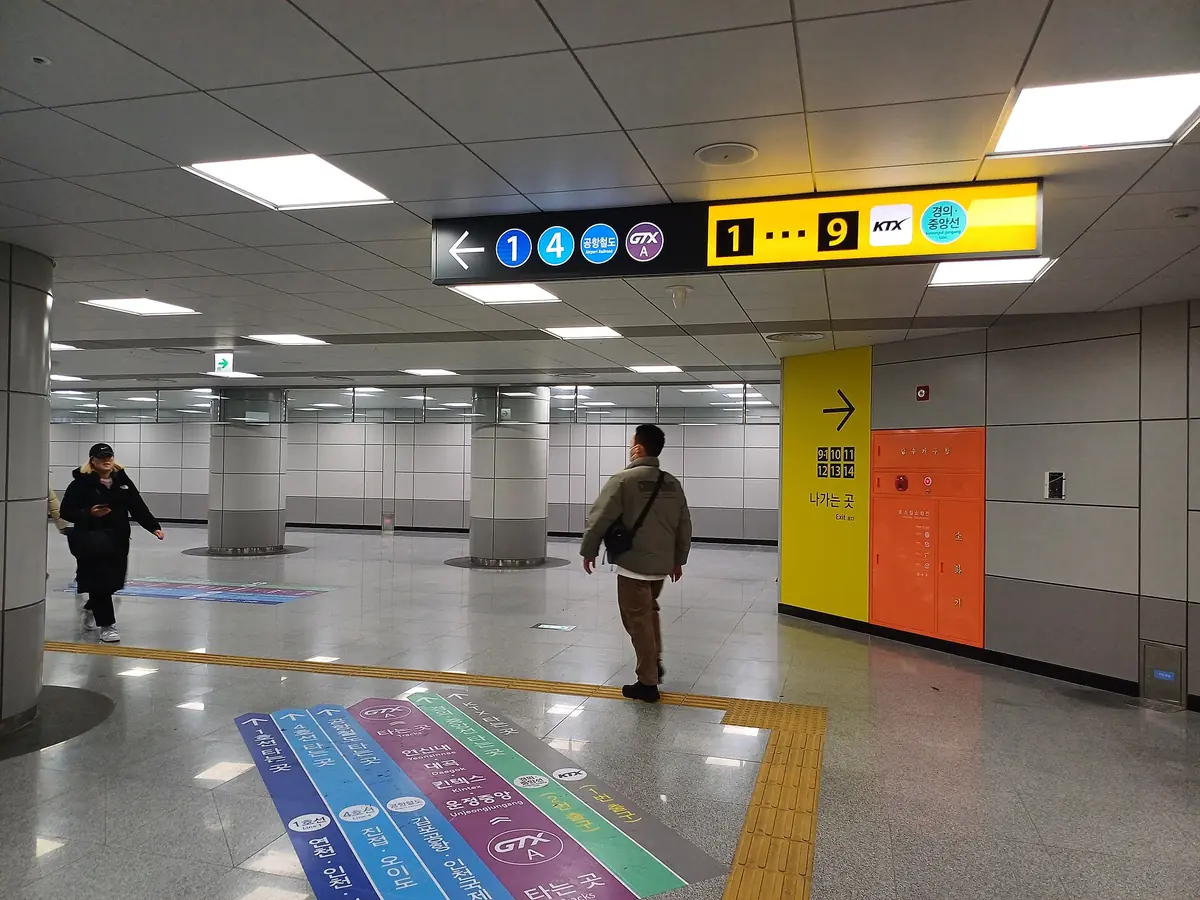
- The pattern: the only thing your card cannot do is the moment of boarding.
- Seoul is converting to an EMV open-loop system where a contactless bank card opens the gate directly…
- Take a four-day trip and count only the scenes where cards fail: street food (budget 10,000 won a da…

Who this is for
- Anyone half-believing the “just tap your Visa on the subway” post
- People who want an actual number for how much cash to exchange
- Anyone who’s frozen at an ATM asking “bill in your home currency?”
“Just tap your Visa on the Seoul subway” is advice you’ll find on social media and in more than one guide. Arrive with London or Singapore habits and you’ll be standing at the gate while it beeps at you: in 2026, foreign cards still cannot tap into Seoul’s transit.
Does that make your card useless here? The opposite. Shopping and dining run almost entirely on cards, and the newer subway ticket machines now accept foreign credit cards for topping up a T-money card. Knowing which side of the line each situation falls on is worth about an hour of your first day.
“So how much cash do I actually need?” Here’s the line, drawn scene by scene—down to the number. Let’s get into it.
Contents
1. The answer, in one table
2. Why tap-to-ride is a “not yet”
3. How much cash you actually need
4. ATM fees, honestly
5. When a card is refused
6. Frequently asked questions
1. Only the Moment of Boarding Fails! The Answer, in One Table
| Scene | Foreign card | Notes |
| Convenience stores, supermarkets | Yes, almost always | Contactless usually works too |
| Restaurants and cafés | Yes, almost always | Street stalls still want cash |
| Tapping into subway/bus | No — not yet | Open-loop is still being built |
| Topping up T-money | Partly — new machines only | Rolling out from major stations |
| Taxis | Yes, in-car terminals | Kakao T also takes card registration |
| Traditional markets, stalls | Depends on the stall | Cash is faster |
| ATM withdrawals | Yes — Global ATM | Fees covered below |
✔ The only thing your card can’t do is the moment of boarding
So the setup is two-layered—get a T-money card, then feed it with your foreign card or cash. Choosing the card itself is covered in our transport card comparison.
✔ There’s another way to do this. Read it against “Exchanging USD in Seoul Is About the Counter, Not the Rate” and you’ll see which fits you.
2. Open-Loop Is Phased to 2030! Why Tap-to-Ride Is a “Not Yet”
✔ The official schedule runs in phases to 2030
Seoul is converting to an EMV open-loop system where a contactless bank card opens the gate directly—but not yet. What’s live in 2026 is the preceding stage: new ticket machines in subway stations that accept foreign credit cards for buying and topping up T-money, spreading outward from the major stations.
So the articles saying “you can ride with your foreign card” are blending the plan with the present. For a visitor, the present is one sentence: T-money (or WOWPASS, or the Climate Card) at the gate, your own card everywhere else.
One exception. The AREX airport railway sells tickets from machines that take foreign cards, both all-stop and express. You can get from Incheon Airport to Seoul Station without any T-money at all — details in our airport transfer guide.
3. 50,000–70,000 Won for Four Days! How Much Cash You Actually Need
✔ Take a four-day trip and count only where cards fail
Street food (budget 10,000 won a day), parts of the traditional markets, the odd small admission fee. 50,000–70,000 won covers it. Change 100,000 and you’ll fly home with change.
Myeongdong beats the airport on exchange rates—the actual gap is calculated in our exchange guide. Run short, and the Global ATM next to any convenience store fills the gap.
4. Frequency Decides Everything! ATM Fees, Honestly
✔ The fee has three layers
Foreign-card ATMs (look for “Global ATM”) are everywhere—convenience stores, subway stations, banks. The ATM’s own charge (around 3,500–4,000 won), your issuer’s foreign transaction fee, and the exchange rate.
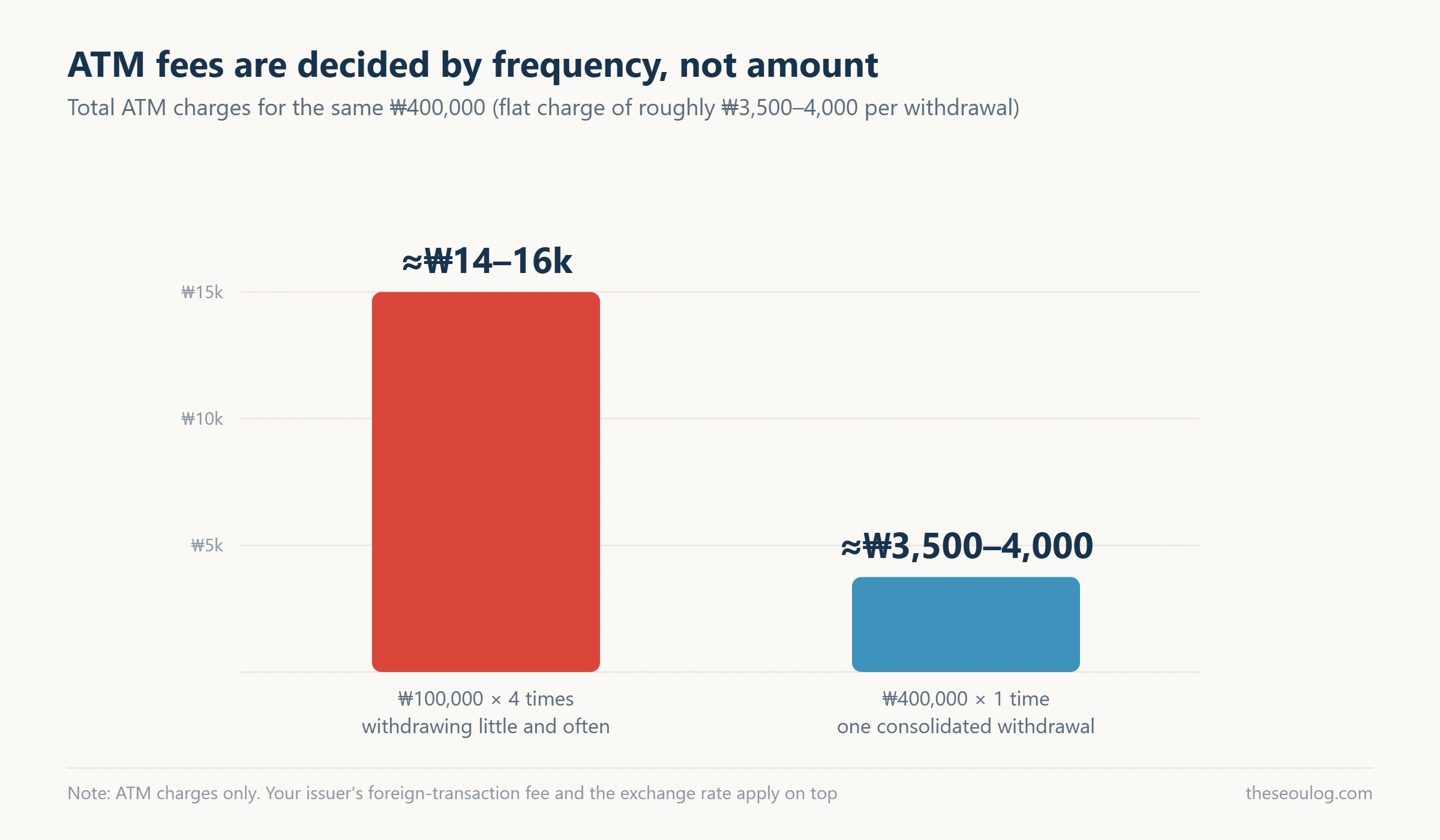
The lever that works is frequency. One withdrawal of 400,000 won beats four of 100,000, because the ATM charge is flat. And when the screen offers to bill you in your home currency, always choose KRW. Dynamic currency conversion is a marked-up rate wearing a convenience costume.
5. Insert the Chip Instead of Tapping! When a Card Is Refused
✔ It’s usually a terminal setting
Occasionally a shop says no to foreign cards. Inserting the chip instead of tapping often goes through. Failing that, switch to cash—or T-money, which convenience stores accept as payment.
Debit cards get refused slightly more often than credit cards. Carry two rails—credit plus debit or cash—and you’ll never be stuck. Get one T-money card, and the gate will never beep at you!
In short
• Foreign cards cannot tap into transit yet — use T-money at the gate
• New ticket machines top up T-money with foreign cards, rolling out from major stations
• Shopping, dining and taxis run almost entirely on cards
• 50,000–70,000 won in cash covers a four-day trip
• Withdraw in one go, and always choose KRW over your home currency
Frequently asked questions
Can I tap my Visa or Mastercard on the Seoul subway?
Not in 2026. The open-loop conversion runs in phases to 2030. Use T-money, WOWPASS or the Climate Card at the gate.
Can I top up T-money with a foreign card?
At the new ticket machines in major subway stations, yes. Older machines and convenience-store top-ups are still cash-only as a rule.
How much cash should I bring?
About 50,000–70,000 won for four days. Beyond street stalls, parts of the markets and small admission fees, cards cover everything.
Should I choose KRW or my home currency at the ATM?
Always KRW. Home-currency billing (DCC) applies a marked-up exchange rate.
What if a shop refuses my card?
Insert the chip instead of tapping — that usually works. Otherwise pay cash, or with T-money at convenience stores.
Information current as of 16 August 2026. The open-loop rollout and the range of card-capable machines change continually.
Sources: Seoul city transport bureau announcement on open-loop conversion (phased to 2030) · Korea Daily, October 2025 · on-the-ground checks. Photograph: Wikimedia Commons
This article is based on the official information below. Rules can change, so please check the original before you travel.
· HiKorea (Korea Immigration Service)
Information as of 2026-08-29 (official listings and Google Maps as shown at publication). Updated when things change.