- Seoul’s winter street snacks appear around November and vanish by the end of February. The big five are bungeoppang (붕어빵, fish-shaped pastry with red bean), hotteok (호떡, a pan-pressed pancake filled with brown sugar), gyeranppang (계란빵, egg bread with a whole egg on top), gungoguma (군고구마, roasted sweet potato) and eomuk (어묵, fish cake skewers in broth). Convenience stores start their winter lineup in mid-October.
- Prices have climbed. Bungeoppang went from 2 for 1,000 won two years ago to 1,000 won each or 3 for 2,000 won today (Konkuk Univ. station, January 2026). The reason is red beans: the wholesale price of 40 kg roughly doubled from 364,873 won (2023) to 726,600 won (November 2025). Hotteok rose from 1,000 to 2,000 won, and the cheese version is 3,500 won.
- Myeongdong is a different price zone. Its stall street (Myeongdong Station to Lotte Department Store) sets up around 4 pm and peaks 5–9 pm, with egg bread at 4,000 won, roasted sweet potato at 6,000 won and tteokbokki at 5,000 won (January 2024 survey). To eat cheaply, use the 붕세권 (Bungsegwon) map app to find neighborhood stalls, or fall back on a GS25 roasted sweet potato at 2,000 won.
Who this guide is for
- Travelers visiting Seoul between November and February who want bungeoppang and hotteok from a street stall
- Anyone who has heard Myeongdong stalls are pricey and wants the going rates first
- People wondering whether stalls take cards, whether fish cake broth is free, and other small rules
If you step out of a Seoul subway station in November and smell something sweet, that’s a bungeoppang stall. Koreans call the fish-shaped pastry 붕어빵 (literally ‘crucian carp bread’), and it’s the food that announces winter.
Prices have changed a lot in two years, though. Anyone who remembers ‘2 for 1,000 won’ freezes at today’s ‘1,000 won each’ sign. Red bean wholesale prices doubled, and the number of stalls itself is shrinking.
The other thing to know is the two-tier pricing between tourist zones and residential streets. On Myeongdong’s stall street, egg bread is 4,000 won and roasted sweet potato is 6,000 won; the same item near a university can easily be less than half that.
This guide covers the going rates for five winter snacks (based on January 2026 reports), Myeongdong stall hours and how to pay, the trick of finding neighborhood stalls with a map app, and the convenience-store sweet potato as insurance. At the end there’s Namdaemun Market’s veteran hotteok stand (1,733 Google reviews) too.
November to February! Seoul’s Five Winter Street Snacks — and the Two Kinds of Fish-Shaped Pastry
✔ The big five: bungeoppang, hotteok, egg bread, roasted sweet potato, fish cake
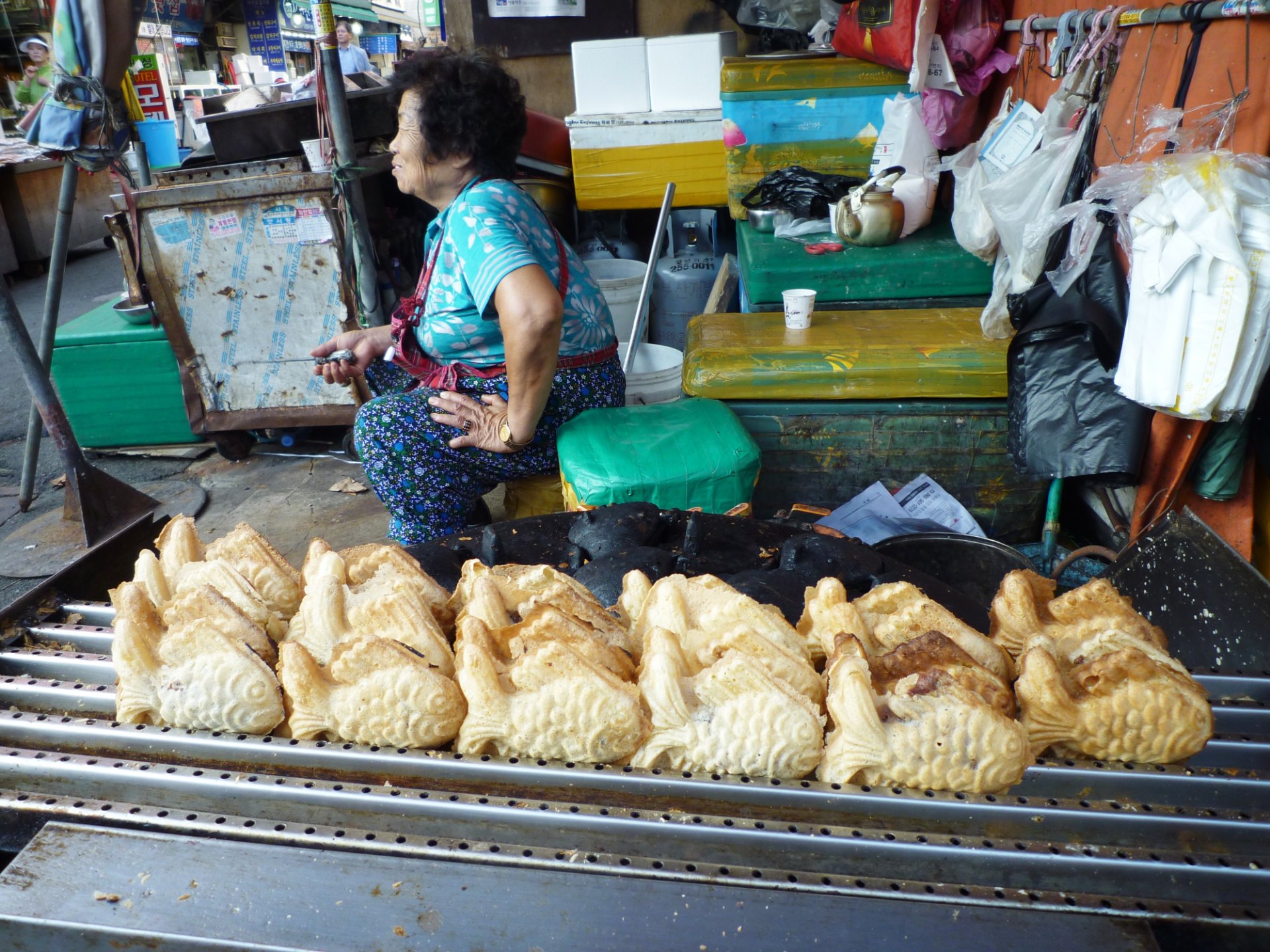
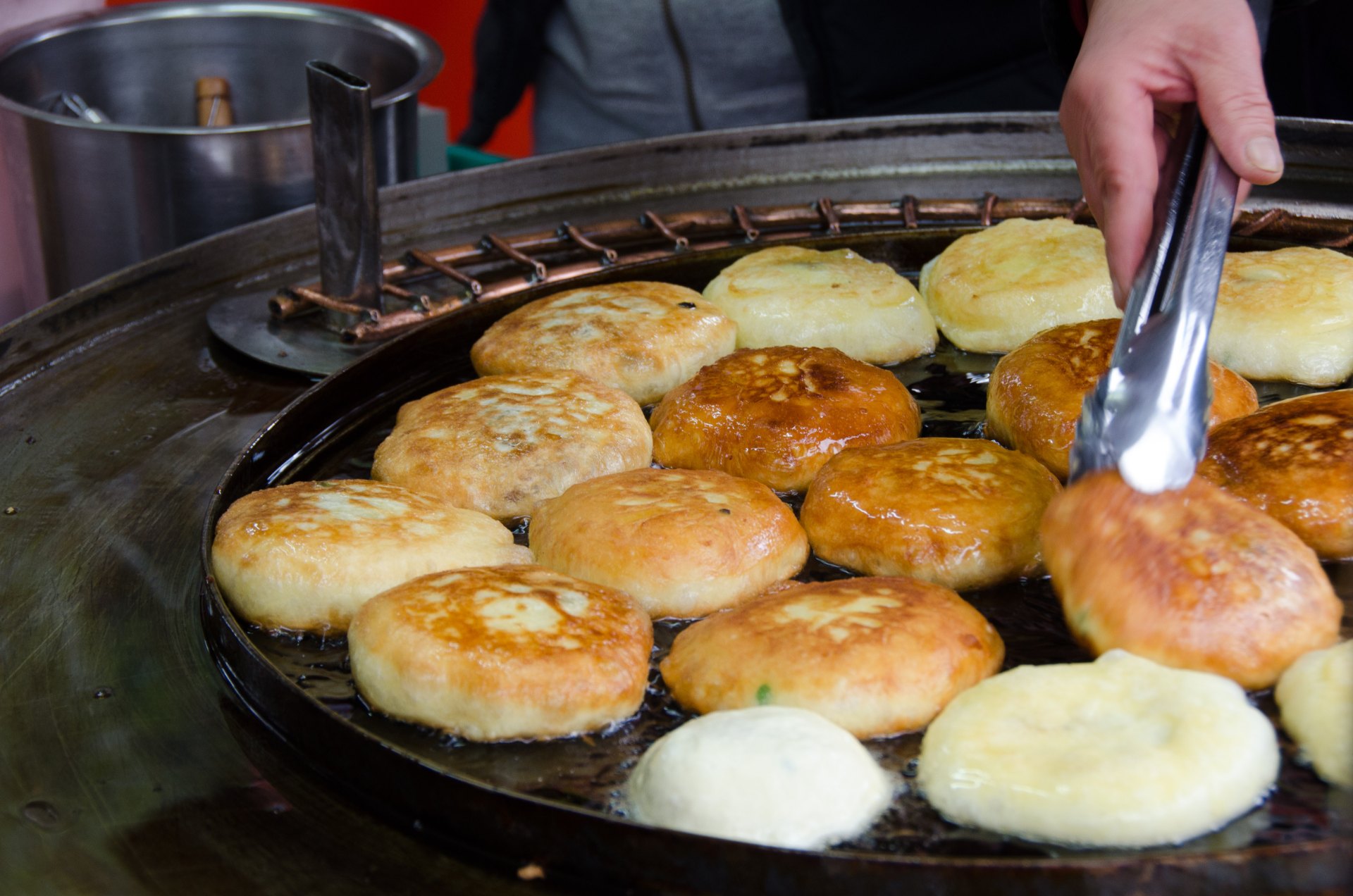
Seoul’s street snacks show up all at once when temperatures drop into the single digits around November, and disappear by the end of February. The classics are bungeoppang (붕어빵), hotteok (호떡, brown sugar and nuts sealed in dough and pressed flat on a griddle), gyeranppang (계란빵, a whole egg dropped onto pancake batter), gungoguma (군고구마, sweet potatoes roasted in a drum) and eomuk (어묵, also called 오뎅, fish cake skewers sitting in hot broth).
There are actually two kinds of fish-shaped pastry. Bungeoppang (붕어빵) uses a wheat batter and comes out thick; ingeoppang (잉어빵, ‘carp bread’) mixes glutinous rice and oil into the batter for a thin, crispy shell with red bean all the way to the tail. Fillings are basically red bean (팥) or custard (슈크림), and the order is ‘팥 두 개, 슈 한 개 주세요’ (pat du gae, syu han gae juseyo — two red bean, one custard, please).
Convenience stores move earlier than the stalls. GS25 put out red bean and honey sweet potato steamed buns (호빵) on October 15, 2025, added vegetable and pizza flavors on October 22, and sold roasted sweet potatoes through October at a bundle price of 2,000 won each or 3 for 4,800 won. Its winter food sales for October 1–15 were up 37.6% on the year — the convenience-store winter starts a step ahead of the street.
| Snack | Residential / market stalls | Myeongdong stall street |
|---|---|---|
| Bungeoppang (fish-shaped pastry) | 1,000 won each / 3 for 2,000 won | — |
| Hotteok | 2,000 won (cheese 3,500) / Namdaemun vegetable hotteok 2,500 | — |
| Gyeranppang (egg bread) | — | 4,000 won |
| Roasted sweet potato | GS25 convenience store 2,000 won each | 6,000 won |
| Fish cake skewer | 1,000–1,500 won + broth 100–500 won | — |
| Tteokbokki / hot dog | — | 5,000 won / 4,000 won |
Read next: Done with the stalls? Move on to a traditional-market food crawl in 『Bindaetteok for 5,000, Mayak Gimbap for 3,000 — Traditional Market Street Food Tour [Things Worth Doing in Korea #5]』.
Three for 2,000 Won Is the Norm! Winter 2026 Prices, and Why Red Beans Doubled
✔ The ‘2 for 1,000 won’ era is over
A stall at Seoul’s Konkuk University station that Money Today visited on January 20, 2026 sold ‘3 for 2,000 won’, and a cafe’s premium version was ‘2 for 2,700 won (1,350 won each)’. Korea Economic Daily (November 28, 2025) reported that bungeoppang, once several for 1,000 won in Seoul, is now ‘1,000 won each’. Newspim (January 4, 2026) listed the same shift — bungeoppang from 2 for 1,000 to 1 for 1,000 won, hotteok from 1,000 to 2,000 won, and cheese hotteok at 3,500 won.
Red beans are the reason. According to Korea Agro-Fisheries & Food Trade Corporation wholesale data, 40 kg of domestic red beans rose from 364,873 won two years earlier to 726,600 won in November 2025, roughly double. Money Today’s January figure was 772,894 won, about 65% above the five-year average. The consumer price index for sugar also climbed from 122 (January 2023) to 147.40 (December 2025), and vendors say there is ‘almost no profit even at 1,000 won each’.
Fish cake skewers run 1,000–1,500 won each, and some stalls have started charging for the broth (국물) that used to be free. A price list reported by Seoul Shinmun (December 21, 2024) charged buyers 100 won per paper cup, 500 won for broth alone, and 500 won extra for a takeout container. It surprised Koreans used to free broth, so the safe move for travelers is to ask before ladling.
Myeongdong’s Stall Street Opens at 4 pm! The 4,000-Won Egg Bread ‘Tourist Price’ and How to Pay
✔ Myeongdong Station to Lotte Department Store, busiest 5–9 pm
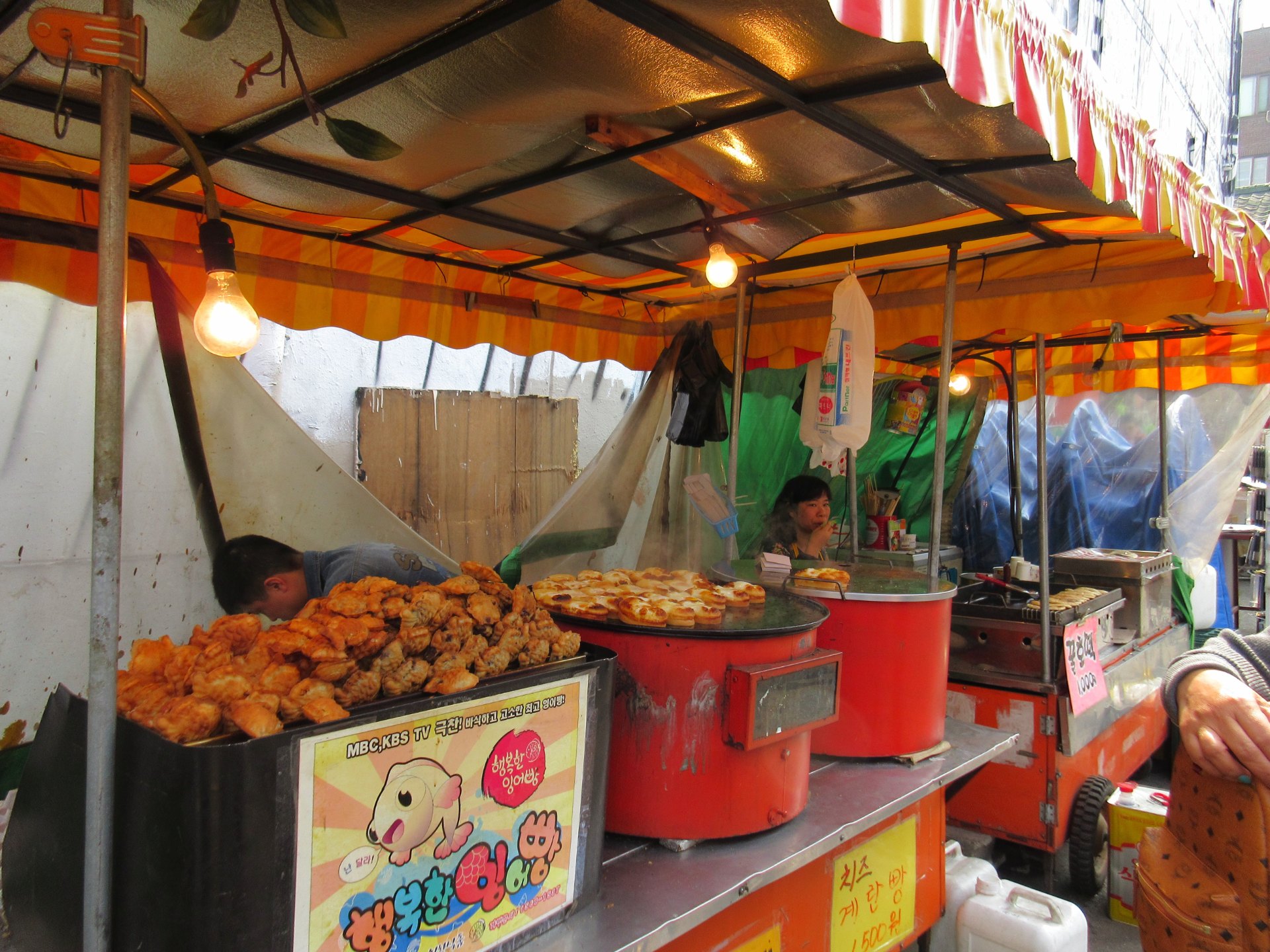
Seoul’s most famous stall street is Myeongdong (명동). Along the central street from Myeongdong Station (Line 4) toward Lotte Department Store’s main branch and the side alleys, stalls start setting up around 4 pm and are most numerous between 5 and 9 pm. In winter the seasonal stars are hotteok, egg bread and croissant taiyaki.
The prices are tourist prices, though. Dailian’s survey (January 17, 2024) found hot dogs at 4,000 won, egg bread 4,000 won, roasted sweet potato 6,000 won, tteokbokki 5,000 won, 6 pieces of gimbap 6,000 won, corn cheese 6,000 won, squid skewers 10,000 won and lobster skewers 20,000 won. One office worker quoted paid 24,000 won for three items — figure on roughly double what a residential-street stall charges.
After the 2023 ‘rip-off’ backlash, Jung-gu district required stalls to display prices. Most now have price tags, but some still don’t, so at an unmarked stall ask ‘얼마예요?’ (eolmayeyo — how much?) before buying. Payment is mostly cash, and many stalls don’t take cards. More stalls accept QR payments like KakaoPay, but carrying a few 1,000- and 5,000-won notes is the winter stall etiquette.
Cheap Means Residential Streets and University Areas! Using the ‘Bungsegwon’ Map App, and the Convenience-Store Backup
✔ Finding a bungeoppang stall is a map-app job now
Korean has a word, 붕세권 (bungsegwon), a play on 역세권 (a station’s walking radius) that means ‘a place with a bungeoppang stall within walking distance’. The app of the same name, 붕세권 (on Google Play and elsewhere), is a user-submitted map of bungeoppang, ingeoppang and chrysanthemum-bread (국화빵) stalls near you. The secondhand-trading app 당근 (Danggeun, ‘Karrot’) launched its own bungeoppang map on November 26, 2024 and collected more than 3,000 reviews in ten days. Both are Korean-only, and stalls come and go, so assume that ‘listed’ can still mean ‘closed tonight’.
Aim for station exits in university and residential areas. As the 3-for-2,000-won report from Konkuk University station (건대입구) shows, student districts like Hongdae, Sinchon and Kondae cost less than half of Myeongdong for the same taste. For hotteok, Namdaemun Market’s ‘vegetable hotteok’ is the famous one — a savory variation stuffed with vegetables and glass noodles, fried on a griddle from dough that starts proofing at 6 am.
The insurance for a night with no stall in sight is the convenience store. From October, GS25 sold roasted sweet potatoes at 2,000 won each (3 for 4,800 won through October 31), red bean steamed buns (팥호빵) from October 15, and a hot Americano for 1,000 won. Grab a sweet potato and a bun on the way back to the hotel and you still get the taste of a Korean winter on a stall-less day.
Where to Eat? Map and Summary — Myeongdong’s Stall Street and Namdaemun Market’s Vegetable Hotteok
To sum up: Seoul’s winter street snacks are ‘November to February, bungeoppang 3 for 2,000 won, hotteok 2,000 won, fish cake 1,000–1,500 won a skewer, and Myeongdong at double’. Street stalls have no names or reviews, so no stall meets this site’s Google Maps bar (★4.5 or higher with 100+ reviews). Instead, here are Seoul’s most-reviewed hotteok stand (★4.2 with 1,733 reviews — noted as below the bar) and the starting point of the stall street. Ratings are as of September 17, 2026.
- Namdaemun Vegetable Hotteok (남대문 야채호떡) — Google ★4.2 (1,733 reviews, below the bar) · 12 Namdaemun-ro, Jung-gu · about 3 min on foot from Hoehyeon Station (Line 4) · from 8:00 · vegetable and honey hotteok 2,500 won each (visitor reviews) · cash
- Myeongdong stall street (명동 노점거리) — Myeongdong Station Exit 6 (Line 4) to Lotte Department Store main branch · sets up around 4 pm, peaks 5–9 pm · egg bread 4,000 won, roasted sweet potato 6,000 won (January 2024 survey) · mostly cash
FAQ
When are Seoul’s street snacks available?
Roughly November to February. Stalls appear outside stations once temperatures drop into the single digits and thin out in March. Convenience stores start selling roasted sweet potatoes and steamed buns in mid-October.
How much is bungeoppang?
Per January 2026 reports, the norm is 1,000 won each or 3 for 2,000 won. Red bean wholesale prices roughly doubled in two years (40 kg from 364,873 to 726,600 won), so the old 2-for-1,000 price hasn’t come back.
What’s the difference between bungeoppang and ingeoppang?
Bungeoppang (붕어빵) is a thicker wheat-batter pastry; ingeoppang (잉어빵) mixes glutinous rice and oil into the batter for a thin, crispy shell with red bean right to the tail. Prices are about the same.
Can I pay by card at a stall?
Often not. More stalls take QR payments like KakaoPay, but bring 1,000- and 5,000-won notes. Price display is mandatory in Myeongdong, so at a stall without a tag, ask the price before buying.
Is the fish cake broth free?
At most stalls it’s free for buyers, but since winter 2024 some charge 100 won per paper cup or 500 won for broth alone. Ask first to be safe.
- ‘1,000 won per bungeoppang’ — customers walk away as red bean wholesale prices run 65% above the five-year average (Money Today, 2026-01-20)
- Winter street snacks bungeoppang and hotteok get pricier on surging import prices (Newspim, 2026-01-04)
- ‘1,000 won too expensive? There’s no profit’ — bungeoppang vendors’ tears (Korea Economic Daily, 2025-11-28)
- Myeongdong’s rip-off prices aren’t over — a stall price survey (Dailian, 2024-01-17)
- Street fish cake broth now charged: ‘500 won a cup, 500 won for takeout’ (Seoul Shinmun, 2024-12-21)
- Convenience stores kick off winter season — GS25 steamed buns and roasted sweet potatoes (ET News, 2025-10-16)
- Cold snap lifts winter snacks — GS25 roasted sweet potato sales up 176% (Money Today, 2025-10-20)
- Trying Danggeun’s ‘bungeoppang map’ (Today Economic)
- Namdaemun Market official site: Vegetable Hotteok
How verified: reports by Money Today (2026-01-20), Newspim (2026-01-04), Korea Economic Daily (2025-11-28), Dailian (2024-01-17), Seoul Shinmun (2024-12-21) and ET News (2025-10-16), the Namdaemun Market official site and Google Maps ratings, checked online on 2026-09-17. Stall prices vary by vendor.