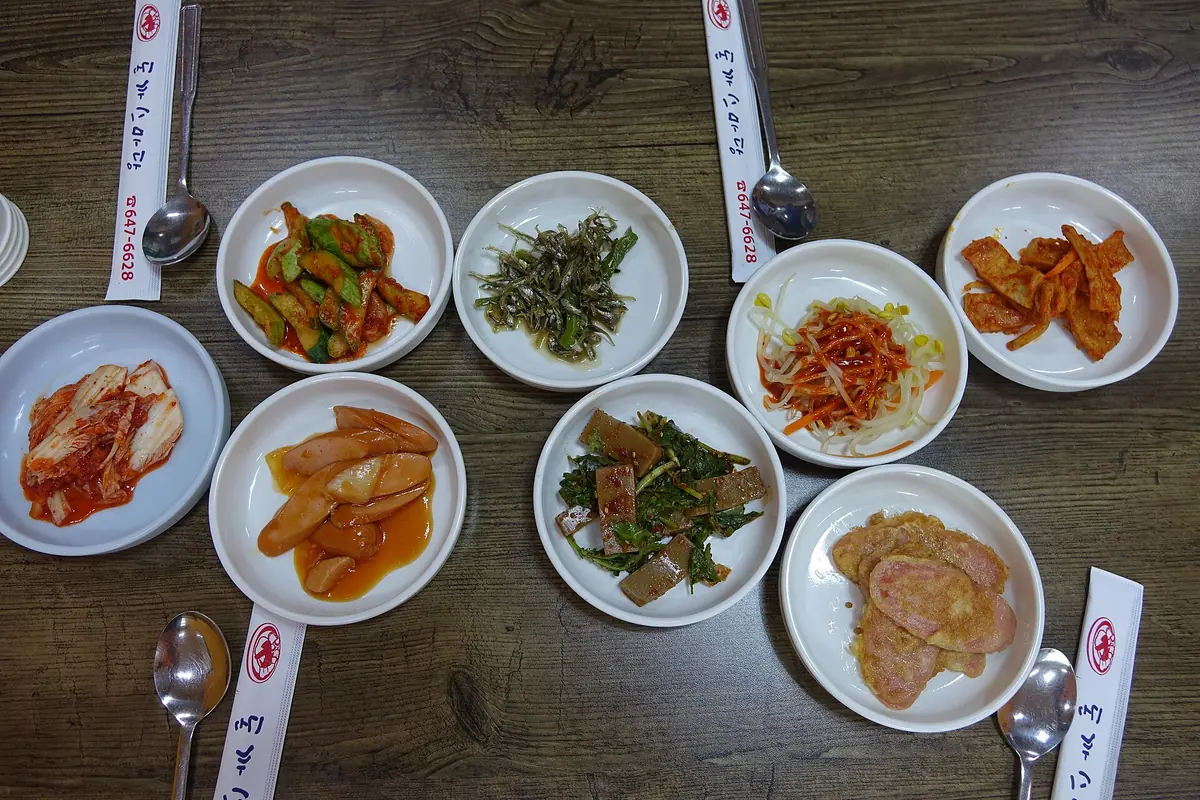
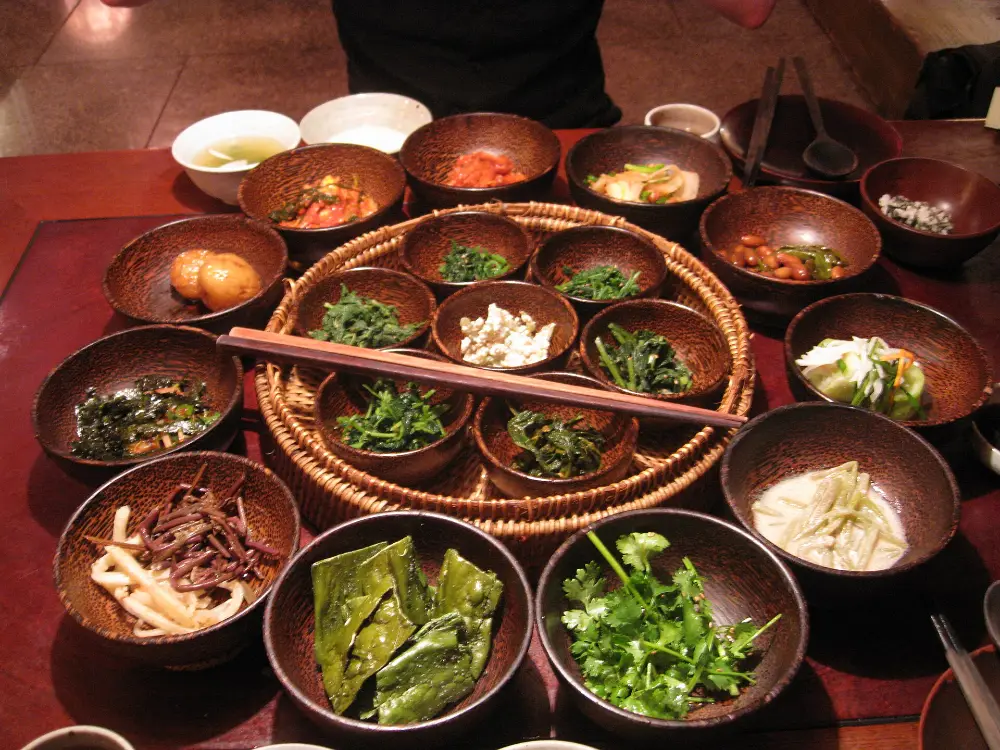
- Order one dish and a spread of small plates arrives with it: kimchi, seasoned vegetables, sometimes …
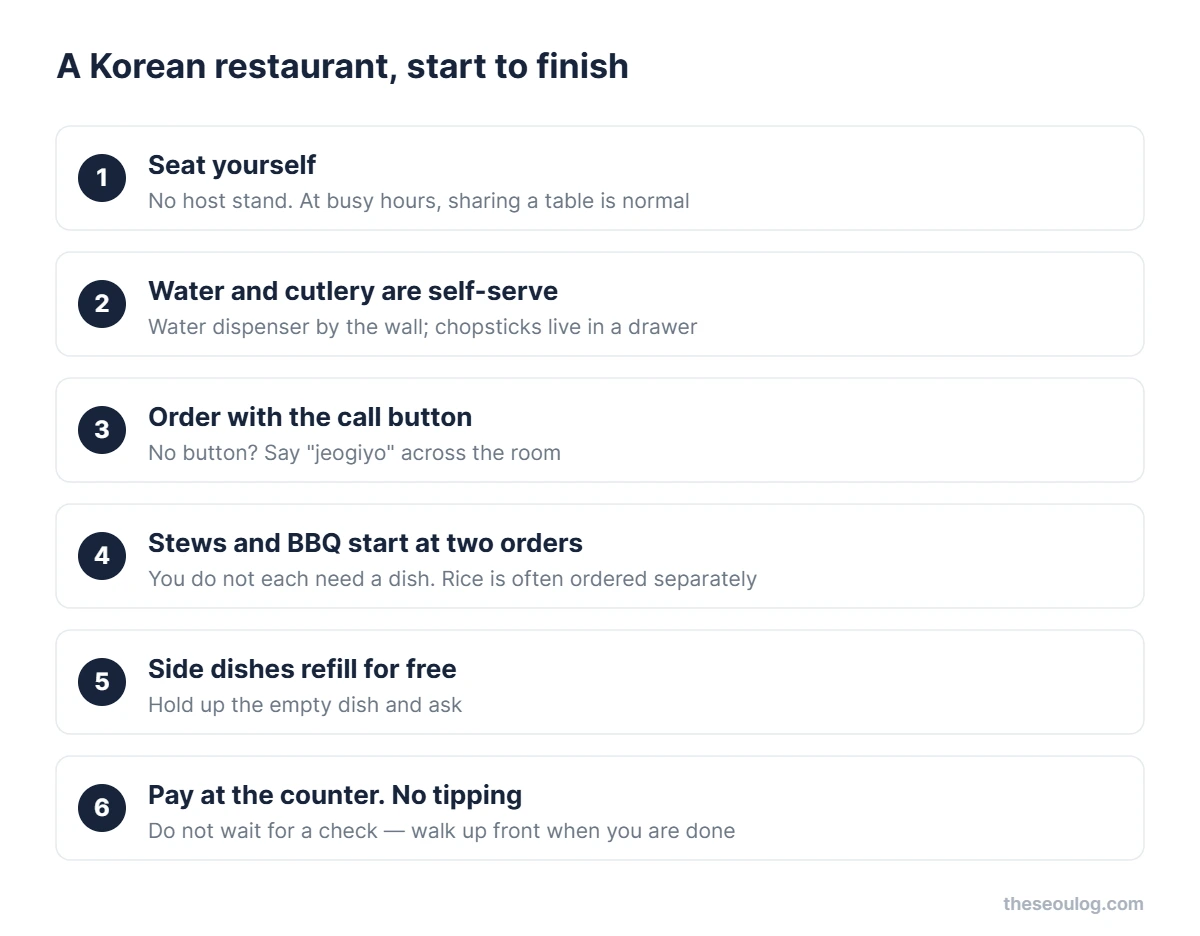
- No server will bring you water.
- Most tables have a small wireless call button on the edge.
Who this is for
- Anyone who’s sat in a Korean restaurant waiting for water that never came
- People worried the unordered side dishes will show up on the bill
- Solo travelers wondering whether they can walk into a BBQ place alone
Most of what feels strange in a Korean restaurant is structure, not etiquette.
Nobody brings water because the dispenser is in the corner and it’s yours to use. Nobody checks on your table because there’s a call button. Almost every moment that reads as inattentive service is simply a different division of labour.
“So what do I need to know going in?” Once that clicks, Korean restaurants become unusually relaxing places to eat. What you’re allowed to help yourself to is decided in advance. Ten points—let’s get into it.
- 1. Plates You Never Ordered! The Side Dishes Are Free—and Refillable
- 2. No Server Is Coming With It! Water Is Self-Serve
- 3. Sit Quietly and You’ll Be Ignored! Press the Call Button (or Shout)
- 4. Check the Side of the Table! Cutlery Hides in a Drawer
- 5. Sharing One Stew Is Fine! Stews and BBQ—Two-Portion Minimum
- 6. Take the Slip to the Door! Pay at the Counter, Not the Table
- 7. A Small Nod Is Plenty! Table-Sharing at Busy Hours
- 8. Cross-Legged Is Fine! Floor Seating—Shoes Off
- 9. Staff May Chase You to Return It! No Tipping. Ever.
- 10. “Honjayeyo” Gets You a Seat! Fast Turnover and Solo Dining (Honbap)
1. Plates You Never Ordered! The Side Dishes Are Free—and Refillable
✔ Order one dish and a spread of small plates arrives with it
Kimchi, seasoned vegetables, sometimes fish cakes or a little pancake. These are banchan (반찬), and they’re included in the price of your meal.
Better yet, at most everyday restaurants they’re refillable at no charge. Just ask: “Banchan deo juseyo” (반찬 더 주세요—more side dishes, please). Many places have a self-serve banchan station; help yourself.
✔ Got this far? Then this is your next move. “Korean Cafe Culture—the Unwritten Rules” is the step after.
2. No Server Is Coming With It! Water Is Self-Serve
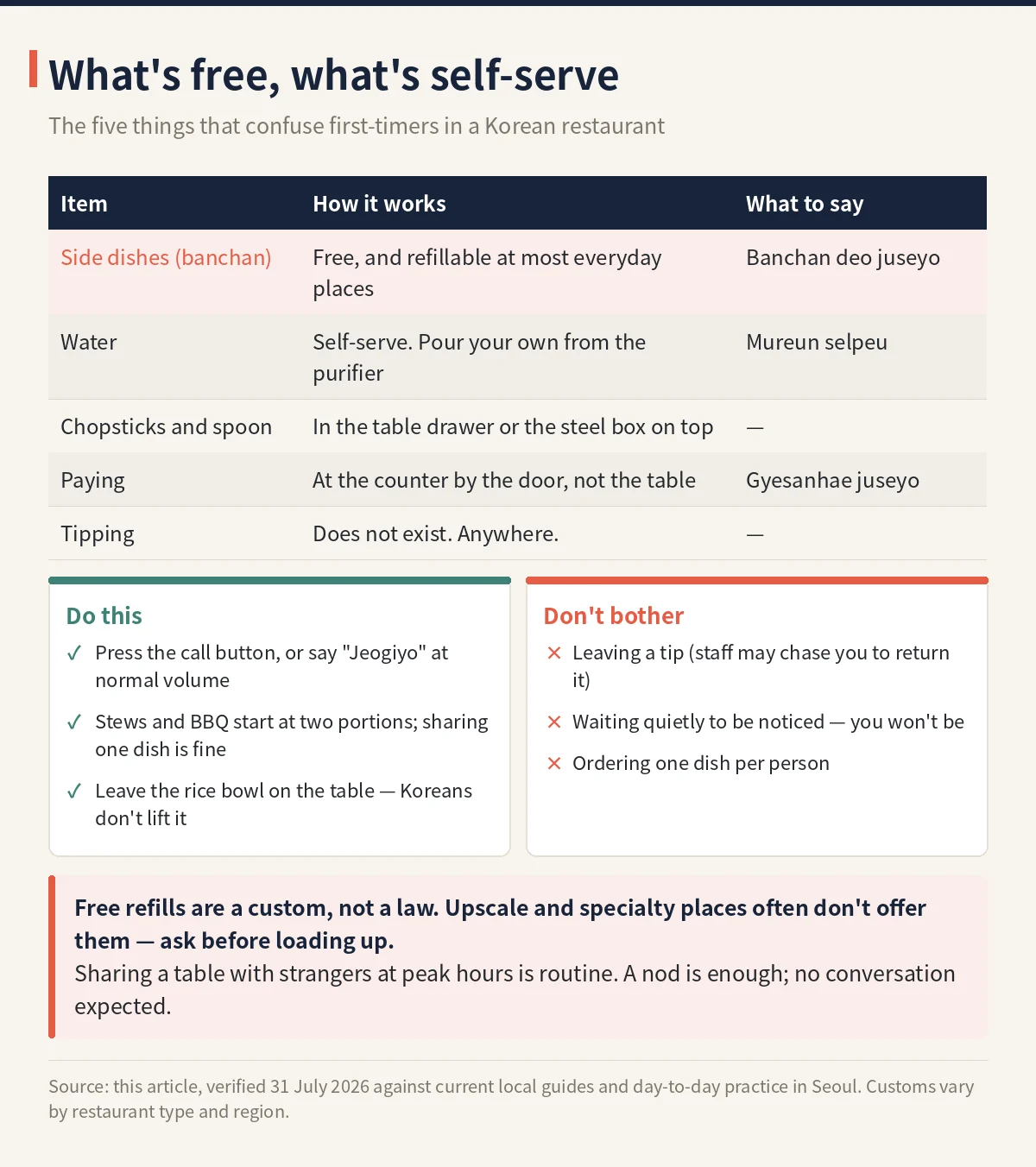
| Situation | How Korea does it |
|---|---|
| Water | Self-serve — the purifier is in the corner |
| Banchan (side dishes) | Free by default, refills usually welcome |
| Getting the staff | Table bell, or call out “jeogiyo” — waiting silently gets you nowhere |
✔ No server will bring you water
The standard setup is a water purifier or a small fridge in the corner—grab a metal cup and pour your own. Cups are stacked by the purifier or sitting in a holder on your table.
Look for the sign “물은 셀프” (mureun selpeu—water is self-serve). This is normal in Korea, but it may feel unfamiliar at first—it’s not neglect, it’s the system.
3. Sit Quietly and You’ll Be Ignored! Press the Call Button (or Shout)
✔ Most tables have a small wireless call button on the edge
Press it and a server appears. Don’t be shy—that’s exactly what it’s for.
No button? Call out “Jeogiyo!” (저기요—excuse me!) at full conversational volume. In Korea, staff wait to be called; sit quietly and you’ll be politely ignored. To order, pointing at the menu plus “Igeo juseyo” (이거 주세요—this one, please) works every time.
4. Check the Side of the Table! Cutlery Hides in a Drawer
✔ Can’t find chopsticks or a spoon?
Check the side of your table—there’s usually a slim built-in drawer—or the stainless-steel box sitting on top. Napkins are in there too.
The Korean setup is a long spoon (sutgarak) for rice and soup, and flat metal chopsticks (jeotgarak) for everything else. One local point: the rice bowl stays on the table—Koreans don’t lift it while eating.
5. Sharing One Stew Is Fine! Stews and BBQ—Two-Portion Minimum
✔ Stews and barbecue are built for sharing
So many restaurants set a two-portion minimum. Dishes like dak-hanmari (chicken hot pot) or gamjatang (감자탕, pork-bone stew) often can’t be ordered for one.
Watch for “2인분부터” (from two portions) or “2인 이상” (two people or more) on the menu. The flip side: there’s no one-dish-per-person rule. Two people sharing one stew plus rice—“gonggibap” (공기밥)—is completely normal.
6. Take the Slip to the Door! Pay at the Counter, Not the Table
✔ Take the bill slip to the register by the door
Table-side payment barely exists; some casual soup joints (gukbap places) even have you pay first.
If in doubt: “Gyesanhae juseyo” (계산해 주세요—check, please). Credit cards are accepted at virtually every restaurant, though it’s smart to carry some cash for market stalls.
7. A Small Nod Is Plenty! Table-Sharing at Busy Hours
✔ Being seated across from a stranger is routine
At a packed lunch spot, hapseok (합석) just happens. A small nod as you sit is plenty; no conversation is expected.
The unspoken deal: everyone eats, then promptly frees the seat for the next hungry person.
8. Cross-Legged Is Fine! Floor Seating—Shoes Off
✔ Traditional restaurants often have low tables on a raised floor
Take your shoes off at the entrance and leave them on the rack or by the step.
Wear slip-on shoes if a traditional place is on your list. Sitting cross-legged or shifting position is fine—nobody expects visitors to kneel formally.
9. Staff May Chase You to Return It! No Tipping. Ever.
✔ US readers, this one’s for you
Korea has no tipping culture. Not at restaurants, not in taxis, not for delivery. There’s no tip line on card receipts, no percentage math, no exceptions to memorize. Leaving cash on the table will confuse staff, who may chase you down to return it.
Gratitude is verbal here. After a good meal, “Jal meogeosseumnida” (잘 먹었습니다—I ate well / thank you for the meal) said on your way out earns real smiles.
Find the place and its hours in Naver Map, not Google. A few older restaurants are still cash-only, so it’s worth reading where to change money before you go looking for one.
10. “Honjayeyo” Gets You a Seat! Fast Turnover and Solo Dining (Honbap)
✔ Korean restaurants run fast
Food arrives quickly, people eat efficiently, and lingering long after finishing—especially with a line outside—is frowned upon. Cafes are where Koreans go to sit for hours.
Solo dining, or honbap (혼밥), is more mainstream every year. Say “Honjayeyo” (혼자예요—just one) and you’ll be seated without fuss. Just remember the two-portion minimum at BBQ and stew places—eating alone, I’d steer you toward soup, noodle, and rice-bowl spots and save the BBQ craving for a night with company.
- Banchan is free and usually refillable; water and cutlery are self-serve (check the table drawer)
- Call staff with the button or “Jeogiyo” — waiting silently gets you nowhere
- Stews and BBQ often require two portions; sharing one dish is fine
- Pay at the counter, and never tip — anywhere, for anything
- Two phrases carry you far: “juseyo” (please give me) and “Jal meogeosseumnida” (thanks for the meal)
✔ None of this is a test you can fail
Press the button, point at the menu, skip the tip—locals will read you as someone who gets it, and that’s most of what “etiquette” here amounts to.
When you’re unsure whether something would be rude abroad, the gap is usually not in the local manners but in how the room is designed. Read the design and most of the hesitation disappears. Start with one loud “Jeogiyo!”
Frequently asked questions
Are the side dishes really free? Can I get more?
Yes. The small plates that arrive unordered are banchan, and they are free at virtually every Korean restaurant. Most places refill them on request — say “반찬 더 주세요” (banchan deo juseyo). Some restaurants have a self-serve banchan station instead, in which case you help yourself.
How do I get a server to come over?
Press the call button on the edge of the table. If there is no button, say “저기요” (jeogiyo) loudly. This feels rude to most visitors, but in Korea the opposite is true — servers will not check on you unprompted, so not calling out is how you end up ignored.
Can I eat alone at a Korean restaurant?
Yes. Solo dining, honbap, has become normal, and “혼자예요” (honja-yeyo — just me) is all you need to say. The exception is stew and BBQ places with a two-portion minimum, so as a solo diner aim for soup-and-rice or set-meal restaurants.
Do I tip in Korea?
No — never, anywhere. There is no tipping culture in restaurants, taxis, or hotels, and offering money usually creates confusion rather than goodwill. Saying “잘 먹었습니다” (jal meogeotseumnida) on the way out does far more.
Do I pay at the table or at the counter?
At the counter by the door. Take your bill, walk over, and pay there — waving a card at your table will not get you anywhere. Cards are accepted almost everywhere, but older restaurants and stalls inside traditional markets are sometimes cash-only, so carry a small amount of won.
This article is based on the official information below. Rules can change, so please check the original before you travel.
· Korea Tourism Organization official site
Information as of 2026-08-13 (official listings and Google Maps as shown at publication). Updated when things change.