- Myeongdong, Seoul’s main shopping district, packs dozens of government-licensed private exchange boo…
- Korean won is a low-volume “exotic” currency at US banks and airport kiosks, and they price it accordingly.
- Incheon Airport’s bank counters are noticeably better than US airports but still several percent wor…
Who this is for
- Anyone planning to “just change some at the airport before I go”
- People standing in front of a whole row of Myeongdong booths with no idea which door to pick
- Anyone who agonises every trip over how much cash to carry
There’s a money detail that gets overlooked on most Seoul trips. Here’s the thing: most of what you lose exchanging currency is decided by where you do it, not by the exchange rate.
On the same day, with the same $1,000, a licensed booth in Myeongdong and an airport kiosk back home can differ by more than a hundred dollars. Nothing moved in the market. Only the counter changed—and a hotel night went with it.
“So where do I actually change money?” The good news is that the ranking has held steady for years. The numbers go stale by your next trip; the order doesn’t. Seoulog lined it up using 2026 spot-check rates—let’s get into it.
- 1. Within Half a Percent of Market! Why Myeongdong Booths Give Korea’s Best Rates
- 2. Losing 5–12% Before Boarding? Don’t Exchange at Home or at US Airports
- 3. $50–100 and No More! Incheon Airport Is for Day-One Cash Only
- 4. Set Up Before You Fly, or Load After You Land? Wise, Revolut and WOWPASS Compared
- 5. Korea Is 90%+ Cashless—So Why Does One Button Cost You 3–8%?
- 6. $70–150 for Three Days! How Much Cash Do You Actually Need?
1. Within Half a Percent of Market! Why Myeongdong Booths Give Korea’s Best Rates
✔ Competition does the work for you
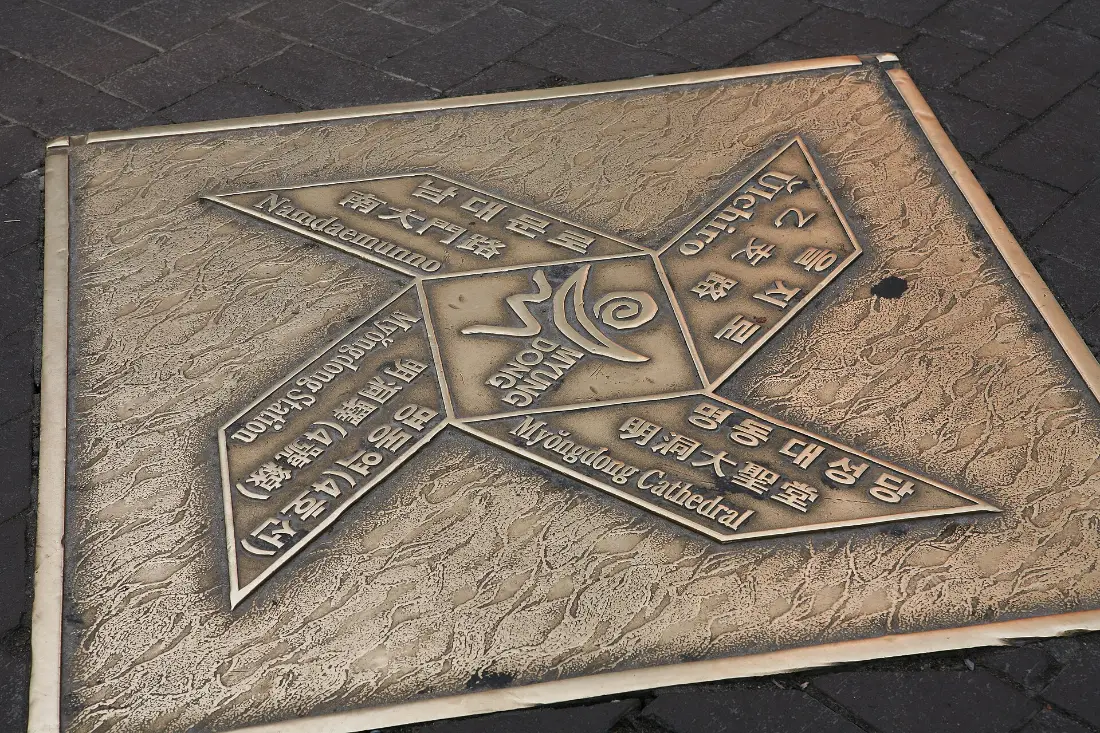
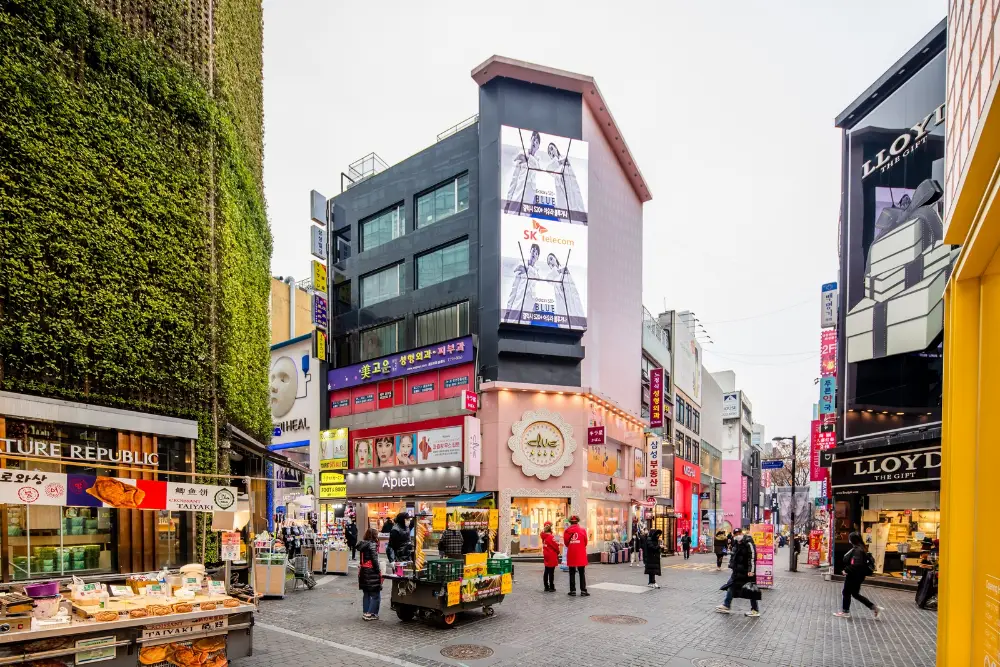
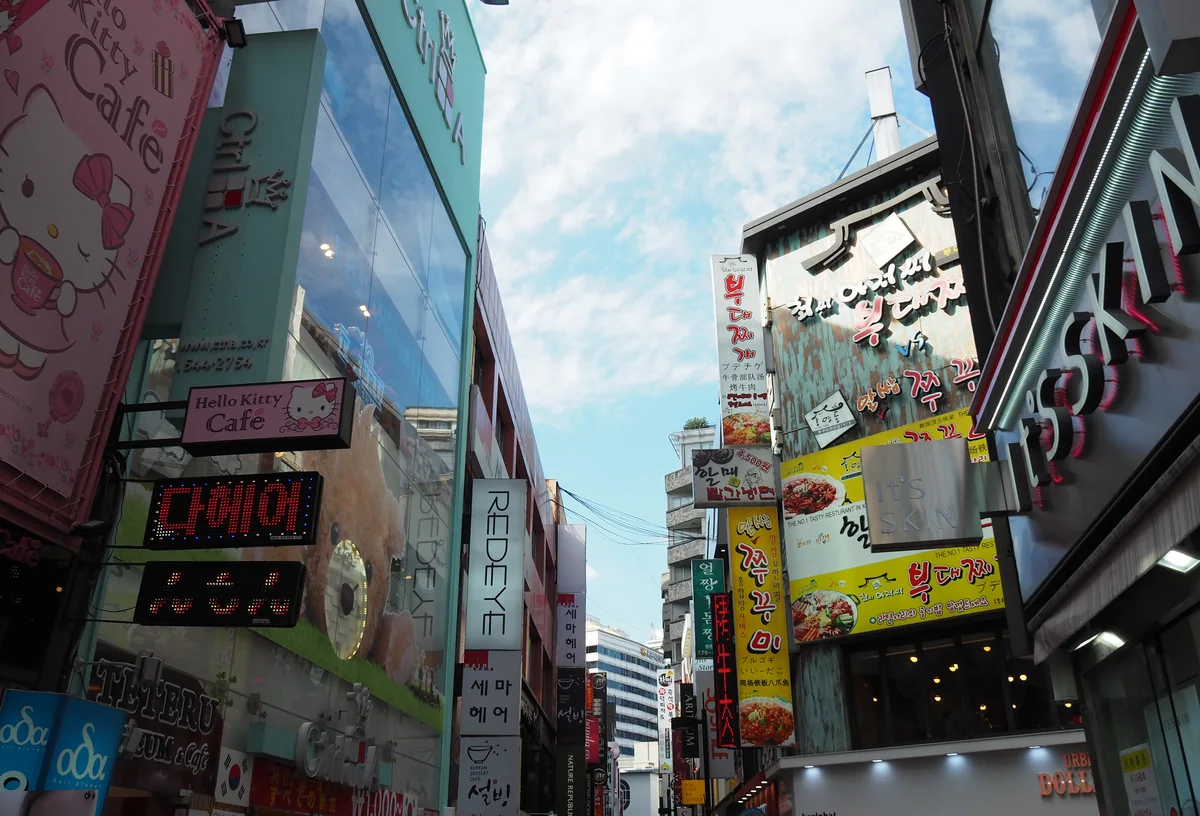
Myeongdong, Seoul’s main shopping district, packs dozens of government-licensed private exchange booths into a few blocks. Tourist demand is intense, competition is brutal, and the result is rates that sit remarkably close to the interbank market—in late-July 2026 spot checks, the best booths were within roughly half a percent of the market rate, with no separate commission.
Comparing them is easy. Each booth displays a lit board with its buying rate for USD. Walk past two or three, pick the biggest number, and you’re done. Look for a “수수료 없음” (susuryo eopseum—no commission) sign, and bring your passport; booths are required to check it.
Between the well-known booths, the difference on a few hundred dollars is pocket change. Don’t burn twenty minutes queuing at a famous one when the booth next door is nearly identical.
One caveat, though. If you’re only exchanging $100 or so, don’t make a special trip here for it—the savings over the airport won’t cover your subway fare and your time. Do it when you’re in Myeongdong anyway.
For reference, the market rate hovered around 1,390 KRW per US dollar in late July 2026 (about $0.72 per 1,000 KRW)—but rates move daily, so verify current rates before you fly.
✔ There’s another way to do this. Read it against “Where a Foreign Card Works and Where It Doesn’t” and you’ll see which fits you.
2. Losing 5–12% Before Boarding? Don’t Exchange at Home or at US Airports
✔ “Exotic” currency, exotic markup
Korean won is a low-volume “exotic” currency at US banks and airport kiosks, and they price it accordingly. Spreads of 5–12% off the market rate are routine at airport exchange counters—on $1,000, that’s $50–120 evaporating before you’ve even boarded.
The same logic applies in Singapore, Malaysia and the Philippines: unless you have access to an unusually competitive money changer at home, carrying clean USD bills to Seoul and exchanging in Myeongdong will almost always net you more won.
Rule of thumb: exchange nothing before departure beyond what makes you comfortable. The USD cash itself is the thing worth carrying.
3. $50–100 and No More! Incheon Airport Is for Day-One Cash Only
✔ Better than home, worse than town
Incheon Airport’s bank counters are noticeably better than US airports but still several percent worse than Myeongdong—spot checks have put the gap at around 5–7% off market.
The standard local playbook: exchange only what you need for arrival day—airport transport and a first meal, say $50–100 worth—then do your main exchange in Myeongdong once you’re in the city. Or skip the counter entirely with a WOWPASS kiosk at the airport (more on that below).
4. Set Up Before You Fly, or Load After You Land? Wise, Revolut and WOWPASS Compared
✔ Three cards, one verdict
Cash isn’t the only route. Multi-currency travel cards have become the default for many travellers, and in Korea they work extremely well.
| Card | What it does |
| Wise | Multi-currency debit card issued at home. Converts USD to KRW at close to the live market rate plus a small transparent fee. |
| Revolut | Similar model: convert USD to KRW in the app at near-market rates, then tap to pay. Watch for weekend markups on some plans. |
| WOWPASS | Issued from a kiosk after you land. Accepts USD cash directly for loading at rates near Myeongdong’s better booths, and has T-money transit built in. |
Wise and Revolut are the “set it up before you fly” option; WOWPASS is the “landed with a wallet full of USD” option. Any of the three beats an airport exchange counter, and all three sit within a couple of percent of the best Myeongdong booths.
5. Korea Is 90%+ Cashless—So Why Does One Button Cost You 3–8%?
✔ Your regular card covers most of the trip
Korea runs on cards: cashless payment share is estimated at over 90%, among the highest in the world. Convenience stores, cafes, taxis, restaurants—foreign-issued Visa and Mastercard work almost everywhere, so your regular credit card covers most of the trip (check your issuer’s foreign transaction fee, typically 0–3%).
6. $70–150 for Three Days! How Much Cash Do You Actually Need?
✔ Cash is for markets and street food
For typical sightseeing, cards handle nearly everything. Cash is mainly for traditional markets, street-food stalls and the occasional small mom-and-pop restaurant.
One quirk to remember: regular T-money transit cards are topped up in cash at convenience stores (though more subway machines now take foreign cards). WOWPASS users sidestep this, since transit is built in.
A reasonable target is $70–150 worth of won for a 3-day trip, more if markets and street food are a priority. Exchange only what you’ll spend—converting leftover won back to USD means paying the spread twice.
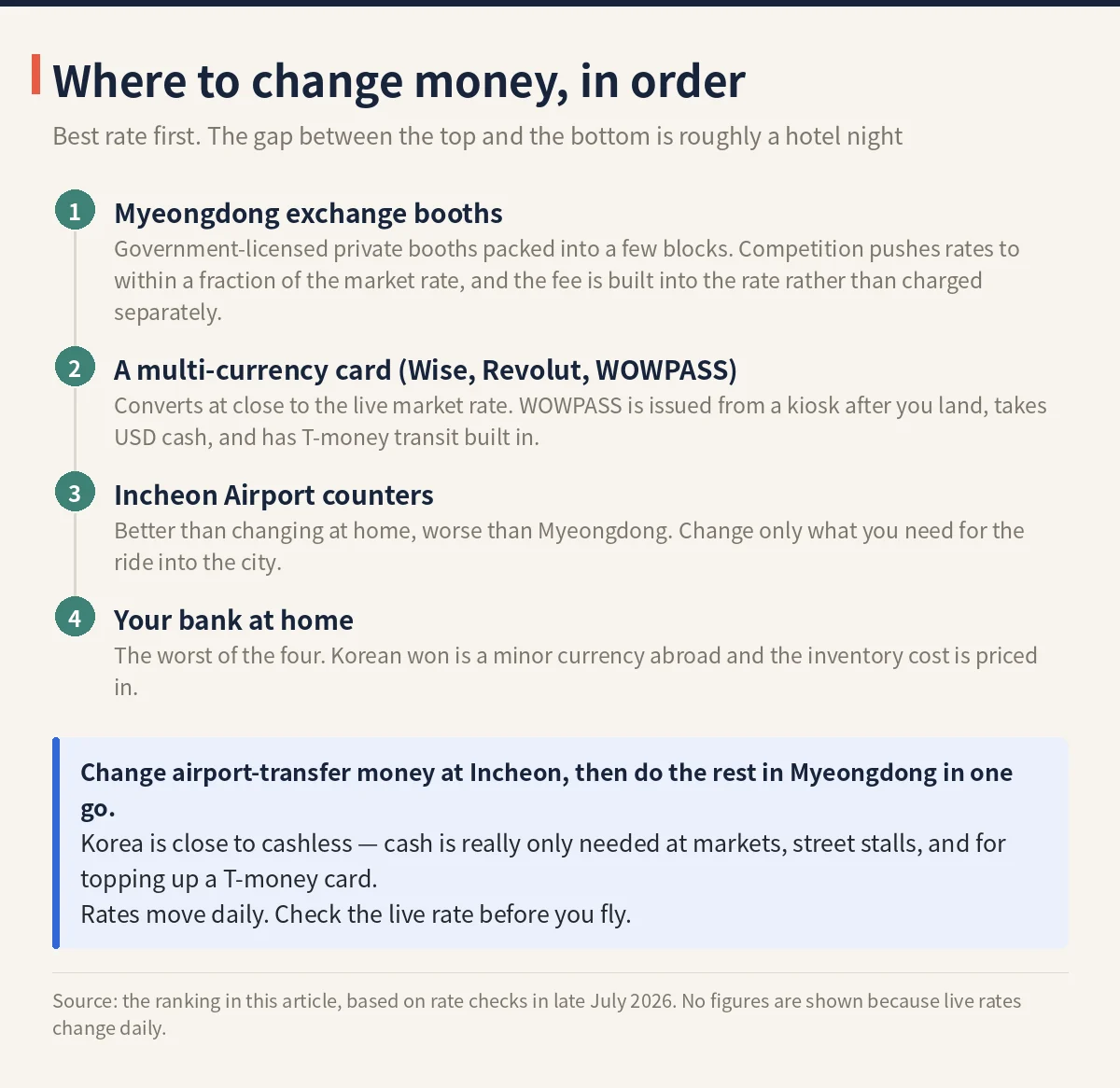
- Best-to-worst rates: Myeongdong licensed booths > Wise/Revolut/WOWPASS > Incheon Airport > home banks and US airports
- Bring USD cash; exchange the bulk of it in Myeongdong, not before departure
- Incheon Airport is fine for $50–100 of day-one cash only
- Korea is 90%+ cashless — Visa/Mastercard work almost everywhere
- Always pay in KRW, never USD, when a terminal offers the choice (DCC markup)
Truthfully, the biggest money leak isn’t picking the second-best booth—it’s tapping “USD” on a card terminal without thinking. Get the DCC habit right and you can be lazy about everything else on this page.
Rates move daily, but the pecking order of exchange channels barely moves at all. That order is the part worth remembering—give it one more look before you fly.
Frequently asked questions
Should I exchange dollars before I fly to Korea?
Only a token amount, if any. US banks and airport kiosks treat won as an exotic currency and price it accordingly, with spreads of 5–12% off the market rate. Bring USD cash and change the bulk of it at a licensed Myeongdong booth instead.
Is Incheon Airport a bad place to exchange money?
It is fine for day-one cash and poor for anything more — roughly 7% off the market rate in late-July 2026 checks. Change $50–100 there for transit into the city, then do the rest in Myeongdong.
How do I pick a Myeongdong booth, and do I need my passport?
Compare the USD figure on the street-facing boards and take the highest, and look for the 수수료 없음 (no commission) sign. Bring your passport — booths are required to check it. The gap between well-known booths is pocket change, so do not queue twenty minutes for a famous one.
Wise, Revolut, or WOWPASS — which should I use?
Wise and Revolut are the set-it-up-before-you-fly options. WOWPASS is issued from a kiosk after you land, accepts USD cash directly, and has T-money transit built in. All three sit within a couple of percent of the best Myeongdong booths and beat any airport counter.
How much cash do I actually need in Seoul?
Around $70–150 worth of won for a three-day trip, more if traditional markets and street food are a priority. Korea is over 90% cashless; the main cash-only holdouts are markets, some small restaurants, and T-money top-ups.
Should I pay in USD or KRW when the card terminal asks?
Always KRW. Choosing USD triggers dynamic currency conversion, where the payment processor sets the rate and adds a markup of several percent. Getting this habit right saves more than optimizing which booth you use.
Sources: late-July 2026 rate observations in Myeongdong and at Incheon Airport / WOWPASS official rate guide / Wise and Revolut published pricing / Bank of Korea cashless-payment statistics coverage
This article is based on the official information below. Rules can change, so please check the original before you travel.
· Korea Tourism Organization official site
Information as of 2026-08-12 (official listings and Google Maps as shown at publication). Updated when things change.