- Korean BBQ restaurants sell meat by the portion (il-in-bun), and most require at least two portions. There is no legal portion size: it is 120 to 200 g depending on the restaurant. Since 2013, menus must list the price per 100 g alongside the portion weight, so check that line before ordering.
- Price guide: Seoul’s average for 200 g of samgyeopsal (pork belly) is 21,321 won as of June 2026, up 4.3% from a year earlier. Soju is a standard 6,000 won a bottle. Two portions plus one soju for two people comes to 48,642 won; four portions plus three sojus is 103,284 won by one newspaper’s estimate.
- The flow: sit down, order by headcount, let staff grill if they offer, refill lettuce and kimchi for free at the self-serve bar, finish with cold noodles or soybean stew, then pay at the counter. No tipping. Two Google Maps 4.7-star restaurants sit near Dongdaemun History and Culture Park Station (as of 2026-09-17).
Who this is for
- You have never been inside a Korean BBQ restaurant and the ordering rules are a mystery
- You have been told “two portions minimum” and froze, or you are traveling solo
- You want the actual number two people spend on dinner before you go
The single most common dinner question we get from Korea travelers is “I walked into a BBQ place and had no idea how to order.” A Korean-only menu, a “200 g” next to the price, and a server saying “two portions minimum”: those three things freeze a lot of people.
Once you know the rules, Korean BBQ might be the friendliest grilled-meat experience anywhere. Staff cut the meat with scissors for you, lettuce and kimchi refills are free, and nobody expects a tip.
The catch is that a “portion” means something different at every restaurant, and not knowing that costs you money. Since the government scrapped its serving-size standard in 1993, a portion can be 120 g at one place and 200 g at the next. That is why menus have had to show the price per 100 g since 2013.
This guide walks you from sitting down to paying, then uses Seoul’s average price (21,321 won per 200 g) to work out what two people actually spend. At the end you get two Google Maps 4.7-star restaurants by Dongdaemun History and Culture Park Station, so tonight’s dinner is already picked!
“Two Portions Minimum” Is the Rule! How Ordering Works at a Korean BBQ Restaurant—and Why a Portion Is 120 to 200 g
✔ Order by headcount. Two people, two portions, then add
Korean BBQ restaurants sell meat in portions called il-in-bun (일인분), and you start with one per person. Most places set a two-portion minimum, so even a solo diner orders two. If you want more, say “il-in-bun deo ju-se-yo” (일인분 더 주세요, one more portion) and it comes mid-meal.
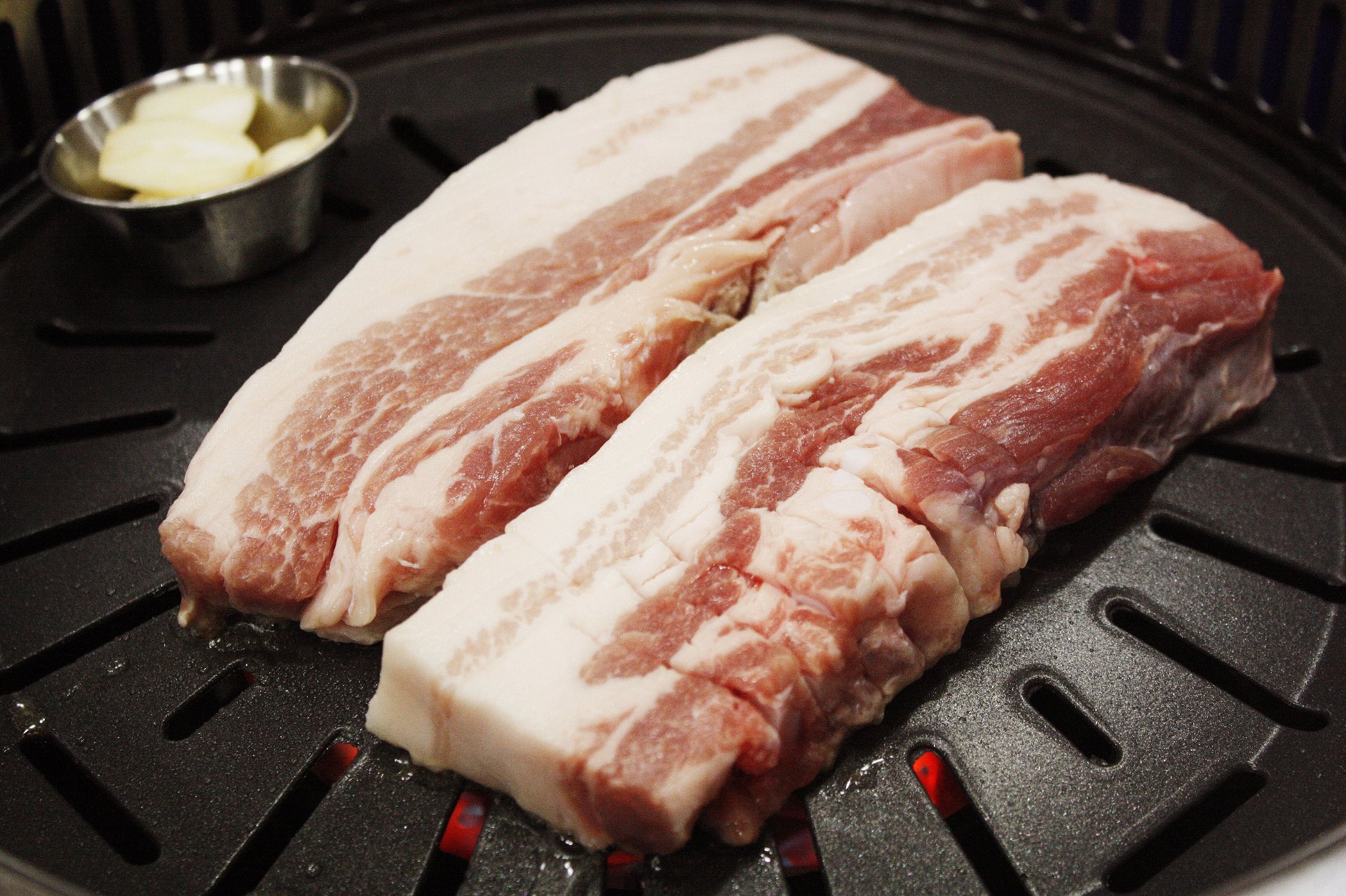
Here is the part worth knowing: a portion weighs something different at every restaurant. After the government abolished its food serving-size standard in 1993, restaurants were free to decide. For samgyeopsal that means 120 to 200 g, with most places now landing somewhere in the 150 to 180 g range. The old 200 g standard has become the exception.
That is why, since January 2013, menus have been required to show the price per 100 g next to the portion weight and price. A line like “삼겹살 1인분(180g) 16,000원” is exactly that. When you compare two restaurants, the per-100 g number is the one that matters. Seoul’s overall average is 21,321 won per 200 g as of June 2026 (Korea Consumer Agency), up 874 won or 4.3% from a year earlier.
| Order | Won | Note |
|---|---|---|
| Samgyeopsal, 2 portions (200 g equivalent x 2) | 42,642 | Seoul average 21,321 won x 2 |
| Soju, 1 bottle | 6,000 | Standard restaurant price |
| Total (2 portions + 1 soju) | 48,642 | About 24,000 won a head |
| 4 portions + 3 sojus | 103,284 | Segye Ilbo’s estimate, a night-out scale |
✔ Put one dinner into the whole trip budget Spending 50,000 won on BBQ for two is a real share of a four-day food budget. The 『Korea trip budget guide』 breaks down a $600 budget trip and a $1,000 mid-range trip, so you can see where this meal fits.
It’s Not Just Pork Belly! Reading the Menu, and the Reality of 6,000-Won Soju
✔ Five cuts cover almost every menu
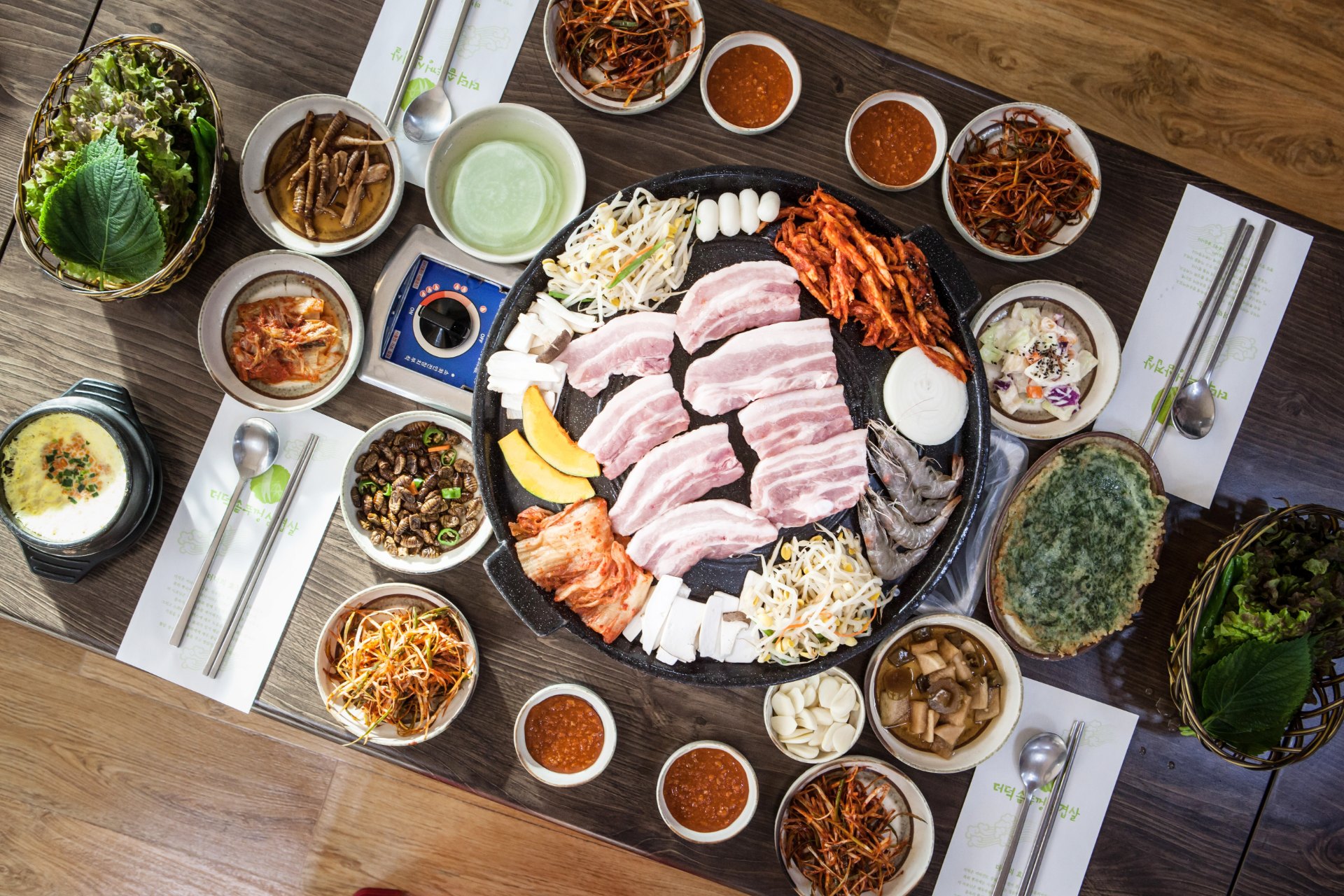
Learn five words and you can read most pork BBQ menus: samgyeopsal (삼겹살, pork belly), moksal (목살, pork shoulder), hangjeongsal (항정살, pork jowl), galmaegisal (갈매기살, skirt), and yangnyeom (양념, marinated). “Saeng” (생) in front means fresh, “sukseong” (숙성) means dry-aged. For a first visit, two portions of samgyeopsal plus one of moksal is the combination that never fails.
Drinks: soju (소주) is a standard 6,000 won a bottle in restaurants, and beer (맥주) is about the same. Segye Ilbo’s estimate put two people eating four portions (800 g) with three bottles of soju at 103,284 won. Scale it back to two portions and one soju and it is 48,642 won, around 24,000 won a head. Finishing the meat before you add more always works out cheaper.
The finishing course (siksa, 식사) is where cold noodles (naengmyeon, 냉면), soybean stew (doenjang-jjigae, 된장찌개) or kimchi fried rice (김치볶음밥) made with your leftover meat come in. After the grilling is done, staff ask “siksa-neun-yo?” (식사는요?, and for the meal?). Order it then. You do not have to order everything up front.
Scissors, Then Lettuce! How to Grill, How to Eat, and What “Free Refills” Actually Covers
✔ If staff grill for you, let them. If not, tongs and scissors
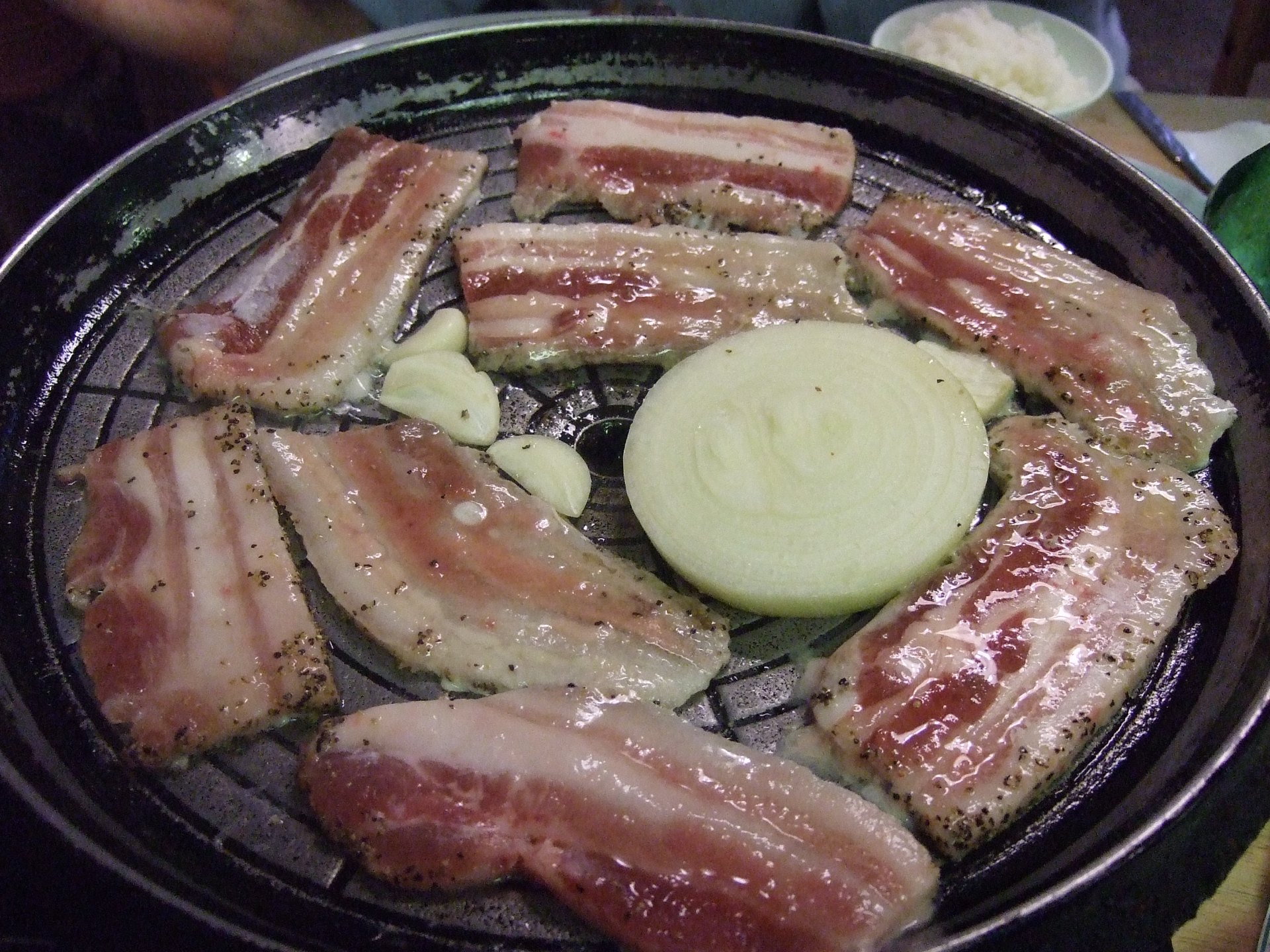
At restaurants where staff do the grilling (reviews mention “구워줘요”, meaning they grill it for you), keep your hands off and let them work: it tastes better. At self-grill places, sear the thick slabs on both sides, cut them into bite-sized pieces with the scissors, and push them to the edge of the grill to stay warm. Kimchi and onion go on any empty spot on the grill, where they soak up the pork fat.
To eat, put a piece of meat, some ssamjang (쌈장) and grilled garlic on a lettuce (상추) or perilla (깻잎) leaf and fold it into one bite. That wrap is called ssam (쌈). The small side dishes (banchan, 반찬) are free, and at most places lettuce, kimchi and bean sprouts can be refilled as often as you like from the self-serve bar (셀프바). To ask staff, “sangchu deo ju-se-yo” (상추 더 주세요) gets you more lettuce.
Ordering is done with the table call button (호출벨) or, increasingly, a tablet. Tablet restaurants usually let you switch to English or Japanese, so you just pick cuts and quantities without reading Korean. Daetongnyeong Samgyeopsal near Dongdaemun History and Culture Park Station is one where reviews keep mentioning the tablets.
Pay at the Counter, No Tip! The 50,000-Won Reality for Two, and Escape Routes for Solo Diners
✔ You do not pay at the table. Take the bill to the register
At a Korean BBQ restaurant you take the bill (계산서) left at your table to the counter (카운터) and pay there. Nearly every restaurant takes cards, including foreign-issued Visa and Mastercard. There is no tipping culture and tax is already in the menu price, so the total on the bill is what you pay.
Putting numbers on it: order two portions at Seoul’s average of 21,321 won per 200 g, add one soju, and you are at 48,642 won. Even with cold noodles or stew to finish, two people land in the 50,000 to 60,000 won range. The 100,000-won-plus scenario of four portions and three sojus is a night-out scale, more than a travel dinner needs.
Solo travelers hit the two-portion wall hardest. Three ways around it, in order of practicality: order two portions and turn the leftovers into kimchi fried rice at the end; pick a restaurant with a lunch set (삼겹살 정식); or find a solo BBQ (honggogi, 혼고기) restaurant with small single grills. Searching “혼고기” in a map app near your hotel turns them up.
Where to Eat? Map and Recap—Two 4.7-Star Restaurants by Dongdaemun History and Culture Park Station
To recap, Korean BBQ is five steps: order by headcount, let them grill, wrap in lettuce, order the finishing course, pay at the counter. A portion is 120 to 200 g depending on the restaurant, so check the per-100 g price before you decide. Ratings are Google Maps as of September 17, 2026.
- Daetongnyeong Samgyeopsal (대통령삼겹살) — Google 4.7 (1,034 reviews), 249-24 Jangchungdan-ro, Jung-gu, about 5 minutes on foot from Dongdaemun History and Culture Park Station (Lines 2/4/5), open until 23:00, 20,000 to 30,000 won a head, tablet ordering
- Seouljip (서울집) — Google 4.7 (501 reviews), 2F, 6 Eulji-ro 44-gil, Jung-gu, about 5 minutes on foot from Dongdaemun History and Culture Park Station, open until 23:00, 20,000 to 50,000 won a head, beef and pork
FAQ
Can I eat at a Korean BBQ restaurant alone?
Yes, but most places require two portions, so you end up ordering two. Turn the leftovers into kimchi fried rice, pick a place with a lunch set, or look for a solo BBQ (혼고기) restaurant with single grills.
How many grams is a portion?
There is no legal standard. It is 120 to 200 g depending on the restaurant. Since 2013 menus must list the price per 100 g and the portion weight, so compare that line.
How much does samgyeopsal cost?
Seoul’s average is 21,321 won per 200 g as of June 2026 (Korea Consumer Agency), up 874 won or 4.3% from a year earlier. Soju is a standard 6,000 won a bottle.
Do lettuce and kimchi refills cost extra?
Usually no. Take them yourself at the self-serve bar, or say “sangchu deo ju-se-yo” (상추 더 주세요) and staff bring more.
Do I need to tip?
No. Tax is included in the menu price. Take the bill to the counter and pay there. Foreign-issued cards work at nearly every restaurant.
- Two people, four portions of samgyeopsal, 100,000 won: a Seoul dining cost estimate (Segye Ilbo, 2026-08-01)
- Pork got cheaper but restaurant prices did not: Seoul samgyeopsal tops 20,000 won a portion (NEWS-WA, 2026-08-10)
- Samgyeopsal ingredient costs, Korea Consumer Agency data (Seoul Shinmun, 2026-08-25)
- Why a portion of meat weighs something different at every restaurant (Waeng, Daum)
- Korea Consumer Agency price portal: dining prices by city and item
How this was checked: Korea Consumer Agency’s Seoul dining price data for June 2026, reports by Segye Ilbo and Seoul Shinmun, and Google Maps ratings were verified online (2026-09-17). Prices are averages and vary by restaurant.