- K-ETA — the Korea Electronic Travel Authorization — is the online permission visa-free travellers no…
- This is where the confusion lives.
- Exempt travellers may still apply for K-ETA voluntarily.


Who this is for
- Anyone who heard “K-ETA is gone” and never heard of the arrival card
- People planning a Korea trip from January 2027 onward
- Anyone who visits twice a year or more and wants to stop filling in forms
“K-ETA has been waived” is accurate but incomplete. What was waived is K-ETA. The entry process itself did not disappear.
There’s also a paradox almost nobody mentions. Even if your country is on the exemption list, applying for K-ETA voluntarily exempts you from filling in the arrival card. Getting the thing you don’t need saves you the thing you do.
And the waiver has an expiry date: 31 December 2026. “So what do I do if I’m going in 2027?” If you’re planning a trip over New Year or into 2027, that becomes a practical problem rather than a technicality. Here’s the whole picture—let’s get into it.
Contents
1. Where things stand
2. What is waived, and what is not
3. The paradox — when applying anyway pays off
4. What happens after 2026
5. While you are at it
6. Things people confuse
7. Frequently asked questions
1. Waived for 22 Countries and Regions! Where Things Stand
✔ K-ETA is the Korea Electronic Travel Authorization
It’s the online permission visa-free travellers normally apply for before flying to Korea. Since April 2023 it has been temporarily waived for 22 countries and regions, Japan, Taiwan and the United States among them.
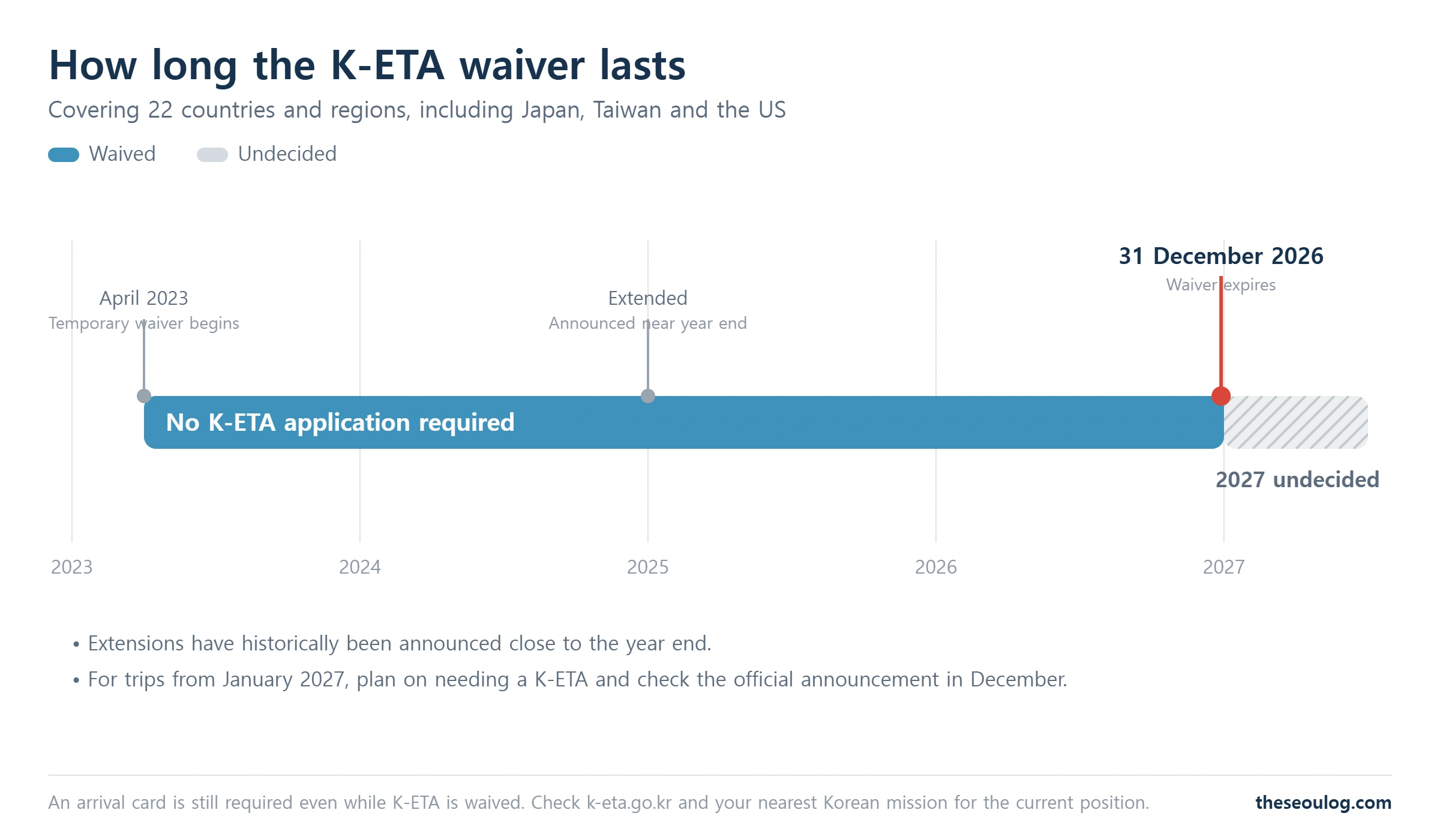
The waiver has been extended repeatedly and currently runs to 31 December 2026. Passport holders from eligible countries entering within that period can board without applying.
If you already hold a valid K-ETA, it remains valid until its own expiry. The waiver doesn’t cancel it.
✔ Got this far? Then this is your next move. “Korea Entry 2026: The One Thing You Still Must Do” is the step after.
2. Everyone Still Needs an Arrival Card! What Is Waived, and What Is Not
| Item | Current status |
| K-ETA (travel authorization) | Waived for 22 countries and regions until 31 December 2026 |
| Arrival card (e-Arrival Card) | Not waived. Everyone needs one |
| Visa | Visa-free short stays continue under existing agreements |
| Customs declaration | Unchanged for those who need to declare |
✔ This is where the confusion lives
K-ETA may be waived, but you still need an arrival card. Paper forms are handed out on the plane, but you can now submit online in advance—the e-Arrival Card, which opens a few days before entry.
Filling it in beforehand beats hunting for a pen at 30,000 feet. We have a separate guide to completing the e-Arrival Card.
3. Worth It at Two Visits a Year? The Paradox—When Applying Anyway Pays Off
✔ Exempt travellers may still apply voluntarily
And an approved K-ETA exempts you from completing the arrival card.
A K-ETA is valid for several years, or until your passport expires, whichever comes first. So if you visit Korea repeatedly, applying once removes the arrival card from every subsequent trip. There’s a fee, but at two visits a year or more it’s worth the arithmetic.
For a single trip, don’t bother. Submitting the arrival card online costs nothing and takes minutes.
4. Plan on Needing It! What Happens After 2026
✔ Here’s the crux
The waiver expires on 31 December 2026. What applies from 1 January 2027 has not been decided as this article is written.
The pattern so far is that extensions are announced close to the year end. In late 2025 the announcement came late enough to cause confusion at check-in desks. Assuming an extension is reasonable; assuming an early confirmation is not.
The practical conclusion: if you’re travelling to Korea from January 2027, plan on needing a K-ETA, then check the official announcement in December. If it’s extended, you simply don’t apply. Do it the other way round and you’re carrying a risk at the boarding gate.
Trips that straddle New Year need particular care. Entering on 30 December 2026 and leaving on 3 January 2027 is fine under current rules, because your entry date falls inside the waiver period — the date of entry is what counts. That said, rule changes could alter how this is treated, so check the official guidance before you fly.

5. Is Your Passport Valid Long Enough? While You Are at It
✔ Passport validity
Korean entry itself imposes no long validity requirement, but airlines apply their own rules. Allow your stay plus a few months.
Visa-free duration. Japanese, Taiwanese and US passports all allow up to 90 days for short-term tourism. Beyond that you need a visa.
Return ticket. Immigration may ask to see it. On a one-way ticket, be ready to explain how you intend to leave.
Your address in Korea. The arrival card asks for it. Keep a screenshot of your accommodation address on your phone.
6. Never Use Third-Party Sites! Things People Confuse
✔ K-ETA is not a visa
It’s advance permission for people who are already visa-free. If your nationality requires a visa, the waiver doesn’t apply to you.
K-ETA is not the arrival card either. One is pre-boarding authorization, the other is a declaration on entry. Only the first has been waived.
Don’t apply through third-party sites. A great many websites charge a markup to submit a K-ETA on your behalf. Apply directly through the official site. That warning holds during the waiver period too. First job: get the e-Arrival Card done before you fly!
In short
• K-ETA is currently waived for 22 countries and regions, including Japan, Taiwan and the US
• The waiver runs to 31 December 2026; 2027 is undecided
• Only K-ETA is waived — everyone still needs an arrival card
• Applying for K-ETA voluntarily exempts you from the arrival card
• Worth doing if you visit Korea twice a year or more
• Plan 2027 trips on the assumption K-ETA is required, then check in December
Frequently asked questions
Do I need a K-ETA right now?
Not if you hold a passport from one of the 22 exempt countries and regions, including Japan, Taiwan and the United States, and enter by 31 December 2026. You still need an arrival card.
What about travelling in 2027?
Undecided at the time of writing. Extensions have historically been announced close to the year end. Plan on needing a K-ETA and check the official announcement in December.
Is there any point applying while it is waived?
Yes. An approved K-ETA exempts you from the arrival card and stays valid for repeat trips, which saves time for frequent visitors.
Where do I submit the arrival card?
Online, through the e-Arrival Card system, from a few days before entry. Paper forms are still available on board, but doing it in advance is faster.
Do I need a visa?
Japanese, Taiwanese and US passport holders can stay up to 90 days visa-free for short-term tourism. Longer stays, or work and study, require a visa.
Information current as of 11 August 2026. The K-ETA waiver period and eligible countries may change. Always check the official site (k-eta.go.kr) and your nearest Korean diplomatic mission before travelling.
Sources: Korean Ministry of Foreign Affairs mission notices on the extension of the K-ETA temporary exemption to 31 December 2026 · Korea Tourism Organization official guidance. Photograph: Wikimedia Commons
This article is based on the official information below. Rules can change, so please check the original before you travel.
· HiKorea (Korea Immigration Service)
Information as of 2026-08-29 (official listings and Google Maps as shown at publication). Updated when things change.