- 598 Ieodo-ro, Seogwipo-si, Jeju (Gangjeong-dong). Mon~Sat 10:30~15:30, closed Sunday — this place serves lunch only.
- The sign reads Moljil Sigyuk Sikdang. A notice in the shop explains that it is the Jeju pronunciation of malgil, the horse path. Clear puffer hotpot 30,000 won for two, jjamppong 9,000 won.
- Google Maps ★4.1 (607 reviews), below the standard this site normally applies (★4.5 with 100 reviews). The reason for covering it anyway is set out in the article.
Who wrote this
- Visited Moljil Sigyuk Sikdang in Gangjeong-dong, Seogwipo, in September 2026, ordering and eating the full sequence.
- Prices come from photos of the menu board and notices in the restaurant taken in September 2026; address and hours were checked on Google Maps on 2026-09-19.
- The Google Maps rating is ★4.1 from 607 reviews, below this site’s usual standard of ★4.5 with 100 reviews — stated openly in the article.
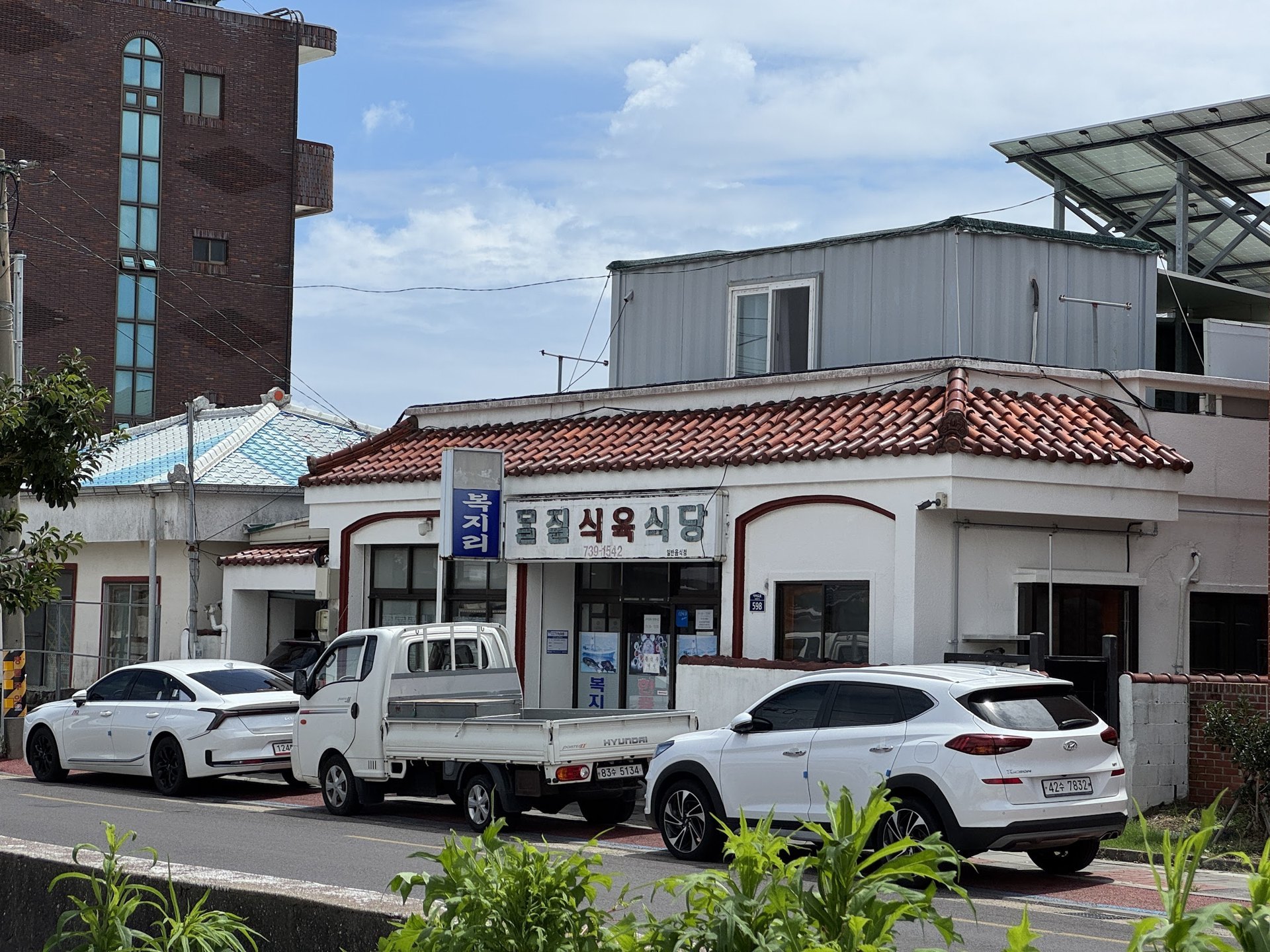
Ten minutes west of central Seogwipo by car. On Ieodo-ro in Gangjeong-dong stands a low building under red roof tiles. A blue acrylic sign, and below it a phone number written without the area code: 739-1542. One look tells you the place has lasted.
Almost everyone reading the name for the first time reads it as muljil sikdang, because muljil is what the haenyeo divers do. But a notice taped to the glass door corrects you before you can ask: our restaurant is called Moljil Sikdang, the Jeju pronunciation of malgil, the horse path.
The road the horses used, malgil. In the Jeju dialect mal becomes mol and gil becomes jil. Hence moljil. A single line of a restaurant name carries the old lay of this neighbourhood.
There are essentially two things to order: pufferfish simmered in a clear broth, and a red jjamppong built on pork. It sounds like a mismatch, and yet on one table it somehow makes sense.
The place — Ieodo-ro in Gangjeong-dong, on the road the horses used
The address is 598 Ieodo-ro, Seogwipo-si, Jeju, or Gangjeong-dong 4521-8 by lot number. Follow Ieodo-ro west out of central Seogwipo and you reach it; it is not far by car from Gangjeong Port or the World Cup Stadium either. You can get there by bus, but this part of the island is easier with a car.
The opening window is short. Monday to Saturday it opens at 10:30am and closes at 3:30pm, and it is closed on Sunday. The bottom of the menu board states it plainly: closed every Sunday. The place does no dinner service at all, so when you slot it into a day, that single line matters most.
The glass wall inside carries a row of plaques and certificates. A wooden plaque from an appearance on SBS’s Baek Jong-won’s Top 3 Chef King, a certificate from the Jeju Food and Wine Festival, a few hygiene certifications. A red band across the bottom of the menu board reads: this establishment uses only domestic rice, kimchi and meat (from Jeju).

And the most interesting single sheet in the place is somewhere else: a small notice taped to the glass door.
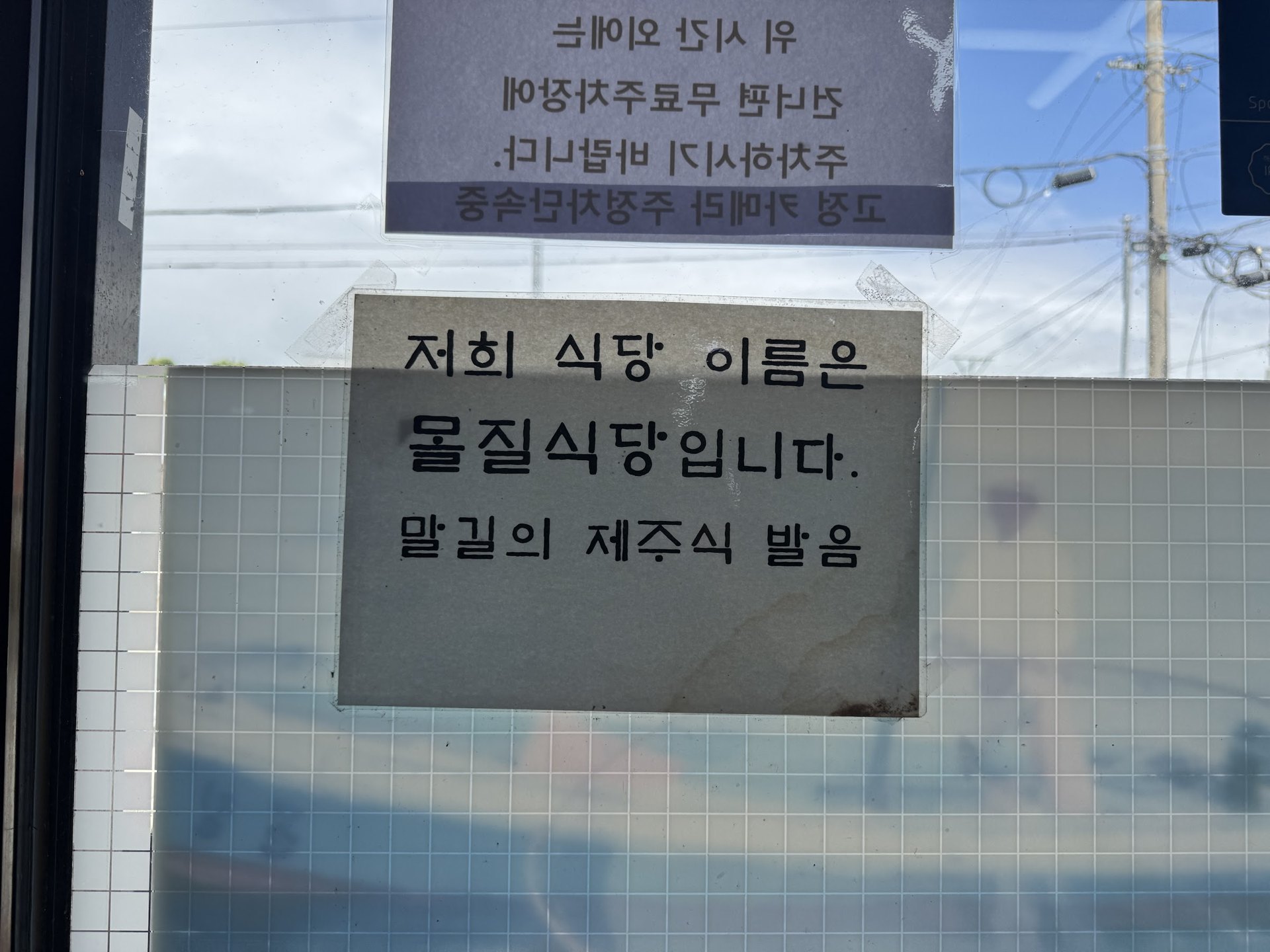
In the Jeju dialect the vowel in mal often leans towards mol, and gil becomes jil. So moljil is malgil, the road the horses travelled. Customers must have asked so often that the owners simply wrote it down and put it up. That same diligence carries through to the food.
| Item | Details |
|---|---|
| Address | 598 Ieodo-ro, Seogwipo-si, Jeju (Gangjeong-dong 4521-8) |
| Phone | 064-739-1542 |
| Hours | Mon~Sat 10:30~15:30 (lunch only) |
| Closed | Every Sunday |
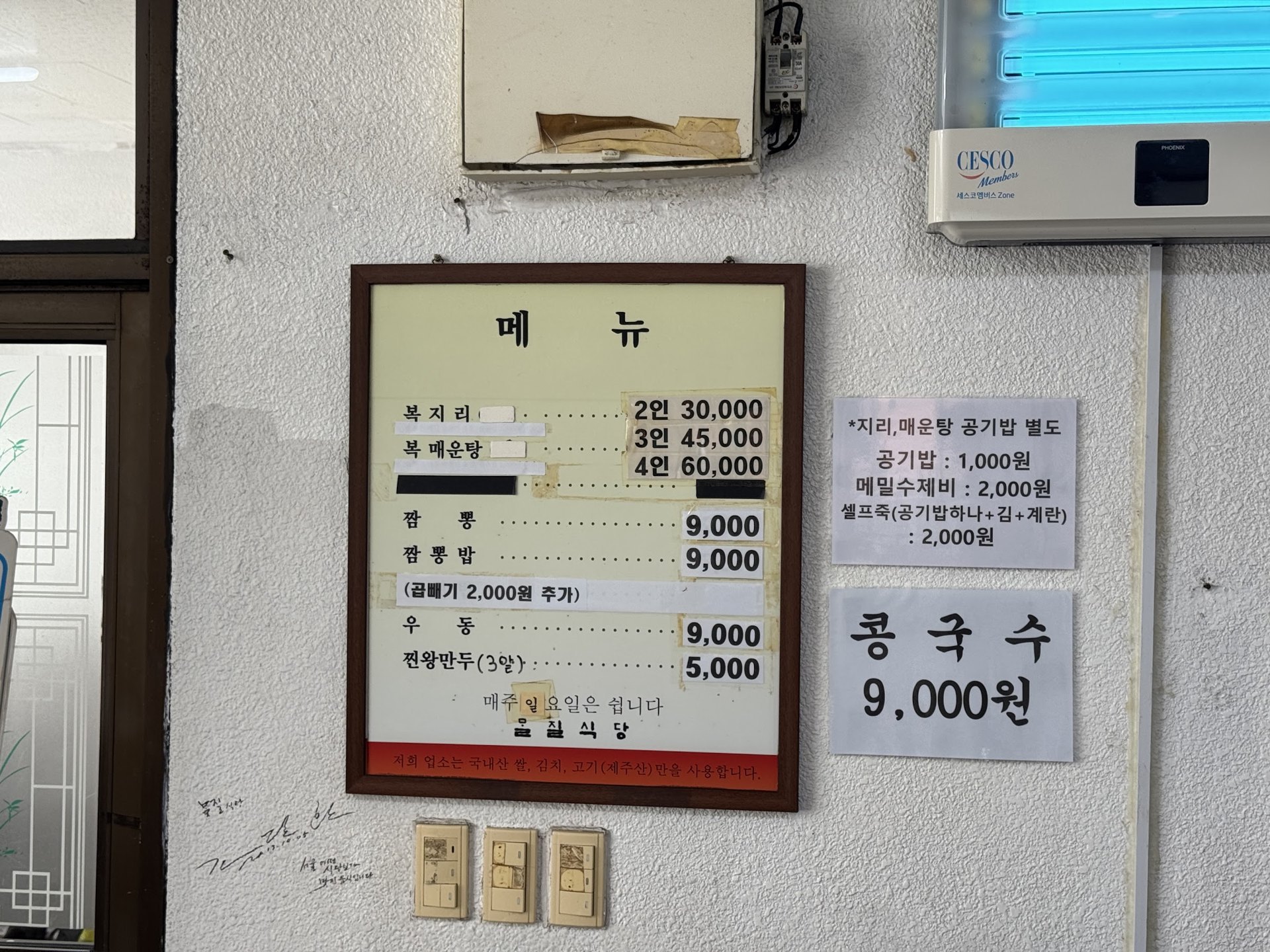
| Clear puffer hotpot / spicy puffer stew | 30,000 won for two · 45,000 won for three · 60,000 won for four (rice extra, 1,000 won) |
| Noodles and rice | Jjamppong 9,000 won · jjamppong rice 9,000 won (extra-large, add 2,000 won) · udon 9,000 won · kongguksu 9,000 won · steamed jumbo dumplings, 3 pieces 5,000 won |
| Add-ons | Buckwheat sujebi 2,000 won · self-serve porridge (rice + gim + egg) 2,000 won |
| Rating | Google Maps ★4.1 (607 reviews) — below this site’s standard (★4.5, 100 reviews); disclosed in the article |
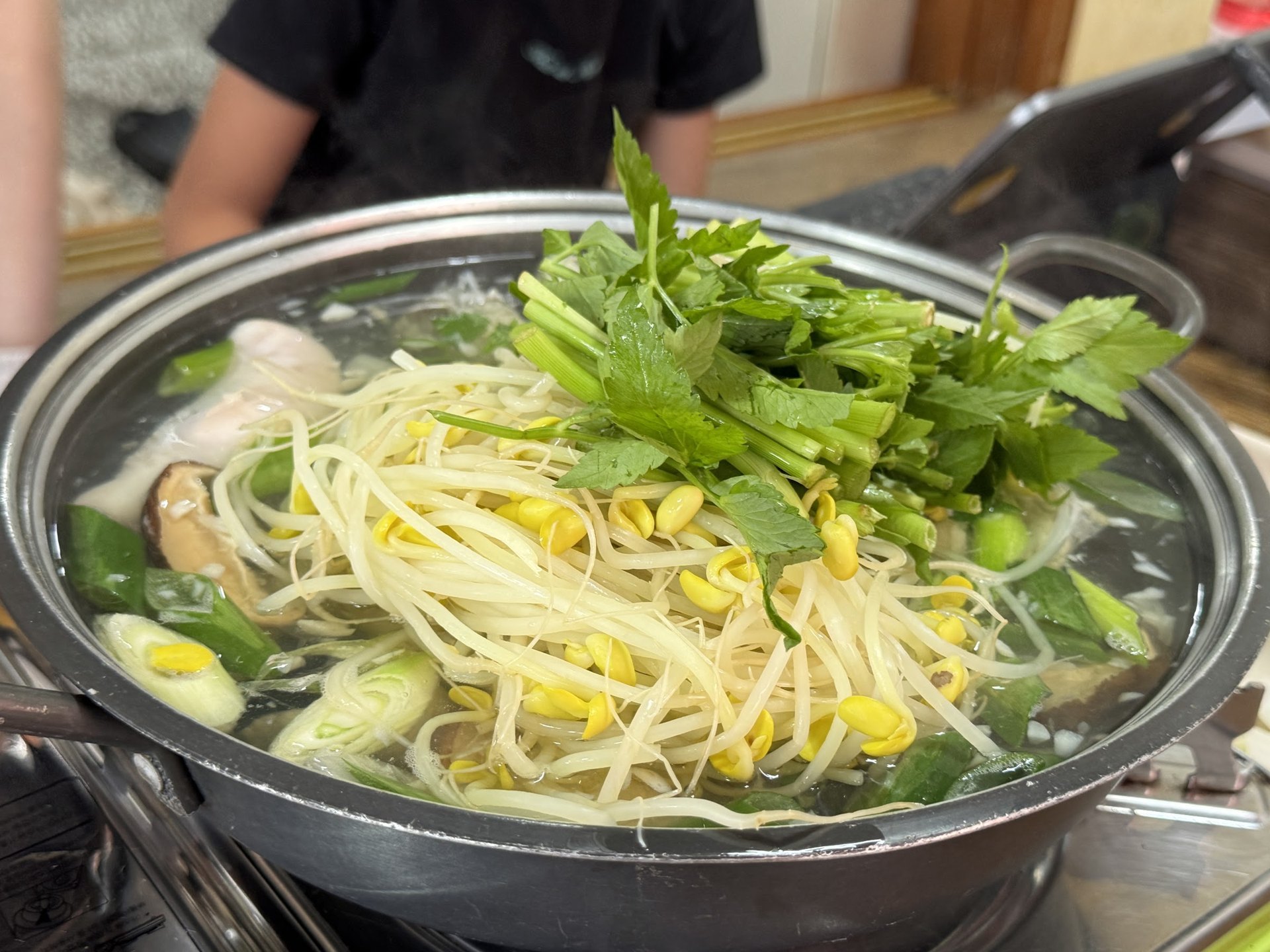
Clear puffer hotpot, 30,000 won for two — served under a blanket of bean sprouts and minari
The clear puffer hotpot starts at 30,000 won for two. It is 45,000 won for three and 60,000 won for four, and the spicy puffer stew costs the same. One thing to watch: the notice beside the menu board says that rice is extra with both the clear hotpot and the spicy stew. A bowl of rice is 1,000 won.
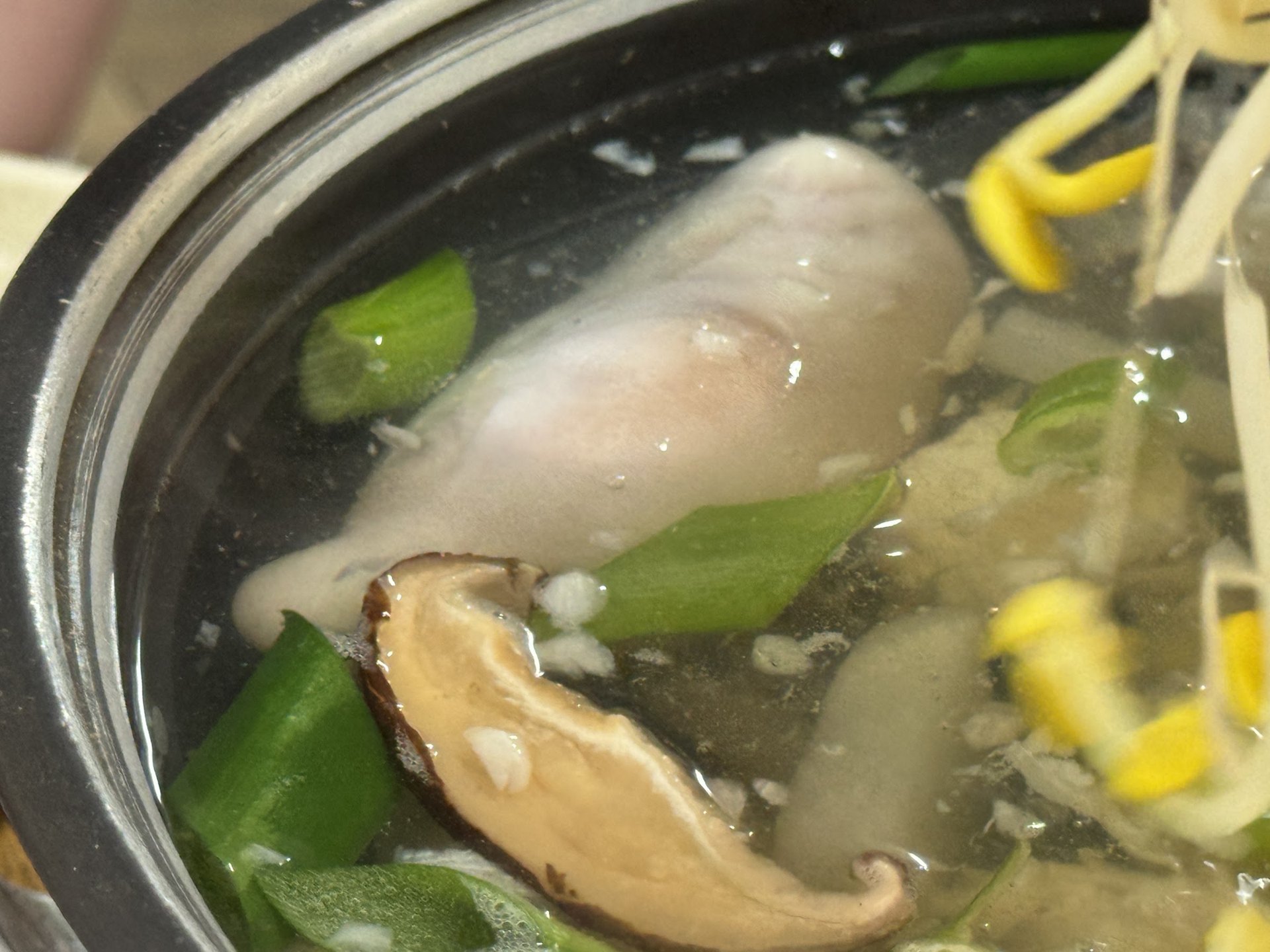
Order it and a whole silver hotpot arrives. Bean sprouts cover the clear broth, and minari goes on top in a layer of green. Shiitake, diagonally cut spring onion and cheongyang chilli are tucked in between. The pufferfish sits submerged and is hard to see at first.
The cooking starts when the burner goes on. The bean sprouts wilt and sink into the broth, and the smell of minari rises first. Once it comes to the boil the broth stays clear but clouds very slightly.
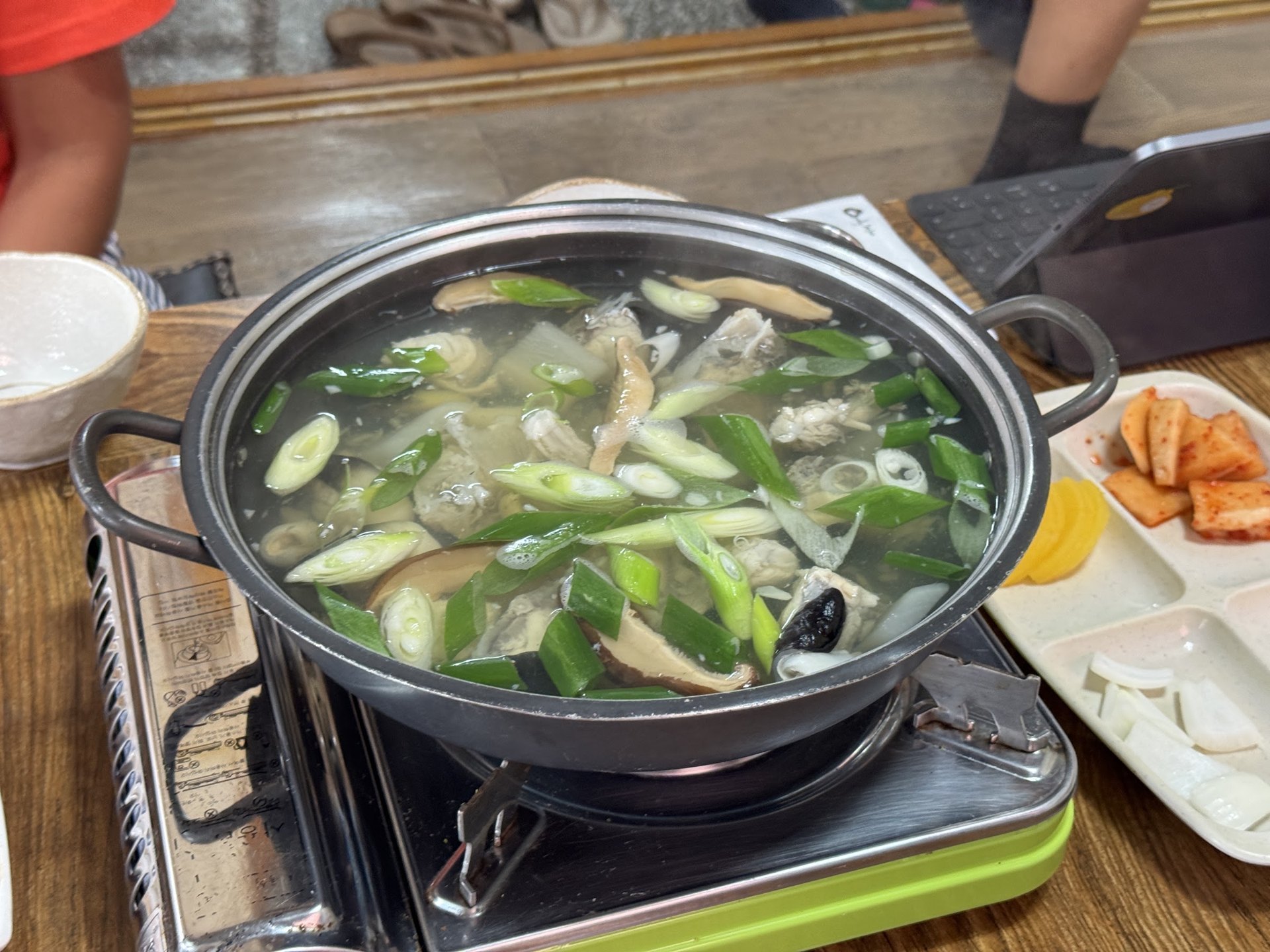
The taste is plain. Not salty, no fat on it, a sweetness left at the back. There is not a single flake of chilli powder in it, yet the cheongyang chilli leaves a faint heat at the back of the throat. If you were drinking the night before, you will understand immediately why this is the broth of a place that trades at lunchtime.
Buckwheat sujebi 2,000 won and self-serve porridge 2,000 won — the real order of things here
Eat only the hotpot and get up, and you have had half the meal. Two small lines on the notice tell you the proper sequence: buckwheat sujebi, 2,000 won, and then self-serve porridge (a bowl of rice + gim + egg), 2,000 won.
First you fish out the pufferfish. Lift it with a ladle and the white flesh splits along the grain. Puffer is firm enough that pushing it with chopsticks does not mash it; it comes away in one piece. The bite is springy first, then quietly sweet.
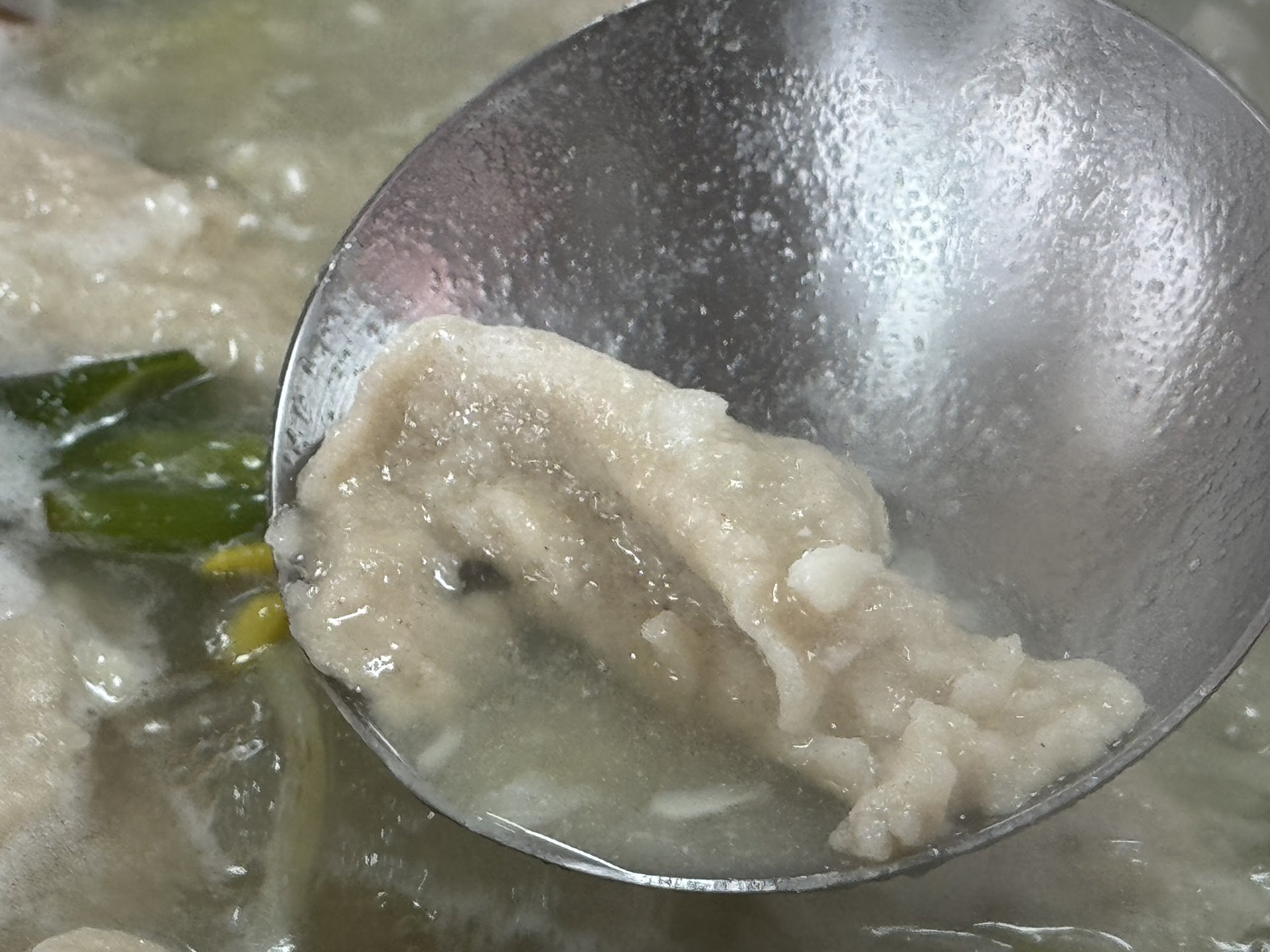
Once you have eaten your way through the fish, order the buckwheat sujebi. The dough arrives in a small bowl and you tear it by hand into the boiling broth. Being buckwheat, it is greyish, less chewy than a wheat-flour sujebi, and it breaks more softly.
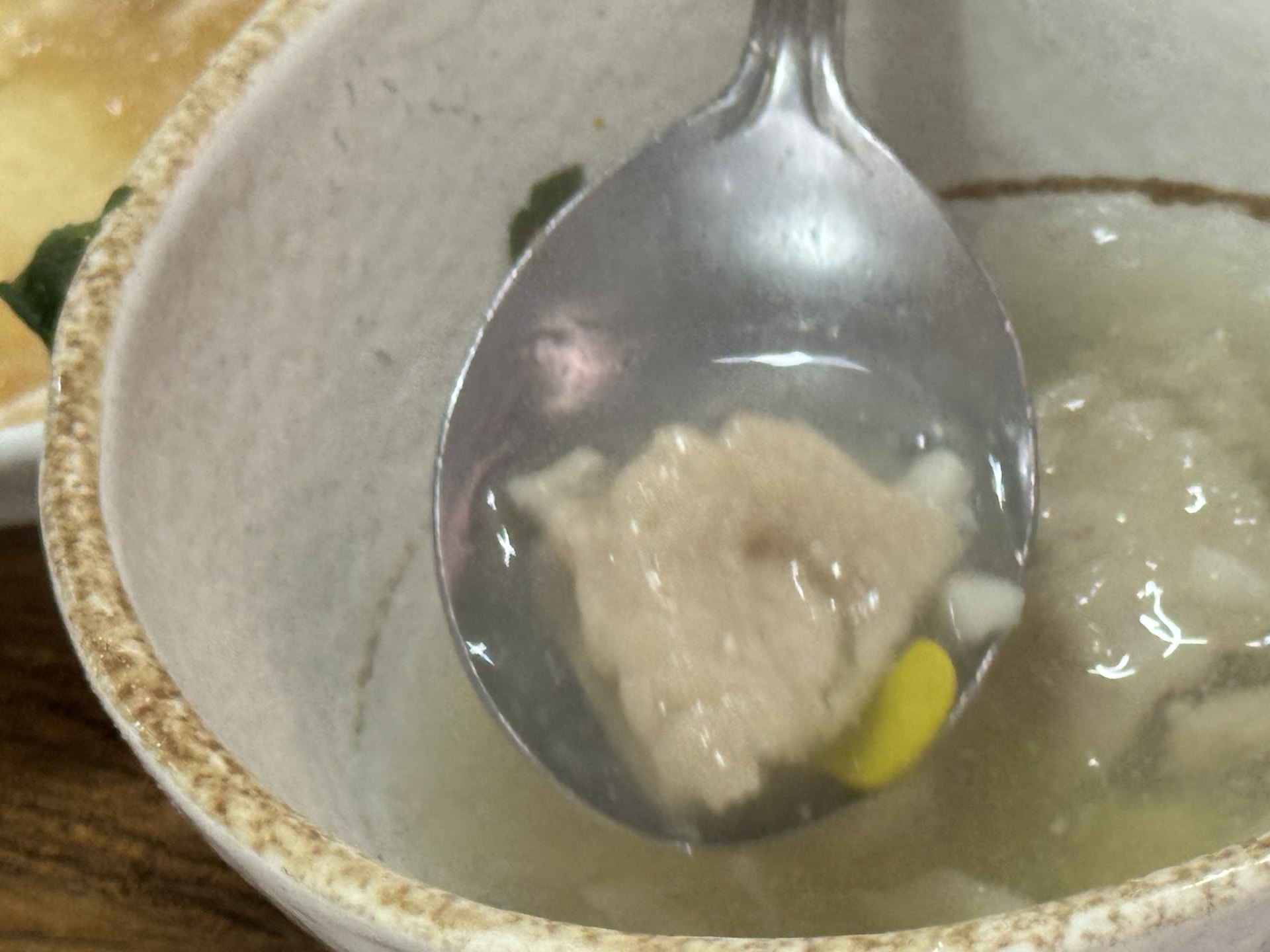
The sujebi clouds the broth a little and the flavour shifts once more. Buckwheat settles over the clear taste it started with, and plenty of people say this stage is the best of the meal. What is left goes to the self-serve porridge: rice, gim and egg arrive, and you tip the rice in and stir it through. For 2,000 won, even the ending is designed for you.
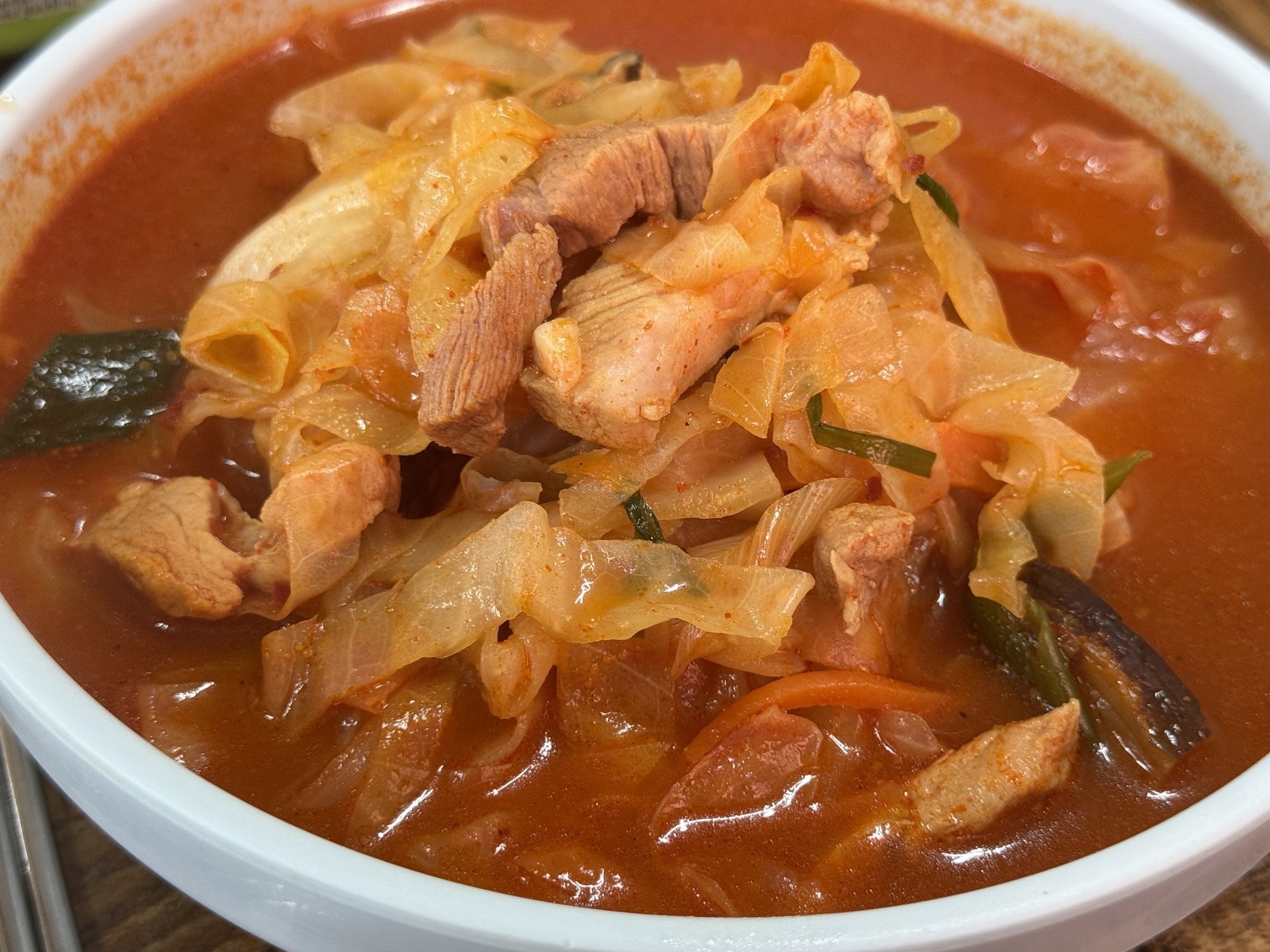
Jjamppong 9,000 won — a red broth built on pork rather than seafood
This is why the name says meat restaurant. The board lists jjamppong at 9,000 won and jjamppong rice at 9,000 won side by side, with a note underneath: extra-large adds 2,000 won. Udon is 9,000 won too, and three steamed jumbo dumplings are 5,000 won.
The bowl arrives with the toppings completely covering the broth. Thin slices of pork are stacked in layers, with cabbage, onion, carrot and cheongyang chilli mixed through. From the photo alone there is no telling whether noodles or rice lie underneath, so nothing will be claimed here about the bottom of the bowl. What sits on top, though, is clear enough.
The broth does not have the sharp heat of a seafood jjamppong. Fat and savour from the pork lie underneath and round it out, while the heat arrives a beat later from the cheongyang chilli. There is a lot of cabbage, so the sweetness is pronounced, and it does not weigh on a palate that has just had the clear hotpot.
For two people, the hotpot for two plus one bowl of jjamppong is the most common order. Alternating spoonfuls of the clear broth and the red one sharpens both.
Map and practicalities — getting there, parking, hours, and the rating
Address 598 Ieodo-ro, Seogwipo-si, Jeju (lot number: Gangjeong-dong 4521-8)
Phone 064-739-1542
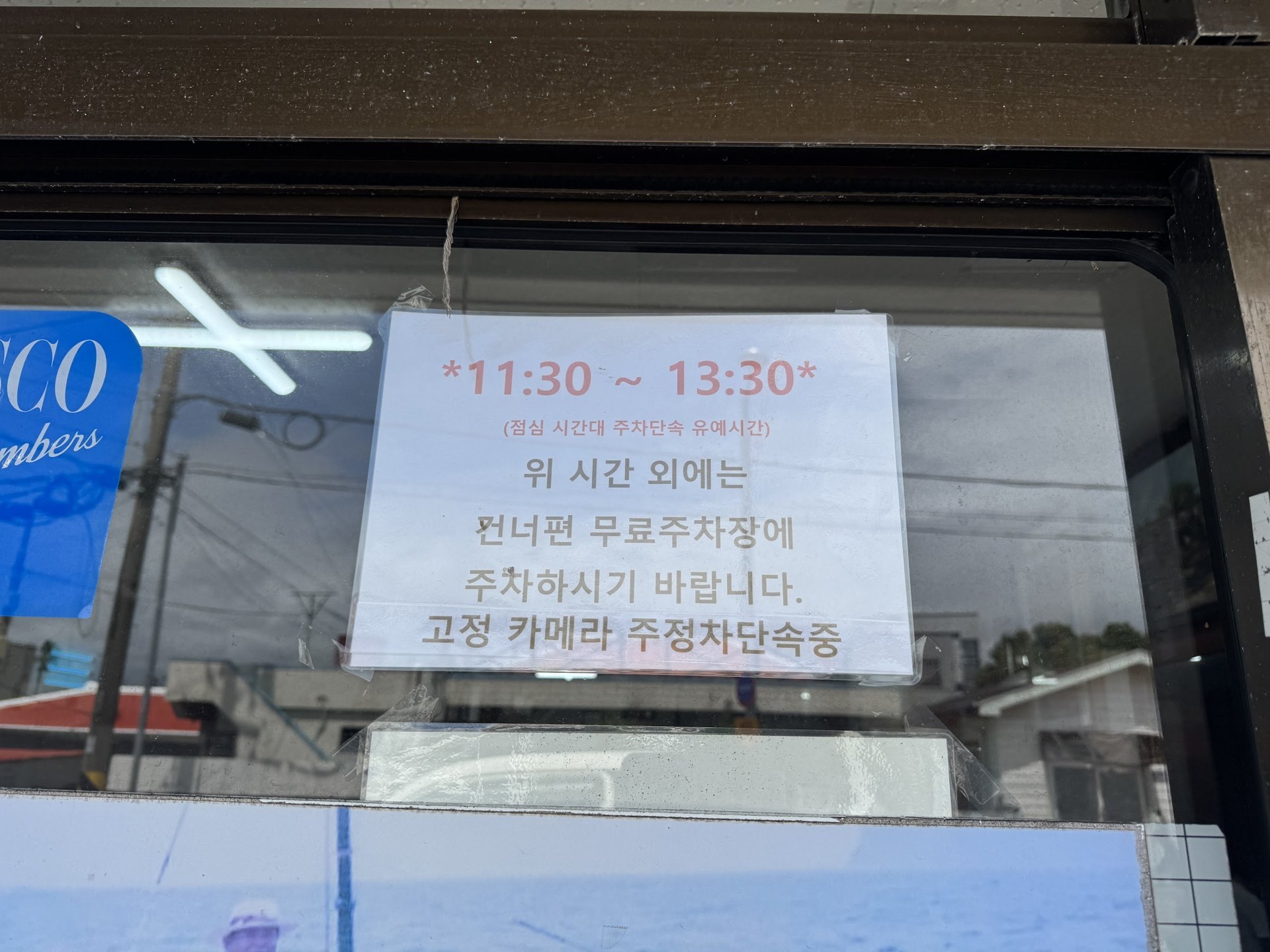
Parking is the thing to plan for here. According to the notice on the glass door, 11:30~13:30 is a grace period during which parking is not enforced, and outside those hours you are asked to use the free car park across the road. The notice also states that a fixed camera is enforcing parking and stopping restrictions. If you go early for the 10:30 opening, or after 2pm, it is easier to park across the road from the start.
The rating, stated honestly. This site normally recommends places with ★4.5 and at least 100 reviews on Google Maps. As of September 2026, Moljil Sigyuk Sikdang has ★4.1 from 607 reviews. The review count is more than enough, but the star rating falls short of the standard.
The reason for writing it up anyway is the character of the place. Five hours of lunch service, a menu five lines long, and the origin of the name written out on paper and taped to the door. Where the stars split, it tends to be over queues and the short opening hours rather than the food. For anyone who can like a four-star old-timer as a four-star old-timer, it is well worth the trip.
FAQ
What time does it open? Is it open in the evening?
Monday to Saturday it opens at 10:30am and closes at 3:30pm. It is closed on Sunday. There is no dinner service, so you have to go at lunchtime.
Is the name muljil or moljil?
It is moljil. A notice on the glass door reads: our restaurant is called Moljil Sikdang, the Jeju pronunciation of malgil, the horse path. In the Jeju dialect mal becomes mol and gil becomes jil, so malgil becomes moljil.
Can one person order the puffer hotpot?
The clear puffer hotpot and the spicy puffer stew both start at 30,000 won for two. On your own, the options are jjamppong, jjamppong rice or udon at 9,000 won, or kongguksu at 9,000 won.
What should I add to the broth?
Drop in the buckwheat sujebi at 2,000 won and let it cook, then finish with the self-serve porridge (rice + gim + egg) at 2,000 won. That sequence is the basic way to eat here. With the clear hotpot and the spicy stew, rice is a separate 1,000 won.
How does parking work?
According to the notice on the glass door, 11:30~13:30 is a grace period for lunchtime parking enforcement, and outside those hours you are asked to use the free car park across the road. The notice also says a fixed camera is enforcing parking and stopping restrictions.
- Google Maps — Moljil Sigyuk Sikdang (address, hours, rating; checked 2026-09-19)
- DiningCode — Moljil Sigyuk Sikdang (address and hours; checked 2026-09-19)
- In-store menu board photos (taken 2026-09; the source for every price in this article)
- Photo of the in-store notice — the origin of the name (taken 2026-09)
- Photo of the in-store notice — parking information (taken 2026-09)
Prices are based on photos of the in-store menu board taken in September 2026. Address, hours and rating were checked on Google Maps on 2026-09-19.